Review · Hearing health
SonoVive review: what is in the capsule and what the research says
SonoVive is sold as a natural way to support hearing. Its label lists eight ingredients that are mostly studied for memory, at small doses. We checked each one on PubMed and looked for anything that ties the formula to the ear.
This is an independent review page. Stark Verve is not the maker or seller of SonoVive, and we earn a commission if you buy through our links.
Our verdict: 1.9 / 5
| Ingredient evidence | 1 | Ginkgo did not beat placebo for ear symptoms in two Cochrane reviews; vinpocetine has one uncontrolled study; nothing else on the label was studied for hearing |
|---|---|---|
| Dosing vs. research | 1 | Every ingredient sits far below trial amounts, from about a fifth for ginkgo to one fortieth for huperzine A |
| Label transparency | 3 | All eight doses printed, but the label sits on a references page, the sales letter calls the product a dropper, and no extract is standardized |
| Value and refund terms | 2.5 | $49 to $69 a bottle with free US shipping; 60 days from delivery, every bottle mailed back at your cost |
Worth considering if you want a low-dose memory-style blend, you take no prescription medicines, and you have already had your hearing checked by an audiologist or doctor.
Probably skip it if you take any regular medication, if your main concern is how well you hear, or if you expect the "less than one month" change the video promises. We found no trial of this formula and no ingredient at a dose that has been shown to help hearing.
Before anything else: a change in your hearing, ringing in the ears, ear pain, dizziness or hearing that drops suddenly in one ear deserves a visit to an audiologist or doctor. Sudden changes in particular should be seen quickly.
Smallest order $69, from $49 per bottle, 60-day refund policy from the seller
See the current SonoVive packages, shipping and refund termsOpens the seller's page. It may start with a long video or letter; the packages and refund terms are usually further down. We may earn a commission.
What SonoVive is
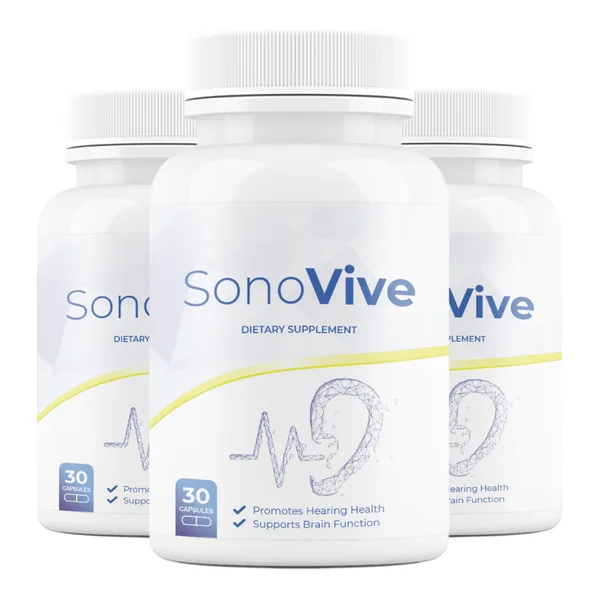
SonoVive is a capsule supplement sold on thesonovive.com, with orders processed by the BuyGoods retail platform. The label names SonoVive of Aurora, Colorado, as the distributor; that same address receives refund returns. Each bottle holds 30 capsules. The label says to take one capsule once or twice a day with meals.
The video page opens with the headline that a brain experiment has found the root cause of hearing loss, and that you can fix it naturally in under a month. The written version tells the story of a retired medical chemist named Sam Olsen who built the formula. We could not find any record of that person or of a study behind the product. The front of the label makes two modest claims: "Promotes Hearing Health" and "Supports Brain Function."
The label is the same as ProMind Complex
When we transcribed the Supplement Facts panel, we recognized it. Every ingredient and every dose matches the label of ProMind Complex, a memory supplement we reviewed earlier: 250 mg St. John's wort, 150 mg L-glutamine, 125 mg phosphatidylserine complex, 120 mg bacopa, 50 mg ginkgo, 50 mg acetyl-L-carnitine, 2 mg vinpocetine and 10 mcg huperzine A. The two products also share the same prices, the same 60-day refund terms and the same warehouse address in Aurora, Colorado. In practice they appear to be one capsule with two brand names. A third product, TribalForce X, uses seven of the same eight ingredients at the same doses and swaps vinpocetine for alpha-GPC.
We also compared the label with the other hearing products we have reviewed: Quietum Plus, ZenCortex, AquaPeace and Audifort. SonoVive shares no meaningful overlap with any of them.
None of this is hidden; anyone can compare the labels. It does tell you that the formula was not designed around ear research. It is a memory blend sold under a hearing name.
The formula next to the research
For each ingredient we looked first for human trials on hearing or ear symptoms. Where none existed, we used the trials on memory in older adults, since that is what these ingredients have mostly been studied for.
| Ingredient | SonoVive per capsule | Amount in human studies | How it compares |
|---|---|---|---|
| Ginkgo biloba (leaf) | 50 mg, extract type not stated | 240 mg/day of standardized extract [9] | About a fifth (two fifths at two capsules); hearing trials found no clear benefit at any dose [1] |
| Vinpocetine | 2 mg | 30 mg/day in the only hearing study [4] | 15 times lower; that study had no control group |
| Bacopa monnieri extract | 120 mg, standardization not stated | 300 mg/day [8] | About 40%; studied for memory, not hearing |
| Phosphatidylserine 4% complex | 125 mg (about 5 mg of phosphatidylserine) | 100 to 300 mg/day [10] | Roughly 20 to 60 times lower |
| Huperzine A | 10 mcg | 400 to 800 mcg/day [11] | 40 to 80 times lower; studied in Alzheimer disease, not hearing |
| Acetyl-L-carnitine | 50 mg | 1,000 mg/day in a single case report [6] | No controlled hearing trial found |
| St. John's wort (flower) | 250 mg, hypericin not stated | No hearing trial found | Cannot be compared; mainly a drug interaction concern |
| L-glutamine | 150 mg | No hearing trial found | Cannot be compared |
Ginkgo: the hearing ingredient that has been tested most
Ginkgo is the one SonoVive ingredient with a real body of ear research, and the sales page leans on it. That research mostly concerns tinnitus, the perception of ringing or buzzing without an outside sound. A 2013 Cochrane review of four trials with 1,543 participants found no evidence that ginkgo helped people whose main complaint was tinnitus [2]. The 2022 update widened the search to 12 trials and 1,915 participants. Pooling two of them, ginkgo made little to no difference to tinnitus severity scores at three to six months compared with placebo, and the authors rated the evidence as very low certainty [1]. An earlier double-blind trial of 66 adults, plus a meta-analysis of six placebo-controlled trials, found that 21.6% of people on ginkgo and 18.4% on placebo reported a benefit, a difference that was not statistically significant. The same trial measured hearing thresholds and found no difference between the groups [3].
For memory, the largest ginkgo trial ever run gave 240 mg a day to 3,069 adults aged 72 to 96 for a median of six years. Rates of decline in memory, attention and other thinking skills were the same as on placebo [9]. SonoVive provides 50 mg of a leaf ingredient whose extract strength is not stated.
Vinpocetine: one open study at a much higher dose
Vinpocetine is a compound derived from the periwinkle plant. The only human hearing study we found was a 12-month, open-label study in Mexico of adults with acquired sensorineural hearing loss, using 30 mg a day in three doses. Hearing worsened over the first six months and then improved on some tests by month 12 [4]. There was no placebo group, so it cannot show whether vinpocetine caused the change, and the abstract does not report how many people took part. SonoVive contains 2 mg. Independent lab testing has also found that vinpocetine supplements often do not contain what the label says: 6 of 23 products tested had none at all [5].
Bacopa, phosphatidylserine and huperzine A: memory ingredients at small doses
Bacopa has the most consistent support of the memory ingredients here. A meta-analysis of nine trials with 518 participants found small improvements in attention speed with standardized extracts taken for at least 12 weeks [7], and a 12-week trial in 54 adults aged 65 and older found better word recall with 300 mg a day [8]. SonoVive's 120 mg is about 40% of that, with no stated standardization.
A "phosphatidylserine 4% complex" at 125 mg supplies roughly 5 mg of phosphatidylserine. The trial in older Japanese adults with memory complaints used 100 or 300 mg a day for six months [10]. Huperzine A was tested at 200 or 400 mcg twice a day in 210 people with Alzheimer disease [11]; SonoVive has 10 mcg. None of these ingredients has been studied for hearing.
Acetyl-L-carnitine, St. John's wort and L-glutamine
For acetyl-L-carnitine and hearing, the human evidence we found is a single case report: one 41-year-old woman took 500 mg twice a day for 30 days [6]. One person is not evidence of a general effect, and SonoVive provides 50 mg. We found no human hearing trials for St. John's wort or L-glutamine. St. John's wort is best known as a mood herb, and its presence matters mostly for safety, covered below.
What the marketing says and what we could verify
The video's central idea is that hearing loss starts in the brain and that a brain experiment revealed the cause. The seller's references page lists news articles about how the brain processes sound and about cochlear neurons, plus pages on ginkgo, bacopa, vinpocetine and huperzine A. Several are news or commercial websites rather than studies, and none we could trace shows that this formula, or any of its ingredients at these doses, changes hearing. We could not verify the "less than one month" timeline at all.
The sales letter also calls SonoVive a "dropper," while the label and the product images describe 30 capsules. It says the product is made in an "FDA approved" facility; the FDA does not approve supplement factories, it registers and inspects them. These look like leftovers from other products' copy. So does the seller's affiliate page, whose product description talks about digestion. None of it changes what is in the capsule, but it lowers our confidence in the rest of the presentation.
For context on what has been tested in older adults with hearing loss: the ACHIEVE trial randomized 977 adults aged 70 to 84 to hearing aids with audiologist counselling or to health education. Over three years, cognitive decline did not differ overall, though a prespecified analysis suggested a benefit in the group at higher risk of decline [12]. The intervention studied there was an audiologist and hearing aids, a reminder that a hearing check comes before any supplement.
Price, packages and refund policy
The site sells each bottle as a 30-day supply. Prices in the site's own pricing data when we checked:
- 6 bottles: $49 each ($294 total), free US shipping.
- 3 bottles: $59 each ($177 total), free US shipping.
- 1 bottle: $69, free US shipping.
Every order is a one-time payment with no subscription. One detail matters for value: the label allows one or two capsules a day, so a bottle sold as 30 days can last 15 days at the higher amount. After checkout the site offers additional bottles at $29 each.
The refund policy gives 60 days from the day the package is delivered. You email support, then mail back every bottle, opened or not, with a note and the packing slip, and you pay the return postage. The seller's own policy recommends three months of use before judging, which is longer than the refund window.
SonoVive packages on the official site
6 bottles, 180-day supply
$49/bottle
$294 total · Free US shipping
Lowest price per bottle
Check the 6-bottle priceButtons open the seller's SonoVive website, where you choose your supply and complete the order. Prices as listed on the seller's site on October 23, 2026; the price shown at checkout is final.Orders are covered by a 60-day refund policy from the seller (see their terms). We may earn a commission.
Safety
St. John's wort is the main concern for men over 50. Taken for 14 days, it roughly halved blood levels of alprazolam in healthy volunteers by speeding up the liver enzyme CYP3A4, which handles at least half of all marketed drugs [13]. Reviews of interaction reports list cyclosporine, digoxin, tacrolimus, warfarin, simvastatin and several others whose levels or effects it can lower; the strength of the effect tracks the hyperforin content, which the SonoVive label does not state [14]. The label itself warns about sun sensitivity and about use with MAO inhibitors, blood thinners or a seizure history.
Ginkgo has a reputation for bleeding risk. A meta-analysis of 18 placebo-controlled trials found no sign of higher bleeding risk in clotting measures with standardized extract [15], and a week of ginkgo did not change the effect of a single warfarin dose in 12 healthy men [16]. The label still advises stopping two to three weeks before surgery or dental procedures, and that is sensible. Vinpocetine and huperzine A are not approved drugs in the US, and lab tests often find their real content differs from the label [5].
Talk to your doctor or pharmacist before taking SonoVive if you use any prescription medicine, especially blood thinners, heart or cholesterol drugs, antidepressants or transplant drugs. Results vary from person to person, and new or worsening hearing symptoms deserve medical care rather than a supplement trial.
What we liked and what gave us pause
Liked
- Every ingredient and dose printed on the label
- The label carries clear caution text
- No subscription; free US shipping on every package
Gave us pause
- Identical label to ProMind Complex, a memory product
- Ginkgo did not beat placebo for ear symptoms in Cochrane reviews
- Doses far below every trial we found
- St. John's wort interacts with many common drugs
- Sales copy calls it a dropper; refund window shorter than the advised trial
Frequently asked questions
Is SonoVive the same as ProMind Complex?
The labels list the same eight ingredients at the same doses, and the two share prices, refund terms and a return address. We have no lab data on either, but on paper they are the same capsule.
Where can I buy SonoVive?
The seller says it is sold only on its own website, with checkout on BuyGoods. Listings elsewhere may not be genuine or covered by the refund policy.
Can SonoVive replace a hearing test or hearing aids?
No. It is a dietary supplement. If you notice changes in your hearing, an audiologist or doctor can find the cause and discuss options that have been tested.
How long before I notice anything?
Results vary. The memory trials of these ingredients ran 12 weeks to six years, and we found no hearing trial of the formula, so there is no evidence-based timeline.
Want to read the label yourself? The link below opens the SonoVive website, where the Supplement Facts panel is posted on the references page and the packages are listed.
Visit the SonoVive websiteHow we reviewed SonoVive
We read the video page and the written presentation, the Supplement Facts label posted on the seller's references page, the refund and shipping pages and the affiliate rules, and took prices from the page's own pricing data. We compared the label with every product in our database and searched PubMed for human trials of each ingredient on hearing and ear symptoms, then on memory where no hearing research existed, plus interaction and bleeding studies. We did not test the product on people, and nobody at Stark Verve is a medical professional or audiologist. Read our editorial policy to learn how we choose and update reviews. Stark Verve earns a commission if you buy through our links; that never changes what we write about the evidence.
References
- Sereda M, Xia J, Scutt P, Hilton MP, El Refaie A, Hoare DJ. Ginkgo biloba for tinnitus. Cochrane Database Syst Rev. 2022;11(11):CD013514. PMID 36383762
- Hilton MP, et al. Ginkgo biloba for tinnitus. Cochrane Database Syst Rev. 2013;(3):CD003852. PMID 23543524
- Rejali D, Sivakumar A, Balaji N. Ginkgo biloba does not benefit patients with tinnitus: a randomized placebo-controlled double-blind trial and meta-analysis of randomized trials. Clin Otolaryngol Allied Sci. 2004;29(3):226-31. PMID 15142066
- Gutierrez-Farfan I, et al. Evaluation of vinpocetine as a therapy in patients with sensorineural hearing loss: a phase II, open-label, single-center study. J Pharmacol Sci. 2021;145(4):313-318. PMID 33712282
- Avula B, et al. Identification and quantification of vinpocetine and picamilon in dietary supplements sold in the United States. Drug Test Anal. 2016;8(3-4):334-43. PMID 26426301
- Gopal KV, Thomas BP, Mao D, Lu H. Efficacy of carnitine in treatment of tinnitus: evidence from audiological and MRI measures, a case study. J Am Acad Audiol. 2015;26(3):311-24. PMID 25751698
- Kongkeaw C, et al. Meta-analysis of randomized controlled trials on cognitive effects of Bacopa monnieri extract. J Ethnopharmacol. 2014;151(1):528-35. PMID 24252493
- Calabrese C, et al. Effects of a standardized Bacopa monnieri extract on cognitive performance, anxiety, and depression in the elderly: a randomized, double-blind, placebo-controlled trial. J Altern Complement Med. 2008;14(6):707-13. PMID 18611150
- Snitz BE, et al. Ginkgo biloba for preventing cognitive decline in older adults: a randomized trial. JAMA. 2009;302(24):2663-70. PMID 20040554
- Kato-Kataoka A, et al. Soybean-derived phosphatidylserine improves memory function of the elderly Japanese subjects with memory complaints. J Clin Biochem Nutr. 2010;47(3):246-55. PMID 21103034
- Rafii MS, et al. A phase II trial of huperzine A in mild to moderate Alzheimer disease. Neurology. 2011;76(16):1389-94. PMID 21502597
- Lin FR, et al. Hearing intervention versus health education control to reduce cognitive decline in older adults with hearing loss in the USA (ACHIEVE): a multicentre, randomised controlled trial. Lancet. 2023;402(10404):786-797. PMID 37478886
- Markowitz JS, et al. Effect of St John's wort on drug metabolism by induction of cytochrome P450 3A4 enzyme. JAMA. 2003;290(11):1500-4. PMID 13129991
- Nicolussi S, Drewe J, Butterweck V, Meyer zu Schwabedissen HE. Clinical relevance of St. John's wort drug interactions revisited. Br J Pharmacol. 2020;177(6):1212-1226. PMID 31742659
- Kellermann AJ, Kloft C. Is there a risk of bleeding associated with standardized Ginkgo biloba extract therapy? A systematic review and meta-analysis. Pharmacotherapy. 2011;31(5):490-502. PMID 21923430
- Jiang X, et al. Effect of ginkgo and ginger on the pharmacokinetics and pharmacodynamics of warfarin in healthy subjects. Br J Clin Pharmacol. 2005;59(4):425-32. PMID 15801937