Review · Hearing health
AquaPeace review: what a seaweed capsule can and cannot show for your ears
AquaPeace is sold as a "deep sea" formula for ear health, built on a story about sea anemones. We read the label, opened the sea anemone papers and searched PubMed for human research on each ingredient. The gap between the pitch and the evidence is wide.
Our verdict: 1.9 / 5
| Ingredient evidence | 1.5 | Hearing data for these ingredients come from cell cultures and mice; we found no human hearing trial for any of them |
|---|---|---|
| Dosing vs. research | 1.5 | The whole capsule is 500 mg; human trials of single ingredients used 72 mg to 1,500 mg of one extract |
| Label transparency | 1.5 | Nine ingredients in one proprietary blend, no individual amounts, no iodine figure |
| Value and refund terms | 3 | $49 to $69 per month, free US shipping, one-time payment; 60-day refund requires returning all bottles |
Worth considering if you already eat little seaweed, you have no thyroid condition, your doctor is comfortable with it, and you want to try a food-based antioxidant capsule while accepting that nobody has tested it on human hearing.
Probably skip it if you take warfarin or thyroid medication, you have ever had a thyroid problem, or you are looking for a product with human evidence behind an ear health claim. We could not find any.
Before anything else: ringing in the ears or a change in your hearing deserves a visit to an audiologist or an ear, nose and throat doctor (ENT). Hearing that drops suddenly, in one or both ears, is a medical emergency: see a doctor within days, not weeks, because prompt care may improve recovery [14].
Smallest order $69, from $49 per bottle, 60-day refund policy from the seller
See the current AquaPeace packages, shipping and refund termsOpens the seller's page. It may start with a long video or letter; the packages and refund terms are usually further down. We may earn a commission.
What AquaPeace is
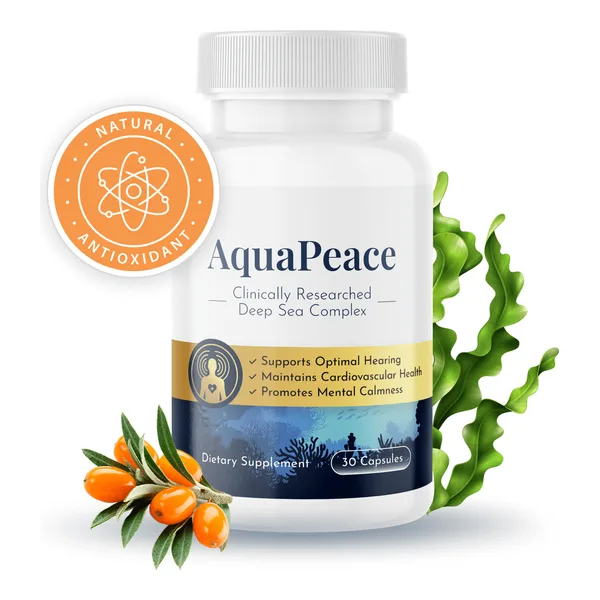
AquaPeace is a capsule supplement sold through Digistore24 from its official website. The label says it is distributed by AquaPeace from an address in Tallmadge, Ohio. You take one capsule a day, and a bottle holds 30. It is sold in 1, 3 and 6-bottle packages as a one-time payment; the order page says there is no automatic billing.
The sales page builds its case on sea anemones. It says these animals keep their hearing hair cells healthy thanks to the fatty acids and nutrients they circulate, and that AquaPeace delivers "deep sea" nutrients to the human inner ear in a similar way. The vendor's affiliate page goes further and frames the product as a tinnitus solution. We look at that story in its own section below.
What the label actually lists
The vendor does not permit affiliates to reuse its images, so we describe the Supplement Facts panel in words. Each capsule contains a single 500 mg proprietary blend of nine ingredients, with no amount given for any of them:
- Kelp powder (leaf)
- Sea mustard (the seaweed known in Korea as miyeok)
- Astaxanthin 2% from Haematococcus pluvialis algae
- Chlorella powder
- Ecklonia cava brown seaweed extract
- Kelp extract (Laminaria japonica), standardized to 10% fucoxanthin
- Nori yaki (roasted nori)
- Spirulina powder (whole plant)
- Sea buckthorn oil
Other ingredients are gelatin, brown rice flour and silicon dioxide. Two details matter. First, the sales page shows seven ingredients "inside every capsule"; the label adds two kelp ingredients that the sales page does not mention. Second, the label does not state how much iodine the capsule provides, even though kelp is one of the richest iodine sources in the food supply. Proprietary blends are legal, but with nine ingredients sharing 500 mg, the average share is about 55 mg each, and you cannot know the real split.
The formula next to the research
For each ingredient we looked for human trials on hearing or ear ringing. When none existed, we noted the best available evidence and the amounts used in human trials of any kind, to judge whether a 500 mg blend could plausibly reach them.
| Ingredient | AquaPeace per day | Best hearing evidence we found | Human amounts studied |
|---|---|---|---|
| Ecklonia cava extract | Undisclosed share of 500 mg | Mouse cochlear tissue and live mice [3] [4] [5] | 72 to 144 mg polyphenols [11]; 1,500 mg extract [10] (blood lipids, blood sugar) |
| Kelp extract (10% fucoxanthin) | Undisclosed | None for fucoxanthin; the vendor cites a fucoidan cell study [6] | No hearing trial |
| Astaxanthin 2% | Undisclosed; at most 10 mg even if the whole blend were this powder | Cells and mice, given into the middle ear [7] | 20 mg/day in one recent trial [12] (heart failure markers) |
| Spirulina | Undisclosed | One study in fast-aging mice [8] | No hearing trial |
| Chlorella, sea mustard, nori, kelp powder, sea buckthorn oil | Undisclosed | No hearing study found | No hearing trial |
Ecklonia cava: the most interesting ingredient, still only in animals
Ecklonia cava is an edible brown seaweed rich in polyphenols called phlorotannins, including one named dieckol. A Seoul research group has published several animal studies. In cochlear tissue taken from newborn mice, dieckol partly protected hair cells from damage by the antibiotic gentamicin [3]. In mice given a purified extract by injection into the abdomen for five days before loud noise, temporary hearing threshold shifts were smaller than in untreated mice [4]. A later mouse study found smaller threshold shifts and better hair cell survival after a single two-hour exposure to 115 dB noise [5].
These results are consistent and worth following, but none involved people, swallowed capsules or age-related hearing changes. The human trials of Ecklonia cava we found measured body fat, cholesterol and blood sugar, at 72 to 144 mg of polyphenols a day for 12 weeks in 97 overweight adults [11] and at 1,500 mg of a dieckol-rich extract a day for 12 weeks in 80 adults with prediabetes [10]. Both reported no significant adverse events. The 1,500 mg figure is three times the entire AquaPeace capsule.
Kelp and fucoxanthin: a cited study about a different compound
The label's kelp extract is standardized to fucoxanthin, an orange pigment. Among the references the vendor lists is a 2023 study on fucoidan, which is a different substance: a sugar-based fiber from brown seaweed. That study used a mouse cochlear cell line in a dish and found fucoidan reduced damage from the chemotherapy drug cisplatin [6]. The label does not claim any standardized fucoidan content. We searched PubMed for fucoxanthin and hearing and found nothing.
Astaxanthin: lab results with a route you cannot copy
Astaxanthin is a red carotenoid from microalgae. In the hearing study we verified, it protected cochlear cells from cisplatin in the lab, and in adult mice it was injected through the eardrum into the middle ear [7]. That says little about a swallowed capsule. For scale, a recent 80-person human trial in a different field gave 20 mg of astaxanthin a day for eight weeks [12]. Because AquaPeace uses a 2% powder inside a 500 mg blend, the capsule cannot provide more than 10 mg even in theory, and almost certainly provides far less.
Spirulina, chlorella and the rest
For spirulina, the only hearing study we found fed a water extract to mice bred to age quickly; after six weeks they had lower hearing thresholds than control mice [8]. We found no hearing research on chlorella, sea mustard, nori or sea buckthorn oil. The sales page links chlorella to "heavy metal detox", but its own cited sources for that are mouse studies and a general review, not hearing research.
One observational finding is relevant to the seaweed idea. In a Korean national survey of 5,201 adults aged 50 and over, people who reported eating more seaweed, fruit, nuts and seeds, and more vitamin A, tended to have better hearing [9]. A survey like this cannot show cause and effect, and it is about whole foods in a regular diet, not a capsule.
About the sea anemone story
This part of the marketing rests on real science, which makes it worth reading closely. Researchers at the University of Louisiana at Lafayette have studied for years how sea anemones repair damaged hair bundles, the sensory structures on hair cells. They found that the repair depends on a group of secreted repair proteins in the anemone's mucus, including heat shock proteins and proteasome components; blocking those proteins interfered with repair [2]. In a 2016 lab experiment, those anemone proteins helped damaged mouse cochlear hair cells in a dish recover structure and function within an hour [1].
Here is where the sales page parts ways with the research. The studies credit proteins made by the anemone, applied directly to tissue. We found no publication showing that fatty acids or circulated nutrients explain anemone hair cell repair, and AquaPeace contains no anemone material or repair proteins. Swallowed proteins are also digested, so even an anemone extract in a capsule would not reach the inner ear intact. The sea anemone discovery is real; the line drawn from it to a seaweed capsule is one we could not verify.
What the marketing says and what we could verify
- "Clinically proven to support healthy hearing" (sales page). We found no clinical trial in humans of the formula or of any single ingredient for hearing. The label itself uses the softer phrase "clinically researched".
- The sea anemone mechanism. The anemone research is about secreted proteins, as described above, not nutrients the formula supplies.
- Ear ringing. The sales page FAQ and the affiliate page talk about quieting ringing. The 2026 tinnitus guideline from the American Academy of Otolaryngology, which reviewed the evidence, advises clinicians not to recommend dietary supplements for persistent, bothersome tinnitus [13].
- Seven versus nine ingredients. The sales page omits the two kelp ingredients that appear on the label.
Price, packages and refund policy
One bottle lasts 30 days. Prices on the official site when we checked:
- 6 bottles: $49 each ($294 total), free US shipping, two digital guides included. About $1.63 a day.
- 3 bottles: $59 each ($177 total), free US shipping, two digital guides included.
- 1 bottle: $69, free US shipping.
Shipping to Canada, the UK, Ireland, Australia and New Zealand costs extra. The refund policy gives you 60 days from the day the package is delivered. To get your money back you email the vendor and return all bottles, opened or not, at your own shipping cost. That is shorter than the three months the vendor itself suggests for trying the product, so if you buy, put the refund deadline in your calendar.
AquaPeace packages on the official site
6 bottles, 180-day supply
$49/bottle
$294 total · Free US shipping
Lowest price per bottle
Includes 2 digital guides
Check the 6-bottle price3 bottles, 90-day supply
$59/bottle
$177 total · Free US shipping
Includes 2 digital guides
Check the 3-bottle priceButtons open the seller's AquaPeace website, where you choose your supply and complete the order. Prices as listed on the seller's site on October 23, 2026; the price shown at checkout is final.Orders are covered by a 60-day refund policy from the seller (see their terms). We may earn a commission.
Safety
Most of these ingredients are foods in East Asian diets, and the human trials we read on Ecklonia cava reported no significant adverse events [11] [10]. A United States Pharmacopeia panel reviewed spirulina, including 31 adverse event reports, and gave it its highest safety class for monograph purposes [18]. The specific concerns for men over 50 are these:
- Iodine from kelp. When Norwegian researchers measured 14 seaweed supplements, iodine per daily dose ranged from 5 to 5,600 micrograms; across all 96 seaweed products tested, 54 would exceed the tolerable upper intake level in one portion or dose [15]. AquaPeace contains two kelp ingredients and states no iodine amount. A published case describes a 70-year-old woman with no prior thyroid disease who developed hyperthyroidism after three months of kelp tablets [16]. If you have a thyroid condition or take thyroid medication, talk to your doctor first.
- Warfarin and chlorella. Chlorella is rich in vitamin K. A case report describes a 75-year-old man whose warfarin effect weakened after he started chlorella [17]. If you take warfarin, do not start AquaPeace without your doctor's input.
- Other medications. Tell your doctor or pharmacist about any supplement if you take blood thinners, blood pressure or diabetes medication, or drugs that suppress the immune system.
Results vary, and no supplement replaces a hearing evaluation. New ringing, ringing in one ear only, ear pain, dizziness, or any change in hearing deserves an audiologist or ENT visit. Sudden hearing loss calls for a doctor within days [14].
What we liked and what gave us pause
Liked
- Every ingredient is named, and they are familiar food-derived algae and seaweeds
- Ecklonia cava has consistent early results in animal hearing studies
- One capsule a day, no subscription, free US shipping on every package
Gave us pause
- No human hearing trial for the formula or any ingredient
- Sea anemone research does not support the nutrient story told about it
- Nine ingredients share 500 mg with no individual amounts
- Two kelp sources and no iodine figure
- Refund requires returning every bottle at your cost within 60 days of delivery
Frequently asked questions
Will AquaPeace stop the ringing in my ears?
We cannot say it will, and no human study suggests it. The current US tinnitus guideline advises against supplements for persistent, bothersome tinnitus and points to options with evidence, such as hearing aid evaluation, sound enrichment and cognitive behavioral therapy [13]. An audiologist or ENT can help you sort out what fits your situation.
Where can I buy AquaPeace?
On the official website, with checkout handled by Digistore24. The vendor does not allow sales on Amazon, eBay or similar sites, so listings there may not be genuine or covered by the refund policy.
How much iodine does it contain?
The label does not say. If iodine matters for you, ask the vendor for a lab figure before buying, and check with your doctor.
Is it a subscription?
No. According to the order page, every package is a one-time payment.
Want to look at the official page yourself? The link below opens the AquaPeace website, where you can read their full presentation and choose a package.
Visit the official AquaPeace websiteHow we reviewed AquaPeace
We read the official sales page, the refund and affiliate terms, and the Supplement Facts label published on the vendor's site. We searched PubMed for human and animal studies of each ingredient on hearing, opened the sea anemone papers behind the marketing story, and checked current clinical guidelines on tinnitus and sudden hearing loss. We did not test the product on people, and nobody at Stark Verve is a medical professional. Read our editorial policy to learn how we choose and update reviews. Stark Verve earns a commission if you buy through our links; that never changes what we write about the evidence.
References
- Tang PC, Smith KM, Watson GM. Repair of traumatized mammalian hair cells via sea anemone repair proteins. J Exp Biol. 2016;219(Pt 15):2265-70. PMID 27489215
- Tang PC, Watson GM. Proteomic identification of hair cell repair proteins in the model sea anemone Nematostella vectensis. Hear Res. 2015;327:245-56. PMID 26183436
- Chang MY, Byon SH, Shin HC, et al. Protective effects of the seaweed phlorotannin polyphenolic compound dieckol on gentamicin-induced damage in auditory hair cells. Int J Pediatr Otorhinolaryngol. 2016;83:31-6. PMID 26968049
- Chang MY, Han SY, Shin HC, Byun JY, Rah YC, Park MK. Protective effect of a purified polyphenolic extract from Ecklonia cava against noise-induced hearing loss: prevention of temporary threshold shift. Int J Pediatr Otorhinolaryngol. 2016;87:178-84. PMID 27368468
- Woo H, Kim MK, Park S, et al. Effect of phlorofucofuroeckol A and dieckol extracted from Ecklonia cava on noise-induced hearing loss in a mouse model. Mar Drugs. 2021;19(8):443. PMID 34436282
- Hsieh CY, Lin JN, Kang TY, et al. Otoprotective effects of fucoidan reduce cisplatin-induced ototoxicity in mouse cochlear UB/OC-2 cells. Int J Mol Sci. 2023;24(4):3561. PMID 36834972
- Nan B, Zhao Z, Jiang K, Gu X, Li H, Huang X. Astaxanthine attenuates cisplatin ototoxicity in vitro and protects against cisplatin-induced hearing loss in vivo. Acta Pharm Sin B. 2022;12(1):167-81. PMID 35127378
- Chan YC, Hwang JH. Effects of Spirulina on the functions and redox status of auditory system in senescence-accelerated prone-8 mice. PLoS One. 2017;12(6):e0178916. PMID 28636628
- Choi JE, Ahn J, Moon IJ. Associations between age-related hearing loss and dietary assessment using data from Korean National Health and Nutrition Examination Survey. Nutrients. 2021;13(4):1230. PMID 33917838
- Lee SH, Jeon YJ. Efficacy and safety of a dieckol-rich extract (AG-dieckol) of brown algae, Ecklonia cava, in pre-diabetic individuals: a double-blind, randomized, placebo-controlled clinical trial. Food Funct. 2015;6(3):853-8. PMID 25608849
- Shin HC, Kim SH, Park Y, Lee BH, Hwang HJ. Effects of 12-week oral supplementation of Ecklonia cava polyphenols on anthropometric and blood lipid parameters in overweight Korean individuals: a double-blind randomized clinical trial. Phytother Res. 2012;26(3):363-8. PMID 21717516
- Mohammadi SG, Shafie D, Feizi A, et al. Impact of astaxanthin on oxidative markers, uric acid, and clinical symptoms in heart failure: a randomized clinical trial. BMC Cardiovasc Disord. 2025;25(1):779. PMID 41162864
- Adams ME, Cramer JD, Tunkel DE, et al. Clinical practice guideline: tinnitus update. Otolaryngol Head Neck Surg. 2026;175 Suppl 1:S1-S62. PMID 42861423
- Chandrasekhar SS, Tsai Do BS, Schwartz SR, et al. Clinical practice guideline: sudden hearing loss (update). Otolaryngol Head Neck Surg. 2019;161(1 Suppl):S1-S45. PMID 31369359
- Aakre I, Solli DD, Markhus MW, et al. Commercially available kelp and seaweed products: valuable iodine source or risk of excess intake? Food Nutr Res. 2021;65. PMID 33889064
- Gherbon A, Frandes M, Lungeanu D, Nicula M, Timar R. Transient hyperthyroidism following the ingestion of complementary medications containing kelp seaweed: a case report. Medicine (Baltimore). 2019;98(37):e17058. PMID 31517826
- Ohkawa S, Yoneda Y, Ohsumi Y, Tabuchi M. Warfarin therapy and chlorella [in Japanese]. Rinsho Shinkeigaku. 1995;35(7):806-7. PMID 8777808
- Marles RJ, Barrett ML, Barnes J, et al. United States Pharmacopeia safety evaluation of spirulina. Crit Rev Food Sci Nutr. 2011;51(7):593-604. PMID 21793723