
Review · Hearing health
ZenCortex review: a crowded label in a small dropper
ZenCortex is sold as liquid drops for healthy hearing. Its label names 22 herbs and amino acids but gives them 200 mg to share per serving. We checked what the research says about the ones that matter and what the doses could be.
Our verdict: 1.6 / 5
| Ingredient evidence | 1.5 | Only Asian ginseng has small human hearing studies; most ingredients have none for hearing or ear ringing |
|---|---|---|
| Dosing vs. research | 1 | 400 mg of blend a day shared by 22 ingredients; the ginseng studies alone used 200 to 3,000 mg |
| Label transparency | 1.5 | Label is published, but every herb sits in a proprietary blend, and it lists caffeine sources the sales page calls stimulant free |
| Value and refund terms | 2.5 | $49 to $79 for a 30-day bottle; 60-day refund, return shipping and fees on you |
Worth considering if you prefer a liquid to capsules, you understand there is no published hearing research behind this formula, and you are comfortable treating it as a 60-day experiment with the refund terms read in advance.
Probably skip it if you want to know how much of each ingredient you are taking, you avoid caffeine, or you are hoping a supplement will change ringing or hearing you have already noticed. The research we found does not support that hope for this formula.
Before anything else: hearing that drops suddenly, in one ear or both, is a medical emergency. Get seen by a doctor within days, since the guideline treatments for it are time sensitive [9]. Ringing that is new, louder on one side or pulsing, and any gradual change in how well you hear, deserve an appointment with an audiologist or an ENT doctor.
Smallest order $79, from $49 per bottle, 60-day refund policy from the seller
See the current ZenCortex packages, shipping and refund termsOpens the seller's page. It may start with a long video or letter; the packages and refund terms are usually further down. We may earn a commission.
Came here for ZenCortex? The highest-rated hearing and ringing label we checked is AquaPeace, 1.9 out of 5.
What ZenCortex is
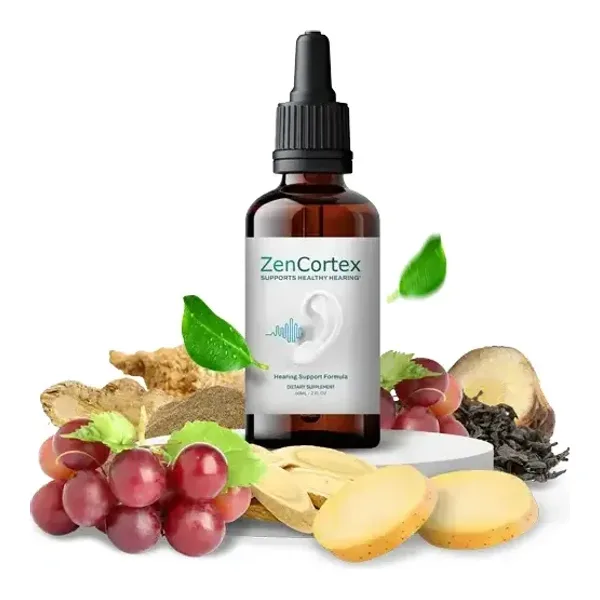
ZenCortex comes as a 60 mL dropper bottle of liquid. The label calls it a "Hearing Support Formula" and gives the serving as 1 mL, taken twice a day, so one bottle lasts a month. The vendor's FAQ says you can put the dropper under your tongue or stir it into water or juice. The label names the distributor as ZenCortex of Aurora, Colorado. It is sold through Digistore24 on the official website as a one-time purchase in 1, 3 and 6-bottle packages.
The sales page describes "360 degree hearing support" and lists eight headline ingredients: grape seed, green tea, gymnema, capsicum, Panax ginseng, astragalus, chromium picolinate and maca. It also promises sharper memory and more energy. Its lead headline, attributed to Harvard, says you have 14 days to act on ear ringing. We return to that below.
What is on the label
The Supplement Facts panel on the official site lists two active entries per 1 mL serving:
- Chromium (as chromium picolinate): 0.7 mcg, which the label itself rates at 2% of the Daily Value.
- Proprietary herbal blend: 200 mg, containing maca root, grape seed, guarana seed, African mango, eleuthero root, astragalus root, green tea leaf, gymnema leaf, Coleus forskohlii root, bird pepper, grapefruit seed, Asian ginseng root, raspberry ketones, L-glutamine, L-tyrosine, L-arginine, beta-alanine, monoammonium glycyrrhizinate (a licorice compound), GABA, L-ornithine, L-tryptophan and L-carnitine.
The base is water, citrus extract, natural flavors, stevia and xylitol. We have not reproduced the label image here because the vendor's affiliate terms limit image use to a supplied resource folder. You can read it on the official site.
A proprietary blend is legal. Under US supplement law, a company must give the blend's total weight and the names inside it, but not the amount of each ingredient [1]. The practical result is the one those authors describe: nobody reading the label can compare the doses with clinical studies. With two servings a day you take 400 mg of blend in total. Spread evenly across 22 ingredients, that would be about 18 mg each. The real split is unknown.
The formula next to the research
We searched PubMed for human studies of each ingredient on hearing, ear ringing or noise exposure. Only three ingredients returned any human data on the ear, and the table shows how far apart the study amounts and ZenCortex are.
| Ingredient | ZenCortex per day | Amount in human studies | How it compares |
|---|---|---|---|
| Asian ginseng | Undisclosed share of 400 mg blend | 200 mg/day [3]; 1,500 to 3,000 mg/day of red ginseng [2] | Cannot be checked; the whole blend is below the higher study doses |
| Astragalus | Undisclosed share of 400 mg blend | Daily intravenous injection in hospital [5] | Not comparable: different route and setting |
| Green tea and guarana | Undisclosed | Caffeine studied only as diet, in large cohorts [11] | No supplement trial for hearing found |
| Grape seed, maca, gymnema, capsicum, African mango, raspberry ketones, forskohlii, eleuthero, amino acids | Undisclosed | No human hearing or ear ringing study found | No research to compare against |
| Chromium | 1.4 mcg | No human hearing study found | About 4% of the Daily Value across two servings |
Asian ginseng: the one ingredient with a hearing track record
Ginseng is the strongest link between this label and the hearing literature, and that literature is thin. In an Iranian study, 48 male textile workers exposed to factory noise were randomly given N-acetylcysteine, 200 mg of ginseng a day, or nothing, for 14 days. Both supplement groups showed a smaller temporary dip in high-frequency hearing after work shifts than the untreated group [3]. There was no placebo, and the outcome was a short-term shift after noise, which is different from age-related hearing change. A meta-analysis of antioxidant trials later picked out ginseng as the agent that best limited threshold worsening at 4 kHz in noise-exposed workers, with no difference at 6 kHz [4].
For ear ringing, a Korean pilot study randomized 61 adults to ginkgo or to 1,500 or 3,000 mg a day of Korean red ginseng for four weeks. Only the 3,000 mg group improved on a tinnitus handicap questionnaire, and loudness ratings did not change in any group. The study was open label, meaning participants knew what they were taking [2]. Even if every milligram of the ZenCortex blend were ginseng, a day's serving would be 400 mg, well below that effective arm.
Astragalus: a hospital injection study
The only human hearing study of astragalus we found gave it intravenously each day for 10 days to hospital patients with sudden hearing loss, alongside their regular care, and reported better hearing gains than in patients who did not receive it [5]. That study was not blinded, and an IV drug used for a medical emergency tells us little about a few milligrams of root extract in a dropper. It should not be read as a reason to manage sudden hearing loss at home.
The rest of the blend
For grape seed, maca, gymnema, capsicum, African mango, raspberry ketones, forskohlii, eleuthero and the amino acids, our PubMed searches turned up no human study on hearing or ear ringing. The few hits were cell or animal work. Several of these ingredients are better known from weight and blood sugar products than from ear research, which makes the blend read more like a general formula than one built around the ear.
The bigger picture on supplements and ear ringing
The American Academy of Otolaryngology's tinnitus guideline recommends against ginkgo, melatonin, zinc or other dietary supplements for treating persistent, bothersome tinnitus. It recommends a hearing evaluation, hearing aids where hearing loss is documented, and cognitive behavioral therapy [8]. A 2026 systematic review of nine randomized trials of over-the-counter products found inconsistent results, frequent placebo responses, and no basis for firm conclusions about any of them [6]. In a survey of 1,788 people with tinnitus, about 71% of supplement users reported no effect and about 10% reported their ringing got worse [7].
None of this means ZenCortex will do nothing for anyone. It does mean the honest expectation for a hearing supplement is low, and for one without published doses it is lower still.
What the marketing claims vs. what we could verify
"You have 14 days" and the Harvard attribution
The sales page headline credits Harvard with the idea that you have 14 days to act on ear ringing. We found no Harvard publication saying that. The closest real 14-day window we know of in the literature belongs to sudden hearing loss: the 2019 clinical guideline asks for a hearing test within 14 days of onset and lists steroid treatment within two weeks as an option [9]. That window is about seeing a doctor quickly, and it supports no supplement.
"No stimulants"
The sales page lists "No Stimulants" among its features. The label lists guarana seed and green tea leaf, both natural sources of caffeine, and does not state how much caffeine a serving provides. For hearing, caffeine is probably not a worry: in a cohort of 65,085 women, higher caffeine intake was linked to a lower rate of new tinnitus [11]. Men who avoid caffeine for sleep, heart rhythm or blood pressure reasons should still know it is there. This mismatch between page and label is a finding in itself.
The "Scientific References" list
The vendor's reference list includes a well-known 2006 Nature paper showing that supporting cells from newborn mouse cochleas could turn into new hair cells in a lab dish [10]. It is real science, but it involved no supplement, no ZenCortex ingredient and no person. Other entries on that list include a spiritual self-help book, a survey of plants used for digestive complaints, and animal models of radiation injury. We could not connect any reference on the list to the ZenCortex formula.
Memory and energy
The page also promises memory, mental sharpness and energy benefits. We did not find any trial of ZenCortex for these, and the label does not disclose doses that could be compared with studies of the individual ingredients.
Price, packages and refund policy
One 60 mL bottle covers 30 days at the label's serving. Prices on the official site when we checked:
- 6 bottles: $49 each ($294 total), free US shipping, two e-books included. About $1.63 a day.
- 3 bottles: $69 each ($207 total), free US shipping, two e-books included.
- 1 bottle: $79 plus shipping, which is added at checkout.
The order page shows struck-through "regular" totals and a countdown clock. We ignore both: the prices above are the ones you actually pay. The vendor's FAQ describes a one-time payment with no future charges.
The refund window is 60 days. Read the terms before you order. The sales page says you return the product, even empty bottles, and get your money back minus shipping and handling. The separate return policy page adds that you must request a return authorization first, send the product back within 14 days of receiving it, at your own cost, and it contains a generic line saying sale items cannot be refunded. Those terms are not fully consistent, so keep your order email, ask for the return authorization in writing, and keep the tracking number.
ZenCortex packages on the official site
6 bottles, 180-day supply
$49/bottle
$294 total · Free US shipping
Lowest price per bottle
Includes 2 digital e-books
Check the 6-bottle price3 bottles, 90-day supply
$69/bottle
$207 total · Free US shipping
Includes 2 digital e-books
Check the 3-bottle price1 bottle, 30-day supply
$79/bottle
$79 total · + shipping (calculated at checkout)
Check the 1-bottle priceButtons open the seller's ZenCortex website, where you choose your supply and complete the order. Prices as listed on the seller's site on October 23, 2026; the price shown at checkout is final.Orders are covered by a 60-day refund policy from the seller (see their terms). We may earn a commission.
Safety
Because the blend has no individual amounts, we cannot judge how much of any one ingredient you get, and that matters most for men on medication. The label's own warning tells you to consult a physician first if you take medication or have a medical condition. Three points worth raising with your doctor:
- Caffeine from guarana and green tea, in an unknown amount.
- Monoammonium glycyrrhizinate, a licorice compound. In volunteers, licorice raised systolic blood pressure in a dose-dependent way, starting at about 75 mg of glycyrrhetinic acid a day [12]. The entire ZenCortex blend is 400 mg a day, so the amount here is likely much smaller, but men with high blood pressure should mention it.
- Several active botanicals at once, including ginseng, forskohlii and gymnema, which your pharmacist can check against blood pressure, blood sugar or blood thinning medication.
Results vary from person to person. Any new ringing, muffled hearing, ear pain, discharge or dizziness deserves medical care, whether or not you take a supplement.
What we liked and what gave us pause
Liked
- The full Supplement Facts label is published before you buy
- Includes Asian ginseng, the one ingredient with small human hearing studies
- One-time purchase, no subscription
- 60-day refund window
Gave us pause
- 22 ingredients share 200 mg per serving, with no individual amounts
- Guarana and green tea on a product sold as stimulant free
- Headline "14 days" and Harvard claim not traceable to any publication
- Reference list does not support the formula
- Return policy terms differ between pages
Frequently asked questions
Is ZenCortex a capsule or a liquid?
A liquid. Each bottle holds 60 mL, and the label directions are about one full dropper (1 mL) twice a day.
Can ZenCortex fix ringing in my ears or bring back hearing?
We found no study of ZenCortex at all, and clinical guidelines recommend against dietary supplements for persistent ear ringing [8]. ZenCortex is a dietary supplement and is not meant to diagnose or treat any condition. An audiologist can test your hearing and discuss options with real evidence, such as hearing aids and sound therapy.
What should I do if my hearing suddenly drops?
Treat it as an emergency and see a doctor within days. The guideline window for testing and treatment is measured in days to two weeks [9]. Do not wait to see whether a supplement helps.
Where can I buy ZenCortex?
Only on the official website. The vendor does not allow resale on Amazon, eBay or other marketplaces, so listings there may not be genuine or covered by the refund policy.
How long before I notice anything?
Results vary, and we cannot point to any study of this formula to set an expectation. If you try it, use the 60-day refund window as your deadline to decide.
Want to read the official page yourself? The link below opens the ZenCortex website, where you can see the label, the full presentation and the packages.
Visit the official ZenCortex websiteHow we reviewed ZenCortex
We read the official sales page, order page, FAQ, return and shipping policies, the vendor's reference list and the Supplement Facts label shown on the site. We searched PubMed for human studies of each ingredient on hearing, ear ringing or noise exposure, compared study amounts with the label where possible, and read the clinical practice guidelines on tinnitus and sudden hearing loss. We did not test the product on people, and nobody at Stark Verve is a medical professional. Read our editorial policy to learn how we choose and update reviews. Stark Verve earns a commission if you buy through our links; that never changes what we write about the evidence.
References
- Saldanha LG, Dwyer JT, Hardy CJ, MacKay DJ. Perspectives on the use of proprietary blends in dietary supplements. J Nutr. 2023;153(5):1305-8. PMID 37004873
- Kim TS, Lee HS, Chung JW. The effect of Korean red ginseng on symptoms and quality of life in chronic tinnitus: a randomized, open-label pilot study. J Audiol Otol. 2015;19(2):85-90. PMID 26413574
- Doosti A, Lotfi Y, Moossavi A, et al. Comparison of the effects of N-acetyl-cysteine and ginseng in prevention of noise induced hearing loss in male textile workers. Noise Health. 2014;16(71):223-7. PMID 25033789
- Souza MEDCA, Costa KVTD, Vitorino PA, et al. Effect of antioxidant supplementation on the auditory threshold in sensorineural hearing loss: a meta-analysis. Braz J Otorhinolaryngol. 2018;84(3):368-80. PMID 28888754
- Xiong M, He Q, Lai H, et al. Radix astragali injection enhances recovery from sudden deafness. Am J Otolaryngol. 2012;33(5):523-7. PMID 22306788
- Menon R, Ziner J, Tolordava A, et al. Effectiveness of over-the-counter treatments for tinnitus symptom relief: a systematic review. Laryngoscope Investig Otolaryngol. 2026;11(2):e70398. PMID 41948711
- Coelho C, Tyler R, Ji H, et al. Survey on the effectiveness of dietary supplements to treat tinnitus. Am J Audiol. 2016;25(3):184-205. PMID 27681261
- Tunkel DE, Bauer CA, Sun GH, et al. Clinical practice guideline: tinnitus. Otolaryngol Head Neck Surg. 2014;151(2 Suppl):S1-S40. PMID 25273878
- Chandrasekhar SS, Tsai Do BS, Schwartz SR, et al. Clinical practice guideline: sudden hearing loss (update). Otolaryngol Head Neck Surg. 2019;161(1 Suppl):S1-S45. PMID 31369359
- White PM, Doetzlhofer A, Lee YS, Groves AK, Segil N. Mammalian cochlear supporting cells can divide and trans-differentiate into hair cells. Nature. 2006;441(7096):984-7. PMID 16791196
- Glicksman JT, Curhan SG, Curhan GC. A prospective study of caffeine intake and risk of incident tinnitus. Am J Med. 2014;127(8):739-43. PMID 24608016
- Sigurjónsdóttir HA, Franzson L, Manhem K, et al. Liquorice-induced rise in blood pressure: a linear dose-response relationship. J Hum Hypertens. 2001;15(8):549-52. PMID 11494093