
Review · Blood sugar
GlucoBerry review: a short label that mostly matches the research
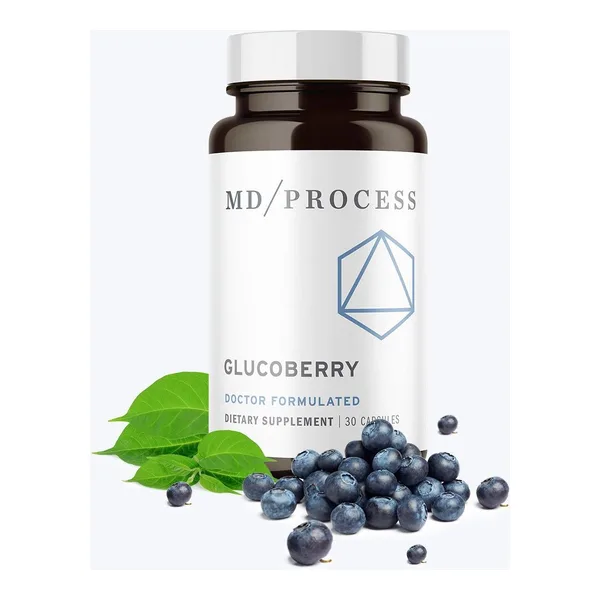
GlucoBerry is a one-capsule blood sugar support supplement from MD Process. Its label is unusually easy to check against the studies, and most of it lines up. The story used to sell it is another matter.
Disclosure: Stark Verve earns a commission if you buy through links on this page. This review was last updated on October 23, 2026. For current ingredients and prices, see the GlucoBerry website. The views here are our own and do not represent the views of MD Process or the GlucoBerry brand.
Our verdict: 3.6 / 5
| Ingredient evidence | 2.5 | Small trials, mostly in people already on glucose medication or with prediabetes; a 2016 NIH-authored review called chromium evidence limited |
|---|---|---|
| Dosing vs. research | 4 | Chromium, biotin, gymnema and maqui amounts all match doses used in published trials |
| Label transparency | 4 | Every dose disclosed; the maqui extract is not named or standardized on the label |
| Value and refund terms | 4 | $39 to $69 per month; 180-day refund, but unopened bottles go back at your cost |
Worth considering if you want a simple, fully disclosed formula built on a chromium and biotin combination with its own placebo-controlled trials, your doctor knows you plan to try it, and you are willing to judge it over about three months.
Probably skip it if you take insulin or a sulfonylurea and cannot check your glucose closely, if you take levothyroxine and do not want to juggle timing, or if the "blood sugar drain" explanation was the reason you were interested. We could not find human research behind it.
Before anything else: GlucoBerry is a dietary supplement. It does not replace medication, diet or medical follow-up. If your glucose readings are high, rising or swinging, see your doctor.
Smallest order $138, from $39 per bottle, 180-day refund policy from the seller
See the current GlucoBerry packages, shipping and refund termsOpens the seller's page. It may start with a long video or letter; the packages and refund terms are usually further down. We may earn a commission.
What GlucoBerry is
GlucoBerry is a capsule supplement sold through ClickBank under the MD Process name. The sales page presents Dr. Mark Weis as its formulator. The serving is one capsule a day with food, and each bottle holds 30 capsules. It is sold on the brand's own website in 2, 3 and 6-bottle packages, as a one-time payment with no subscription, according to the sales page.
The label lists four active ingredients: 180 mg of maqui berry fruit extract, 400 mg of Gymnema sylvestre leaf powder, 600 mcg of chromium as chromium picolinate and 2 mg of biotin. Other ingredients are a gelatin capsule, magnesium stearate and silicon dioxide.
Two small details did not agree. The sales page says the formula combines maqui with "four supporting nutrients", but the label lists three. The website footer gives an Atlanta, Georgia address, while the label names a distributor in Aurora, Colorado. Neither changes what is in the capsule.
The formula next to the research
For each ingredient we looked for human trials on blood sugar markers and compared the amount used there with one GlucoBerry capsule. On dose, this is one of the better-matched labels we have checked.
| Ingredient | GlucoBerry per day | Amount in trials | How it compares |
|---|---|---|---|
| Chromium (picolinate) | 600 mcg | 600 mcg/day with biotin [5] [6] | Same amount and form |
| Biotin | 2 mg | 2 mg/day with chromium [5] [6] | Same amount |
| Gymnema leaf | 400 mg (powder) | 400 to 600 mg/day [9] [10] [11] | Matches the lowest studied dose; extract types differ |
| Maqui berry extract | 180 mg (standardization not stated) | 180 mg/day of an extract standardized to delphinidins [2] | Same amount; equivalence unknown |
Chromium and biotin: the best-matched part of the label
The pairing of 600 mcg of chromium picolinate with 2 mg of biotin is not arbitrary. It is the combination tested in two randomized, placebo-controlled trials. In the larger one, 447 overweight adults with type 2 diabetes who were already on oral medication took the combination or a placebo for 90 days. HbA1c, a three-month average of blood sugar, fell by 0.54 percentage points in the supplement group, and the difference from placebo was statistically significant. The effect was largest in people who started with the highest readings [6]. A smaller four-week pilot from Yale with 43 participants, also on medication, found better glucose curves during a glucose tolerance test than with placebo [5]. That pilot is presumably the "Yale University study" the sales page mentions, and it does exist.
Chromium on its own has a mixed record. A meta-analysis of 25 randomized trials in people with diabetes found an average HbA1c reduction of 0.55 percentage points, with no more side effects than placebo [7]. A review written by researchers at the NIH Office of Dietary Supplements looked at 20 trials and concluded the evidence is of low strength, with few trials reaching clinically meaningful targets [8]. Both views are worth holding at once: the GlucoBerry dose is the studied dose, and the studies are not strong.
Gymnema: long tradition, small trials
Gymnema sylvestre is an Indian climbing plant whose leaves have been used for blood sugar support for a long time. The research is mostly small. A 1990 study gave 400 mg a day of a gymnema leaf extract to 22 adults with type 2 diabetes alongside their usual medication for 18 to 20 months, with no placebo group; blood sugar and HbA1c fell [9]. An open-label three-month study used 500 mg a day [10]. The best-designed trial we found randomized 30 adults with impaired glucose tolerance to 300 mg twice a day or placebo; by the end of the study the gymnema group's HbA1c went from 5.8% to 5.4% [11].
Two meta-analyses point in the same favorable direction but flag the same problems. One pooled 10 studies in type 2 diabetes and compared results mostly with baseline, with very high variability between studies [12]. The other, limited to randomized trials, found lower fasting blood sugar but rated the included studies as low quality [13]. The sales page says GlucoBerry uses the same dose as a 58-person gymnema study. We could not identify that study on PubMed. GlucoBerry's 400 mg does match the 1990 trial, but that trial used a specific extract, and the label lists plain leaf powder.
Maqui berry: the headline ingredient with the thinnest evidence
Maqui is a dark purple berry from Chile rich in delphinidins, a type of anthocyanin. Nearly all of its blood sugar research uses one branded extract standardized to at least 25% delphinidins. In a crossover study of 10 people with impaired glucose regulation, taking it before a rice meal lowered the rise in blood sugar and insulin compared with placebo [1]. An exploratory glucose-tolerance study in people with prediabetes found dose-dependent changes in glucose and insulin curves [3].
The longer study is the one the sales page leans on. In 31 people with newly found prediabetes, 180 mg a day for three months moved average HbA1c from 5.65% to 5.35%. There was no placebo group, and fasting glucose and insulin did not change significantly [2]. A 2026 systematic review of 12 maqui trials summed it up: short-term effects after meals are fairly consistent, while longer-term effects on HbA1c are modest and inconsistent, and certainty ranges from moderate to very low [4].
The sales page also says daily maqui improved long-term blood sugar markers by 23%. The verified three-month result is a drop of 0.3 percentage points, about 5% relative to the starting value. We could not trace the 23% figure to a publication. And because the label does not name the extract or its delphinidin content, we cannot confirm that GlucoBerry's 180 mg is the same material that was studied.
About the "blood sugar drain" claim
The core of the GlucoBerry pitch is that a "blood sugar drain" in the kidneys gets clogged by a "sticky gray protein", that this sends sugar back into the blood, and that maqui helps dissolve the clog. The page attributes the idea to Johns Hopkins and Harvard research without naming a study.
Here is what we could verify. The kidneys do filter glucose, and in healthy people they reabsorb almost all of it back into the blood through transport proteins. A class of prescription drugs works by blocking that reabsorption so more glucose leaves in the urine [14]. The maqui mechanism work, though, looked at glucose transport in the small intestine of rodents, which is about absorbing sugar from food [1]. We found no human study showing that maqui, or any GlucoBerry ingredient, acts on glucose handling in the kidney, and no published description of a "sticky gray protein" clogging it. We are not saying the idea is impossible. We could not verify it, so it plays no part in our score.
How GlucoBerry compares with other blood sugar formulas we reviewed
We compared this label with the blood sugar products already on Stark Verve. It is not identical or near-identical to any of them. The closest is GlucoTrust, which also lists gymnema, chromium and biotin but does not disclose the amounts, and adds several other herbs. Gluco6 and CelluCare also contain chromium and gymnema, inside larger blends with undisclosed amounts. Triple Blood Balance lists chromium and biotin at much lower doses. GlucoBerry is the only one of these built around maqui, and the only one where every active dose can be checked against a trial.
Price, packages and refund policy
One bottle lasts 30 days. These were the packages on the GlucoBerry website when we checked:
- 6 bottles: $39 each ($234 total), free US shipping. About $1.30 a day.
- 3 bottles: $59 each ($177 total), plus $9.95 US shipping.
- 2 bottles: $69 each ($138 total), plus $9.95 US shipping.
There was no single-bottle button on the order section, even though the page text mentions a 30-day supply. The sales page describes a 180-day "empty bottle" refund. The separate refund policy page adds detail: contact the company within 180 days of your order, send back any unopened bottles with the packing slip at your own shipping cost, and opened or empty bottles do not need to be returned. Because the trials ran about three months, the 3-bottle package is the shortest test that resembles the research.
GlucoBerry packages on the brand's website
6 bottles, 180-day supply
$39/bottle
$234 total · Free US shipping
Lowest price per bottle
Check the 6-bottle priceButtons open the seller's GlucoBerry website, where you choose your supply and complete the order. Prices as listed on the seller's site on October 23, 2026; the price shown at checkout is final.Orders are covered by a 180-day refund policy from the seller (see their terms). We may earn a commission.
Safety and medication interactions
In the trials above, the ingredients were generally well tolerated, and the chromium meta-analysis found no more adverse events than placebo [7]. The bigger issue for men over 50 is what else is in the medicine cabinet.
- Glucose-lowering medication. Each ingredient was studied for its effect on blood sugar, and several trials ran on top of diabetes drugs [6] [9]. In the 1990 gymnema study, some participants' drug doses were reduced during the study [9]. A case report described low blood sugar episodes that the authors linked to a chromium supplement [15], and a rat study found that gymnema strengthened the effect of glimepiride, a sulfonylurea [16]. If you use insulin, a sulfonylurea or any other glucose-lowering drug, talk to your doctor first and check your glucose more often when you start.
- Levothyroxine. In a small study of healthy volunteers, chromium picolinate taken with levothyroxine reduced how much of the thyroid hormone was absorbed. The authors advised separating the two by several hours [18].
- Lab tests. GlucoBerry's 2 mg of biotin is far above the daily value. High biotin intake can distort some lab tests that use biotin-based methods, including certain thyroid and heart tests [19]. Tell your doctor and the lab you take it before any blood work.
- Liver. There is a published case of liver injury in a person taking gymnema [17]. It is rare, but stop and seek care if you notice yellowing skin or eyes, dark urine or unusual fatigue.
We found no published drug interaction data on maqui berry extract in people. Results vary from person to person. Do not stop or change any prescription on your own, and see a doctor about any new or worsening symptoms, such as unusual thirst, frequent urination or blurred vision.
What we liked and what gave us pause
Liked
- Chromium and biotin at the exact doses from two placebo-controlled trials
- All four doses disclosed; no proprietary blend
- Short ingredient list, one capsule a day
- 180-day refund policy and no subscription
Gave us pause
- The kidney "drain" mechanism has no human research behind it that we could find
- Maqui extract not named; its key trial had no placebo group
- The 23% maqui figure and the 58-person gymnema study could not be traced
- Real interaction concerns with diabetes drugs and levothyroxine
Frequently asked questions
Can GlucoBerry replace my diabetes medication?
No. It is a dietary supplement meant to support healthy blood sugar levels alongside diet and activity. The trials of its ingredients mostly added them on top of medication. Never stop or reduce a prescription without your doctor.
How long before I notice anything?
Results vary. HbA1c reflects about three months of blood sugar, and the longer trials ran 90 days, so judging any formula like this in a week or two is too early. Ask your doctor whether a follow-up test makes sense.
Where can I buy GlucoBerry?
On the brand's own website. The company says it is not sold in stores, and its affiliate terms forbid resale on Amazon or eBay, so third-party listings may not be covered by the refund policy.
Is it a subscription?
No. According to the sales page, every package is a one-time payment.
Want to read the full presentation yourself? The link below opens the GlucoBerry website, where you can see the label and choose a package.
Visit the GlucoBerry websiteHow we reviewed GlucoBerry
We read the GlucoBerry sales page, its refund policy and the Supplement Facts label shown on the brand's website, and we describe the label in words because we have no permission to reproduce it. We searched PubMed for human trials of each ingredient on blood sugar markers, for evidence behind the marketing claims, and for interaction reports, then compared study doses with the label. We did not test the product on people, and nobody at Stark Verve is a medical professional. Read our editorial policy to learn how we choose and update reviews. Stark Verve earns a commission if you buy through our links; that never changes what we write about the evidence.
References
- Hidalgo J, et al. Delphinol standardized maqui berry extract reduces postprandial blood glucose increase in individuals with impaired glucose regulation by novel mechanism of sodium glucose cotransporter inhibition. Panminerva Med. 2014;56(2 Suppl 3):1-7. PMID 24861886
- Alvarado J, et al. Delphinol standardized maqui berry extract significantly lowers blood glucose and improves blood lipid profile in prediabetic individuals in three-month clinical trial. Panminerva Med. 2016;58(3 Suppl 1):1-6. PMID 27820958
- Alvarado JL, et al. Delphinidin-rich maqui berry extract (Delphinol) lowers fasting and postprandial glycemia and insulinemia in prediabetic individuals during oral glucose tolerance tests. Biomed Res Int. 2016;2016:9070537. PMID 28025651
- Arce-Johnson P, et al. Clinical evidence on the health effects of Aristotelia chilensis (maqui berry) supplementation: a systematic review of human trials. Antioxidants (Basel). 2026;15(6):654. PMID 42351960
- Singer GM, Geohas J. The effect of chromium picolinate and biotin supplementation on glycemic control in poorly controlled patients with type 2 diabetes mellitus: a placebo-controlled, double-blinded, randomized trial. Diabetes Technol Ther. 2006;8(6):636-43. PMID 17109595
- Albarracin CA, et al. Chromium picolinate and biotin combination improves glucose metabolism in treated, uncontrolled overweight to obese patients with type 2 diabetes. Diabetes Metab Res Rev. 2008;24(1):41-51. PMID 17506119
- Suksomboon N, Poolsup N, Yuwanakorn A. Systematic review and meta-analysis of the efficacy and safety of chromium supplementation in diabetes. J Clin Pharm Ther. 2014;39(3):292-306. PMID 24635480
- Costello RB, Dwyer JT, Bailey RL. Chromium supplements for glycemic control in type 2 diabetes: limited evidence of effectiveness. Nutr Rev. 2016;74(7):455-68. PMID 27261273
- Baskaran K, et al. Antidiabetic effect of a leaf extract from Gymnema sylvestre in non-insulin-dependent diabetes mellitus patients. J Ethnopharmacol. 1990;30(3):295-300. PMID 2259217
- Kumar SN, Mani UV, Mani I. An open label study on the supplementation of Gymnema sylvestre in type 2 diabetics. J Diet Suppl. 2010;7(3):273-82. PMID 22432517
- Gaytán Martínez LA, et al. Effect of Gymnema sylvestre administration on glycemic control, insulin secretion, and insulin sensitivity in patients with impaired glucose tolerance. J Med Food. 2021;24(1):28-32. PMID 32460589
- Devangan S, et al. The effect of Gymnema sylvestre supplementation on glycemic control in type 2 diabetes patients: a systematic review and meta-analysis. Phytother Res. 2021;35(12):6802-12. PMID 34467577
- Zamani M, et al. The effects of Gymnema sylvestre supplementation on lipid profile, glycemic control, blood pressure, and anthropometric indices in adults: a systematic review and meta-analysis. Phytother Res. 2023;37(3):949-64. PMID 36580574
- Cersosimo E, DeFronzo RA. Role of the kidney in glucose homeostasis: the basis for pharmacotherapy and prevention of cardiorenal complications in diabetes. Kidney Int. 2026;110(3):583-96. PMID 42302933
- Bharmal SV, et al. Hypoglycaemia: possible mediation by chromium salt medication. Hormones (Athens). 2010;9(2):181-3. PMID 20687403
- Kamble B, et al. Effects of Gymnema sylvestre extract on the pharmacokinetics and pharmacodynamics of glimepiride in streptozotocin induced diabetic rats. Chem Biol Interact. 2016;245:30-8. PMID 26721197
- Shiyovich A, Sztarkier I, Nesher L. Toxic hepatitis induced by Gymnema sylvestre, a natural remedy for type 2 diabetes mellitus. Am J Med Sci. 2010;340(6):514-7. PMID 20856101
- John-Kalarickal J, Pearlman G, Carlson HE. New medications which decrease levothyroxine absorption. Thyroid. 2007;17(8):763-5. PMID 17725434
- Li D, et al. AACC guidance document on biotin interference in laboratory tests. J Appl Lab Med. 2020;5(3):575-87. PMID 32445355