Review · Oral health
DentaBiome review: a postbiotic chewable with no label to check
DentaBiome sells itself as the first oral postbiotic, a tablet of inactivated bacteria plus enzymes, xylitol and cranberry. The ingredient types have some early research. The product gives us no doses to hold up against it.
Our verdict: 1.6 / 5
| Ingredient evidence | 2 | Postbiotics, plaque enzymes, xylitol and cranberry each have a few small human studies, none with this product or its unnamed strains |
|---|---|---|
| Dosing vs. research | 1 | No dose is published for any ingredient, so nothing can be compared with the studies |
| Label transparency | 1 | No Supplement Facts panel on the site; strains, enzymes and amounts are all undisclosed |
| Value and refund terms | 2.5 | $49 to $79 a bottle, no single-bottle option; 60-day refund, but two site pages describe it differently |
Worth considering if you are curious about postbiotics, you like the idea of a daily chewable on top of brushing and flossing, and you are comfortable buying a product whose amounts are not disclosed.
Probably skip it if you want to know what is in each tablet before you pay, or if the FabM "acid-lock" explanation is the reason you are interested. The research on FabM is real but says something much narrower.
Before anything else: bleeding gums, tooth pain, sensitivity that gets worse, loose teeth or bad breath that does not go away deserve a visit to your dentist. They can have several causes, and some need professional care that no supplement replaces.
Smallest order $158, from $49 per bottle, 60-day refund policy from the seller
See the current DentaBiome packages, shipping and refund termsOpens the seller's page. It may start with a long video or letter; the packages and refund terms are usually further down. We may earn a commission.
Came here for DentaBiome? The highest-rated teeth and gums label we checked is ProvaDent, 2.5 out of 5.
What DentaBiome is
DentaBiome is a berry-flavored chewable tablet sold through ClickBank on getdentabiome.com. The site lists Adem Naturals in Tallmadge, Ohio, as the return address, and the affiliate terms name a UK company, Seven Lions Media Limited, as the program owner. The sales page says to chew or slowly dissolve one tablet a day. It is sold in 2, 3 and 6-bottle packages as a one-time purchase; the FAQ says there is no auto-ship.
The pitch has two parts. First, an enzyme called FabM supposedly builds an "acid-lock" around harmful mouth bacteria that shields them from brushing, mouthwash and cleanings. Second, postbiotics (bacteria that have been inactivated, plus what they produce) are presented as a more stable alternative to live probiotics that can break that lock.
The label we could not find
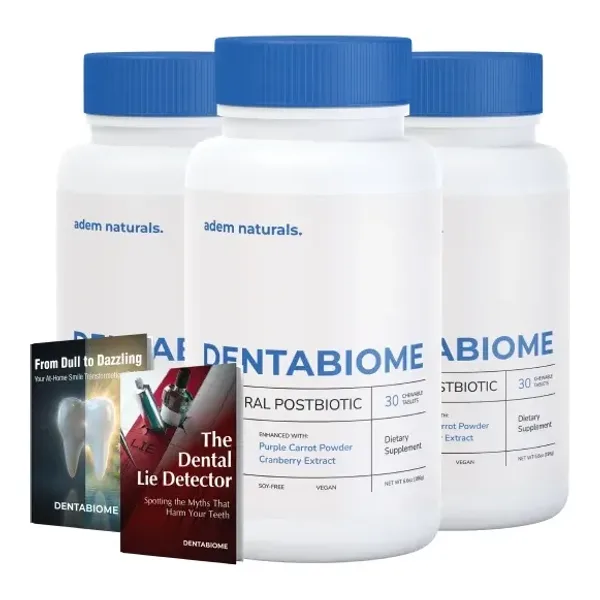
Our reviews normally start from the Supplement Facts panel. DentaBiome's site does not show one. The sales page names the ingredients in marketing terms and calls the whole thing "a unique proprietary blend", but gives no amounts, no strain codes, no enzyme names, no tablet count per bottle and no list of other ingredients. The only product photo is a front-of-bottle image. We also checked the affiliate resources page and its linked asset folder; neither contains a label.
That matters more for this category than most. Postbiotic and probiotic effects are tied to specific strains at specific amounts, and the human trials below all name their strain. Without that information we cannot say whether DentaBiome resembles any of them. Our transparency and dosing scores reflect this.
A close relative: ProvaDent
We have reviewed another chewable from the same Tallmadge, Ohio, return address. ProvaDent lists xylitol, a "BioFresh Clean Complex" of three plaque enzymes, cranberry extract, purple carrot powder and four live probiotic strains, including L. salivarius, all with amounts on its label. DentaBiome's sales page uses the same complex name and the same xylitol, purple carrot and cranberry, but swaps the live strains for inactivated L. plantarum, L. salivarius and L. rhamnosus. Because DentaBiome publishes no label, we cannot tell whether the shared ingredients come in the same amounts. If you want the version where you can see the numbers, ProvaDent is the one to read about.
Our other oral health reviews, for comparison: ProDentim (live probiotic blend with inulin), DentiCore (minerals plus a chlorella and shilajit blend), DentaTonic (enzyme and lactoferrin blend), FortBite (a clay tooth powder) and DentaSmile Pro. None of those lists the same ingredients as DentaBiome.
The named ingredients next to the research
Since we have no doses, this table compares ingredient types with the human studies we found, and notes what would be needed to judge the match.
| Ingredient (as named on the sales page) | DentaBiome per tablet | What human studies used | How it compares |
|---|---|---|---|
| Inactivated L. plantarum (two strains) | Not disclosed | 10 mg/day heat-killed L-137 for 12 weeks [7]; live CCFM1214 with L. salivarius for 4 weeks [10] | Strains unnamed; cannot compare |
| Inactivated L. salivarius | Not disclosed | Heat-killed CP3365 tablets for 8 weeks [8]; AP-32 lozenges for 4 weeks [6] | Strain unnamed; cannot compare |
| Inactivated L. rhamnosus | Not disclosed | No inactivated L. rhamnosus oral trial found | No direct evidence |
| BioFresh Clean Complex (enzymes) | Not disclosed; enzymes not named | Mutanase, beta-glucanase and DNase lozenges for 14 days [13] | Composition unknown on this product |
| Xylitol | Not disclosed | Toothpaste with 10% xylitol; other products low-quality evidence [14] | Cannot compare |
| Cranberry extract | Not disclosed | Tablet with inactivated L. salivarius in children [9]; juice rinse in adults [15] | Cannot compare |
| Purple carrot powder | Not disclosed | No oral health trial found | No direct evidence |
Postbiotics: promising, early and strain-specific
A 2025 systematic review on postbiotics and tooth decay found 21 studies, 18 of them in test tubes and only three randomized human trials. The human trials reported lower salivary S. mutans counts and higher saliva pH after postbiotic use [4]. A 2026 meta-analysis comparing probiotics, prebiotics, synbiotics and postbiotics went further: postbiotic evidence was "sparse, heterogeneous", based on three studies with mostly bacterial counts as outcomes. In the same analysis, live probiotic trials in adults showed no significant effect on new decay [5].
The individual trials are small but interesting. In Taiwan, 75 healthy adults took postbiotic, heat-killed or placebo lozenges for four weeks; the active groups had higher salivary IgA and more beneficial bacteria, and reported better oral comfort on questionnaires [6]. In Japan, 32 healthy adults took heat-killed L. salivarius CP3365 or placebo tablets for eight weeks; plaque, bleeding on probing and pocket depth rose less in the active group [8]. In 39 people already in maintenance care after gum treatment, 10 mg a day of heat-killed L. plantarum L-137 for 12 weeks gave a somewhat greater reduction in pocket depth at deeper sites than placebo [7]. Each of these used a specific, named strain made by the study sponsor. DentaBiome names none.
L. salivarius and L. plantarum for breath
The sales page credits L. salivarius with lowering the sulfur compounds behind bad breath. In a four-week trial of 43 people with breath complaints, live L. plantarum CCFM1214 and L. salivarius CCFM1215 lowered measured sulfur compounds compared with a control powder; 33 people finished [10]. A meta-analysis of seven trials found probiotics improved breath scores over four weeks or less, with a weaker signal afterward and wide variation between studies [11]. Those trials mostly used live bacteria, so they do not directly tell us what an inactivated tablet does.
The enzyme complex
The enzymes in ProvaDent's version of BioFresh are beta-glucanase, DNase and a glucan-splitting enzyme. If DentaBiome uses something similar, the closest evidence is a Danish program. In the lab, mutanase-containing combinations cut biofilm formation by over 90% [12]. In the follow-up randomized trial, 80 healthy adults sucked enzyme or placebo lozenges and stopped brushing for 14 days; plaque was lower with the active lozenge on day 7, with no difference in gum scores or at the other time points. The authors described a slight delay in plaque formation, and the work was co-funded by the enzyme maker [12] [13]. The DentaBiome sales page figures of 47% fewer bacteria in 24 hours and 60% after 8 days do not appear in either paper's abstract, and we could not trace them.
Xylitol and cranberry
Xylitol is a sugar alcohol that mouth bacteria cannot ferment well. The Cochrane review of 10 trials (5,903 people) found low-quality evidence that a fluoride toothpaste with 10% xylitol reduced decay in children compared with fluoride toothpaste alone. Evidence for other xylitol products, including the single adult lozenge trial, was too weak to show a benefit [14]. Cranberry has a different kind of support: in a small crossover study, rinsing with pure unsweetened cranberry juice reduced plaque regrowth and acid production 30 minutes later in eight adults [15], and a tablet combining inactivated L. salivarius with cranberry was linked to fewer early enamel lesions over nine months in 60 preschool children [9]. That pairing is the nearest published match to DentaBiome's idea, but in a very different population.
The FabM "acid-lock": what the research actually says
FabM is real. In 2004, researchers at the University of Rochester showed that S. mutans, the best-known cavity-linked bacterium, uses the fabM gene to make monounsaturated fatty acids for its membrane, and that a strain without it was extremely sensitive to low pH [1]. In rats, that disabled strain caused fewer and milder lesions and spread poorly between animals [2]. A 2026 study confirmed that losing fabM weakens several Streptococcus species and makes them more vulnerable to stress and antibiotics [3].
Here is where the sales page goes beyond the evidence:
- The research describes FabM as an enzyme inside the bacterium that lets it tolerate its own acid. We found no publication describing an "acid-lock" that protects bacteria from toothpaste or professional cleanings.
- We found no study, in people or in the lab, showing that any DentaBiome ingredient blocks or "picks" FabM.
- The "10,000 times more vulnerable" figure and the "Scandinavian military research" do not appear in the FabM papers we read. The sales page's own first reference is a conference abstract, and its second is the general postbiotics review cited above, which does not mention FabM.
- Claims such as eliminating over 99.9% of S. mutans or blocking gum bacteria by 36% may come from lab dishes. We could not connect them to a human study of this product.
The sales page also carries customer stories describing outcomes we would expect only from dental care, and the vendor's affiliate page still contains leftover text describing DentaBiome as a solution for an unrelated blood sugar condition. Neither builds confidence in the editing behind the claims.
Price, packages and refund policy
One bottle is presented as a 30-day supply. Prices on the seller's site when we checked:
- 6 bottles: $49 each ($294 total), free US shipping, two digital bonus guides. About $1.63 a day.
- 3 bottles: $69 each ($207 total), two digital bonus guides; the package card says free US shipping, although the FAQ says only the 6-bottle order ships free.
- 2 bottles: $79 each ($158 total). There is no single-bottle option.
The sales page offers a 60-day money-back guarantee and says you can return "all bottles (even if empty)". The site's own refund page says only unopened and undamaged bottles qualify, and that return postage is on you. Before ordering, we would ask support which rule applies and keep the answer in writing. Sixty days is also short next to most of the trials above, which ran four to twelve weeks before measuring anything.
DentaBiome packages on the seller's site
6 bottles, 180-day supply
$49/bottle
$294 total · Free US shipping
Lowest price per bottle
Includes 2 digital bonus guides
Check the 6-bottle price3 bottles, 90-day supply
$69/bottle
$207 total · Free US shipping (per the package card)
Includes 2 digital bonus guides
Check the 3-bottle priceButtons open the seller's DentaBiome website, where you choose your supply and complete the order. Prices as listed on the seller's site on October 23, 2026; the price shown at checkout is final.Orders are covered by a 60-day refund policy from the seller (see their terms). We may earn a commission.
Safety
Because the doses are unknown, the notes below are about the ingredient types, verified on PubMed.
- Cranberry and warfarin: a systematic review of warfarin interactions lists cranberry among products linked to a higher bleeding risk [17]. A US Pharmacopeia safety review found that interactions were mostly reported with very large intakes (around 3,000 mg of extract a day) and in seriously ill patients [16]. If you take warfarin or another blood thinner, ask your doctor first.
- Xylitol: larger amounts can cause bloating, gas and loose stools [14]. A 2024 study linked higher blood xylitol to cardiovascular events and found that a xylitol-sweetened drink increased platelet reactivity in 10 volunteers [18]. That drink held far more xylitol than a typical chewable, but we cannot confirm DentaBiome's amount. Men with heart disease or clotting concerns should mention it to their doctor.
- Inactivated bacteria: the theoretical risks of live probiotics, such as infection in people with weakened immunity, are discussed in the literature [19]. Inactivated bacteria should carry less of that risk, but if you are immunocompromised, ask your doctor first.
Results vary from person to person. Talk to your doctor or dentist before starting any supplement, especially if you take prescription medication, and get new or worsening symptoms checked rather than waiting to see whether a supplement helps.
What we liked and what gave us pause
Liked
- Inactivated bacteria are stable and do not need refrigeration
- Ingredient types overlap with several small placebo-controlled oral trials
- Simple one-a-day chewable
- One-time price, no subscription
Gave us pause
- No Supplement Facts panel, strain names or doses on the site
- FabM story extends far past the published research
- Percentages on the sales page we could not trace
- Refund and shipping wording that conflicts across pages
- No published trial of DentaBiome itself
Frequently asked questions
Is DentaBiome the same as ProvaDent?
They share a return address, a complex name and several ingredients, but DentaBiome describes its bacteria as inactivated while ProvaDent lists live strains. ProvaDent publishes amounts; DentaBiome does not, so we cannot say how close the formulas are.
What is a postbiotic?
Generally, bacteria that have been inactivated, usually by heat, together with the compounds they produce. Research on them for oral health is young and mostly small trials with specific strains.
How long before I notice anything?
Results vary. The oral trials we found ran from two to twelve weeks, and most measured bacteria or plaque rather than how people felt.
Can it replace dental visits or treatment?
No. DentaBiome is a dietary supplement. Keep brushing with fluoride toothpaste, cleaning between teeth and seeing your dentist.
Where can I buy it?
On the seller's website through ClickBank. Listings elsewhere may not be covered by the refund policy.
Want to read the seller's page yourself? The link below opens the DentaBiome website, where you can see their presentation and ask support for the full Supplement Facts before choosing a package.
Visit the DentaBiome websiteHow we reviewed DentaBiome
We read the sales page, FAQ, refund and shipping pages and the vendor's affiliate terms, and looked for a Supplement Facts panel on the site and in the affiliate resources. We then searched PubMed for human trials and reviews of each named ingredient type for oral health, and for the FabM research behind the main marketing claim. We did not test the product on people, and nobody at Stark Verve is a medical or dental professional. Read our editorial policy to learn how we choose and update reviews. Stark Verve earns a commission if you buy through our links; that never changes what we write about the evidence.
References
- Fozo EM, Quivey RG Jr. The fabM gene product of Streptococcus mutans is responsible for the synthesis of monounsaturated fatty acids and is necessary for survival at low pH. J Bacteriol. 2004;186(13):4152-8. PMID 15205416
- Fozo EM, Scott-Anne K, Koo H, Quivey RG Jr. Role of unsaturated fatty acid biosynthesis in virulence of Streptococcus mutans. Infect Immun. 2007;75(3):1537-9. PMID 17220314
- Baker JL, et al. Monounsaturated fatty acid biosynthesis is critical for streptococcal envelope homeostasis and stress tolerance. J Bacteriol. 2026;208(9):e0002626. PMID 42565831
- Heidari F, et al. Postbiotics and dental caries: a systematic review. Clin Exp Dent Res. 2025;11(1):e70114. PMID 40066530
- Lu C, Zhang S, Hong G. Comparative effectiveness of probiotics, prebiotics, synbiotics, and postbiotics in preventing dental caries: a meta-analysis from an oral microbiota modulation perspective. BMC Oral Health. 2026;26(1):342. PMID 41593561
- Lin CW, et al. Impact of the food grade heat-killed probiotic and postbiotic oral lozenges in oral hygiene. Aging (Albany NY). 2022;14(5):2221-2238. PMID 35236778
- Iwasaki K, et al. Daily intake of heat-killed Lactobacillus plantarum L-137 decreases the probing depth in patients undergoing supportive periodontal therapy. Oral Health Prev Dent. 2016;14(3):207-14. PMID 27175447
- Sakata S, et al. Screening of heat-killed lactic acid bacteria based on inhibitory activity against oral bacteria and effects of oral administration of heat-killed Ligilactobacillus salivarius CP3365 on periodontal health in healthy participants: a double-blinded, randomized, placebo-controlled trial. J Oral Microbiol. 2023;15(1):2250649. PMID 37649969
- Olczak-Kowalczyk D, et al. Effect of tablets containing a paraprobiotic strain and the cranberry extract on caries incidence in preschool children: a randomized controlled trial. Dent Med Probl. 2025;62(2):209-215. PMID 39023333
- Ding L, et al. Effects of Lactiplantibacillus plantarum CCFM1214 and Ligilactobacillus salivarius CCFM1215 on halitosis: a double-blind, randomized controlled trial. Food Funct. 2024;15(16):8386-8394. PMID 39028146
- Huang N, et al. Efficacy of probiotics in the management of halitosis: a systematic review and meta-analysis. BMJ Open. 2022;12(12):e060753. PMID 36600415
- Dukanovic Rikvold P, et al. The effect of enzymatic treatment with mutanase, beta-glucanase, and DNase on a saliva-derived biofilm model. Caries Res. 2024;58(2):68-76. PMID 38154453
- Rikvold PD, et al. The effect of enzymes on dental plaque: a randomized controlled trial. J Dent Res. 2026;105(2):236-244. PMID 40676928
- Riley P, et al. Xylitol-containing products for preventing dental caries in children and adults. Cochrane Database Syst Rev. 2015;(3):CD010743. PMID 25809586
- Wu CD, et al. In vivo exposure to cranberry juice suppresses dental plaque regrowth and acid production in adults and children: a PGRM study. Sci Rep. 2026;16(1):28663. PMID 42337282
- Madden E, et al. Safety of cranberry: evaluation of evidence of kidney stone formation and botanical drug-interactions. Planta Med. 2021;87(10-11):803-817. PMID 34015833
- Tan CSS, Lee SWH. Warfarin and food, herbal or dietary supplement interactions: a systematic review. Br J Clin Pharmacol. 2021;87(2):352-374. PMID 32478963
- Witkowski M, et al. Xylitol is prothrombotic and associated with cardiovascular risk. Eur Heart J. 2024;45(27):2439-2452. PMID 38842092
- Doron S, Snydman DR. Risk and safety of probiotics. Clin Infect Dis. 2015;60 Suppl 2:S129-34. PMID 25922398