Review · Oral health
FortBite review: a clay tooth powder, checked against its own references
FortBite is a tooth powder made from two clays, chalk and kitchen herbs. You brush with it twice a day and spit it out. We looked at what the site actually discloses, opened the studies it cites, and compared the formula with oral care research.
This is an independent review page. Stark Verve is not the maker or seller of FortBite, and we earn a commission if you buy through our links.
Our verdict: 1.6 / 5
| Ingredient evidence | 2 | Herbal toothpastes have low-quality plaque data; the two clays that headline the formula have no human oral care trials we could find |
|---|---|---|
| Dosing vs. research | 1 | No amounts or percentages disclosed for any ingredient, so nothing can be compared with a study |
| Label transparency | 1 | No ingredient label published; the site promises 11 ingredients but names 10 |
| Value and refund terms | 2.5 | $49 to $69 per 3 oz jar; 60-day refund, all jars returned at your cost |
Worth considering if you already brush with a fluoride toothpaste, you like the taste and feel of herbal tooth powders, and you want to try one as an occasional extra with a 60-day refund window behind you.
Probably skip it if you are thinking of replacing your regular toothpaste with it, you want to know exactly what is in the jar and how much, or you are buying it because of the "toxins in your tooth pores" story. We could not find research behind that idea.
Before anything else: bleeding gums, loose teeth, a sore that does not heal or new sensitivity deserve a visit to your dentist. Those signs can have several causes, and some need professional care.
Smallest order $69, from $49 per jar, 60-day refund policy from the seller
See the current FortBite packages, shipping and refund termsOpens the seller's page. It may start with a long video or letter; the packages and refund terms are usually further down. We may earn a commission.
Came here for FortBite? The highest-rated teeth and gums label we checked is ProvaDent, 2.5 out of 5.
What FortBite is
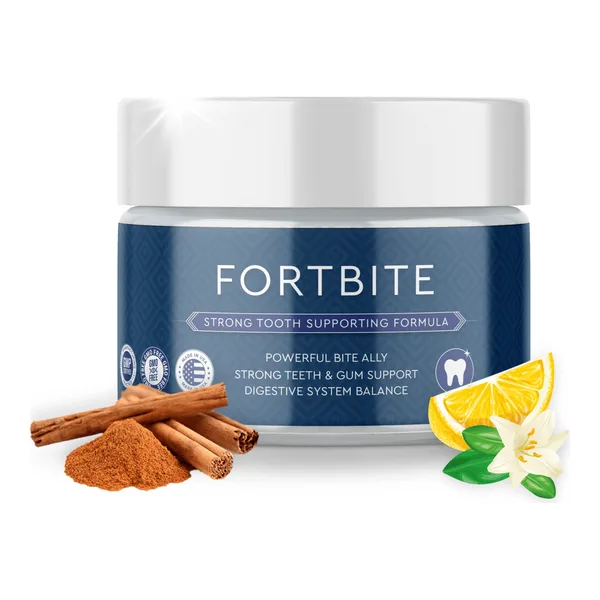
FortBite is sold through its own website, with checkout run by BuyGoods, a US online retailer. The site does not name a manufacturing company. Each jar holds 3 ounces (90 mL) of powder. The directions are simple: put a small amount on your toothbrush, brush teeth and gums for about two minutes, rinse and spit, morning and night.
The sales presentation says microplastics, "forever chemicals" and other toxins enter the teeth through microscopic pores, and that the two clays in FortBite pull them out like a detox while the herbs handle bacteria and breath. The jar itself reads "strong tooth supporting formula" and also "digestive system balance". We come back to both points below, because they do not fit together well.
What is in the jar, and what is missing
The site describes a "proprietary formula of 11" ingredients and then names ten: bentonite clay, kaolin clay, calcium carbonate, cinnamon extract, clove, peppermint, myrrh, ginger, lemon peel and stevia. We found no ingredient label on the sales page, the text version of the page or any of the policy pages, and no amounts or percentages anywhere. So we cannot tell you whether the herbs make up a meaningful share of the powder or are there mainly for flavor.
What is clearly missing is fluoride. That matters more than any single ingredient in this review, so we start there.
The formula next to the research
FortBite is used on the teeth and spat out, so the relevant research is on toothpastes, powders and rinses rather than on swallowed supplements. For each ingredient group we looked for human trials of oral care products and what they actually measured.
| Ingredient | FortBite amount | What oral care studies used | How it compares |
|---|---|---|---|
| Fluoride | None | 1,000 to 1,500 ppm toothpaste, 5,000 ppm in older adults [1] [2] | Absent from the formula |
| Calcium carbonate | Not stated | Used as the abrasive in fluoride toothpastes [3] [4] | Same role likely; studied benefit came with fluoride |
| Clove, ginger (in herb blends) | Not stated | 15% nine-herb toothpaste, 12 weeks [6] | Cannot be compared |
| Cinnamon | Not stated | Cinnamon extract rinse, 4 weeks [7] | Cannot be compared; different product form |
| Ginger | Not stated | Green tea plus ginger rinse, 30 days [8] | Cannot be compared |
| Myrrh | Not stated | Myrrh rinse after implant surgery, 1 week [9] | Different setting and outcome |
| Bentonite and kaolin clay | Not stated | No human oral care trial found [10] [11] | Lab and general reviews only |
Fluoride: the ingredient FortBite leaves out
The Cochrane review of toothpaste trials is about as solid as dental evidence gets. In three trials with 2,162 adults, brushing with 1,000 to 1,100 ppm fluoride toothpaste led to fewer new decayed, missing or filled tooth surfaces than a non-fluoride paste over the follow-up period, with moderate certainty [1]. For men over 50 the relevant detail is the exposed root surface that comes with receding gums. In a two-year trial of 345 independent older adults in Chile, all with at least one root lesion, a 5,000 ppm fluoride paste did much better than a standard 1,450 ppm paste at keeping root surfaces sound [2].
None of that applies to FortBite, because it contains no fluoride. If you brush with it instead of your usual toothpaste, you are giving up the best-supported part of a daily routine.
Calcium carbonate: a real toothpaste abrasive
Calcium carbonate is ordinary chalk and one of the most common polishing agents in toothpaste, so its presence is sensible. The research on it, though, is about calcium carbonate paired with fluoride. In a small crossover study of 10 volunteers, a calcium carbonate toothpaste with 1,500 ppm fluoride protected enamel blocks worn in the mouth better than a silica paste with the same fluoride [3]. A lab study of a calcium carbonate and perlite whitening paste found good stain removal with abrasion in line with other whitening pastes [4]. We found nothing showing calcium carbonate on its own "fortifies" teeth the way the sales page suggests.
The herbs: plausible, small, short studies
The best summary we found is a 2020 meta-analysis with NIH authors. It pooled 24 randomized trials of herbal toothpastes and rinses in 1,597 adults. Herbal toothpastes reduced plaque in short-term studies about as well as regular pastes, but they did not beat fluoride toothpaste, and the authors rated the evidence as low quality [5].
Individual trials point the same way. A 12-week, placebo-controlled trial of a toothpaste with nine herbs, including clove and ginger, at 15% of the paste, in 60 young adults found that plaque and gum bleeding fell in the herbal group but not in the placebo group [6]. A 4-week trial of a cinnamon extract rinse in 105 students saw plaque and gum scores fall, though the difference from the other groups was not statistically significant [7]. A 30-day trial in 60 children found a green tea plus ginger rinse performed similarly to chlorhexidine on plaque and gum scores [8]. Myrrh has been tested as a rinse after dental implant surgery in 35 patients, where results were similar to chlorhexidine over one week [9]. None of these used a clay powder, and none tells us what the herb amounts in FortBite are.
The two clays: the headline ingredients with the least evidence
FortBite's story rests on bentonite and kaolin "sucking out" toxins. We could not find a human trial of either clay as a tooth powder or toothpaste on plaque, enamel, gums or breath. The bentonite paper on the site's own reference list is a short general review that concludes more research is needed [11]. The kaolin paper on that list is a lab study on human periodontal cells in a dish. It found that kaolinite reduced cell viability as the concentration rose, and that it did not meaningfully change the inflammation-related signals the researchers measured [10]. That is a reasonable early safety study. It does not support the "helps reduce inflammation" line on the sales page.
A dental literature review of charcoal tooth powders, a close cousin of clay powders, noted that a third of the products it sampled also contained bentonite, and found too little clinical or lab data to back their antibacterial and "oral detox" claims [12].
What the marketing claims, and what we could verify
"Toxins enter through tooth pores." We searched PubMed for research showing that microplastics or "forever chemicals" build up inside teeth and gums through enamel pores, or that clay draws them back out. We found none. What we did find is a 2024 study that detected microplastic particles in every oral care product it tested in India, from toothbrushes and toothpastes to tooth powders and mouthwash [14]. That is a fair reason to think about plastics in a bathroom cabinet. It says nothing about FortBite removing them.
The reference list. The FortBite site lists 18 "scientific references". Several have nothing to do with teeth: a surgical device for acid reflux, a pancreatitis guideline, a study on clay used in concrete, and a dissertation on early Viking art. Others are about reflux, swallowed ginger and peppermint oil for digestion. About a third concern the mouth or teeth.
"Digestive system balance." The jar and the text page tie FortBite to stomach health and acid reflux. A powder you brush with for two minutes and spit out is a poor fit for a digestive claim, and none of the digestive references on the site tested a tooth powder.
"Manufactured in an FDA-approved facility." The FDA registers and inspects manufacturing facilities, but it does not approve them. We would read this line as a statement about registration.
We are not saying FortBite does nothing. Brushing twice a day with a mild abrasive and herbal flavor will clean teeth. We are saying the specific mechanism on the sales page could not be traced to a publication.
Price, packages and refund policy
The site positions one jar as a 30-day supply. Prices on the official page when we checked:
- 6 jars: $49 each ($294 total), free US shipping, two digital guides included. About $1.63 a day.
- 3 jars: $59 each ($177 total), free US shipping, two digital guides included.
- 1 jar: $69, free US shipping.
Shipping to Canada, the UK, Ireland, Australia and New Zealand is $15.95. Each order is a one-time payment. For context, a tube of fluoride toothpaste costs a few dollars at any pharmacy, so FortBite is priced far above the product it would most often sit next to.
The refund policy is 60 days from delivery. You must email support, then send back every jar, opened or not, with the packing slip, and you pay the return postage. One detail stood out: the refund page itself advises using the product for at least three months before judging it, which is longer than the 60-day window.
FortBite packages on the official site
6 jars, 180-day supply
$49/jar
$294 total · Free US shipping
Lowest price per jar
6 jars; includes 2 digital guides
Check the 6-jar price3 jars, 90-day supply
$59/jar
$177 total · Free US shipping
3 jars; includes 2 digital guides
Check the 3-jar priceButtons open the seller's FortBite website, where you choose your supply and complete the order. Prices as listed on the seller's site on October 23, 2026; the price shown at checkout is final.Orders are covered by a 60-day refund policy from the seller (see their terms). We may earn a commission.
Safety
Because FortBite is brushed and spat out, exposure to its herbs is small compared with a capsule. A few points are still worth knowing.
- Cinnamon. Cinnamon flavoring is a recognized, if uncommon, cause of allergic reactions inside the mouth, including from toothpaste. Reported signs include burning, redness, swelling or peeling of the gums, tongue or cheeks, which often go unrecognized [15]. Stop using any product that causes these.
- Clays and metals. Dutch food safety researchers tested clays sold for oral use and found that some "health clays" could exceed safe intake limits for lead or arsenic if swallowed regularly [13]. FortBite publishes no heavy metal testing, so we suggest spitting thoroughly and not swallowing the powder.
- Myrrh and warfarin. A published case report describes myrrh, taken as an herbal medicine, weakening the effect of warfarin [16]. The amount absorbed from brushing is likely far lower, but if you take a blood thinner, tell your doctor and dentist before adding any myrrh product.
- Abrasion. Gums often recede with age, exposing softer root surfaces. Use a soft brush and gentle pressure with any powder.
Talk to your doctor or dentist before using FortBite if you take prescription medication, have dental work such as implants or bridges, or have sensitive teeth. Results vary from person to person. New or worsening symptoms in your mouth deserve professional care, not a change of toothpaste.
What we liked and what gave us pause
Liked
- Calcium carbonate is a familiar, mild toothpaste abrasive
- Herbal oral care products have shown short-term plaque benefits in trials
- Spit-out use keeps herb exposure low
- Free US shipping and no subscription
Gave us pause
- No fluoride
- No ingredient label, no amounts, and 11 promised ingredients with 10 named
- The clays that headline the formula have no human oral care trials we could find
- A reference list padded with unrelated papers, and a digestive claim on a spit-out powder
- Return postage on you, and a refund window shorter than the advised trial period
Frequently asked questions
Can FortBite replace my toothpaste?
We would not use it that way. It contains no fluoride, and fluoride toothpaste has the strongest evidence of anything in a home routine [1]. If you like FortBite, the safer approach is to use it in addition to a fluoride toothpaste, and to ask your dentist first.
Where can I buy FortBite?
On its own website, with checkout through BuyGoods. The seller's affiliate rules bar listings on Amazon, eBay and other marketplaces, so third-party listings may not be genuine or covered by the refund policy.
How long before I notice anything?
Results vary. The herbal oral care trials we found lasted from one week to twelve weeks. Fresher breath after brushing is immediate with almost any flavored product, so it is not a good test of whether the formula is doing more.
Is it a subscription?
No. According to the sales page, each package is a one-time payment.
Want to read the sales page yourself? The link below opens the FortBite website, where you can see their full presentation and choose a package.
Visit the FortBite websiteHow we reviewed FortBite
We read the FortBite sales page in its video and text versions, the FAQ, the refund, shipping, terms and disclaimer pages, the reference list and the seller's affiliate rules, and checked package prices in the page's own pricing data. We then searched PubMed for human trials of fluoride, calcium carbonate, herbal toothpastes and rinses, and clay in oral care, plus safety reports on cinnamon, myrrh and oral clays, and opened the studies from the seller's list that are indexed there. We did not test the product on people, and nobody at Stark Verve is a medical or dental professional. Read our editorial policy to learn how we choose and update reviews. Stark Verve earns a commission if you buy through our links; that never changes what we write about the evidence.
References
- Walsh T, Worthington HV, Glenny AM, Marinho VC, Jeroncic A. Fluoride toothpastes of different concentrations for preventing dental caries. Cochrane Database Syst Rev. 2019;3:CD007868. PMID 30829399
- León S, et al. High fluoride dentifrice for preventing and arresting root caries in community-dwelling older adults: a randomized controlled clinical trial. J Dent. 2019;86:110-117. PMID 31176788
- Cury JA, et al. Effect of a calcium carbonate-based dentifrice on enamel demineralization in situ. Caries Res. 2003;37(3):194-9. PMID 12740543
- Pickles MJ, et al. In vitro efficacy of a whitening toothpaste containing calcium carbonate and perlite. Int Dent J. 2005;55(3 Suppl 1):197-202. PMID 16004254
- Janakiram C, Venkitachalam R, Fontelo P, Iafolla TJ, Dye BA. Effectiveness of herbal oral care products in reducing dental plaque and gingivitis: a systematic review and meta-analysis. BMC Complement Med Ther. 2020;20(1):43. PMID 32046707
- Jayashankar S, et al. A randomised double-blind placebo-controlled study on the effects of a herbal toothpaste on gingival bleeding, oral hygiene and microbial variables. Ceylon Med J. 2011;56(1):5-9. PMID 21542426
- Gupta D, Jain A. Effect of cinnamon extract and chlorhexidine gluconate (0.2%) on the clinical level of dental plaque and gingival health: a 4-week, triple-blind randomized controlled trial. J Int Acad Periodontol. 2015;17(3):91-8. PMID 26373226
- Deshpande A, et al. Effect of green tea, ginger plus green tea, and chlorhexidine mouthwash on plaque-induced gingivitis: a randomized clinical trial. J Indian Soc Periodontol. 2021;25(4):307-312. PMID 34393401
- Ibraheem WI, et al. Evaluating soft tissue healing after implant placement using two different mouthwashes (myrrh and chlorhexidine gluconate): a randomized control trial. Medicina (Kaunas). 2022;58(10):1351. PMID 36295512
- Müller AS, et al. The response of periodontal cells to kaolinite. Clin Oral Investig. 2020;24(3):1205-1215. PMID 31420747
- Moosavi M. Bentonite clay as a natural remedy: a brief review. Iran J Public Health. 2017;46(9):1176-1183. PMID 29026782
- Brooks JK, Bashirelahi N, Reynolds MA. Charcoal and charcoal-based dentifrices: a literature review. J Am Dent Assoc. 2017;148(9):661-670. PMID 28599961
- Reeuwijk NM, et al. Levels of lead, arsenic, mercury and cadmium in clays for oral use on the Dutch market and estimation of associated risks. Food Addit Contam Part A. 2013;30(9):1535-45. PMID 23862762
- Protyusha GB, et al. Microplastics in oral healthcare products (OHPs) and their environmental health risks and mitigation measures. Environ Pollut. 2024;343:123118. PMID 38092338
- Isaac-Renton M, Li MK, Parsons LM. Cinnamon spice and everything not nice: many features of intraoral allergy to cinnamic aldehyde. Dermatitis. 2015;26(3):116-21. PMID 25984687
- Al Faraj S. Antagonism of the anticoagulant effect of warfarin caused by the use of Commiphora molmol as a herbal medication: a case report. Ann Trop Med Parasitol. 2005;99(2):219-20. PMID 15814041