
The Brotherhood Problem: Why Men Over 50 Are Quietly Lonely
There is a particular kind of loneliness that does not look like loneliness from the outside.
The man experiencing it has a full calendar. A family that depends on him. Colleagues who respect him. A social media presence that suggests a life well-connected. He is not isolated in any visible sense. He goes to dinners, attends events, exchanges messages with people he has known for decades.
And yet something is missing. A quality of connection that used to exist and has gradually thinned to the point where he cannot remember the last time he had a conversation that felt genuinely real. Where he said what he actually thought to someone who actually knew him. Where he left an interaction feeling less alone rather than more efficiently scheduled.
This is the brotherhood problem. And it is one of the most common and least discussed realities of life for American men in their 50s.
How Male Friendship Actually Works, and Why It Breaks Down
Male friendship in younger years operates primarily through shared activity and shared context. Men become close through proximity (school, military service, early career environments, team sports) and through the regular contact that those contexts provide automatically.
The friendship does not require maintenance in the conventional sense because the structure provides it. The same people, the same place, the same recurring situation. Closeness accumulates as a byproduct of showing up for something else.
This model works well until the contexts dissolve. Career advancement separates men from the colleagues they were closest to. Geographic mobility moves men away from the places where their friendships formed. Marriage and children restructure social time around family obligations that leave little room for the kind of unstructured time that male friendship requires. And the older a man gets, the more his social environment becomes defined by professional relationships that carry implicit performance requirements rather than the unconditional quality that genuine friendship needs.
By the mid-50s, most men have lost the structural scaffolding that built and maintained their closest friendships without them having to think about it. What remains requires deliberate investment, which is precisely the kind of social maintenance that men were never taught to provide and rarely prioritize when life is full.
The result is a slow thinning that happens gradually enough that most men do not notice it until the absence is significant.
Related: What your father never told you about staying strong after 50
The Health Cost That Nobody Talks About
The link between social connection and health is stronger than most men would expect, and more relevant to daily life than the abstract idea of loneliness suggests.
Long-term loneliness tends to feel a lot like chronic stress. Sleep suffers. Tension builds. Everything else feels harder to carry. Public health officials have taken notice too: in 2023 the US Surgeon General issued an advisory describing loneliness and isolation as a serious public health concern.
The Harvard Study of Adult Development, one of the longest-running studies of adult life, has followed its original group of men since 1938. One of its best-known findings, as its current director Robert Waldinger has described it, is that the men who were most satisfied with their relationships at 50 tended to be the healthiest at 80, and that relationship satisfaction at midlife predicted later health better than cholesterol levels did.
Not the number of relationships. The quality of them.
The dinner party circuit does not count for much on its own. Neither does the group chat, or the annual golf trip where nobody says anything real.
What counts is the conversation where a man can say what is actually happening in his life and trust that the man across from him will receive it without judgment and respond with honesty.
For many men over 50, that conversation is happening with nobody.
Why Men Do Not Fix This On Their Own
The brotherhood problem is self-perpetuating in ways that make it resistant to the standard solutions.
Men who feel socially disconnected tend to withdraw further rather than reaching out, because reaching out in the absence of a structural context feels vulnerable in a way that contradicts the model of self-sufficiency most men carry. The very men who most need deeper connection are often the ones least likely to initiate it, because initiating it requires acknowledging the need, which the inherited definition of strength does not easily accommodate.
There is also a practical dimension. Men do not typically call each other to talk. Male friendship has historically been built around doing something together rather than processing something together. The activity is the container for the connection. Without a shared activity, most men do not have a comfortable format for the kind of regular contact that friendship requires to remain real.
And the older a man gets, the more his available time is perceived as already spoken for. The idea of investing regular time in friendships sits in competition with professional obligations, family commitments, and the general sense that everything important is already barely managed. Friendship gets classified, without conscious decision, as a lower priority: a luxury for when things slow down, which they never quite do.
The result is that most men wait for the conditions that used to create friendship automatically, without recognizing that those conditions are gone and will not return on their own.
If the loneliness has started to feel heavy, or has settled into a low mood that will not lift, talking with a doctor or counselor is a reasonable and worthwhile step alongside everything below.
Related: How the world’s most vital men manage stress without burning out
“A man who has three friends who know him completely is one of the wealthier men alive. Most men in their 50s would struggle to name one.”
Grant Whitaker, Stark Verve
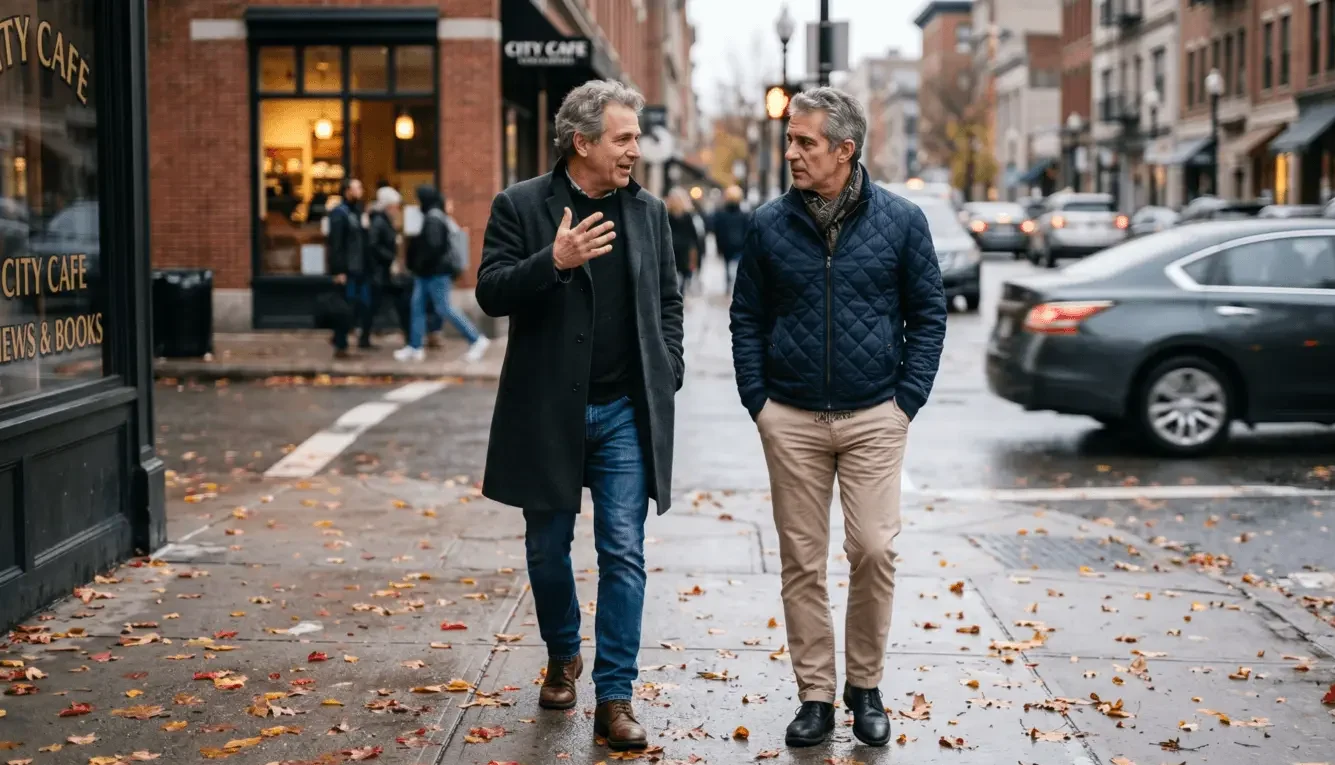
What the Men Who Solve This Actually Do
The men who maintain genuine brotherhood through their 50s and beyond have almost always done one of two things. They either protected and deliberately invested in friendships that survived the structural dissolution of earlier decades. Or they built new ones using a different approach than the one that worked at 25.
Both paths share a common element: intentionality. The friendship did not sustain or form itself. It was treated as something requiring regular investment and structure, in the same way that physical training or professional development requires scheduled time and deliberate effort.
They created recurring structure. A monthly dinner with the same three men. A weekly walk. An annual trip that has become non-negotiable. The specific activity matters less than its consistency. The recurring structure does what the institutional contexts of younger years did automatically: it ensures regular contact without requiring a separate decision each time.
They raised the quality of the conversation. Men who have genuine brotherhood do not necessarily talk more. They talk differently. At some point they have moved past the sports scores and the professional updates and the mutual complaints about the news, into the territory of what is actually happening in each other’s lives. This transition rarely happens on its own. It usually requires one man to go first, to say something real and create the permission for the other to respond in kind.
They invested in new friendships with the same deliberateness they brought to professional relationships. Making friends at 55 feels counterintuitive to most men. The model they carry is that real friends come from shared history. But shared history is simply accumulated shared experience, and shared experience can be created intentionally. Men who join organizations, take on new pursuits, or volunteer in settings where they spend time with other men over months often find that genuine connection still forms at 55. It just requires more conscious initiation.
They became the man who reaches out first. In most male friendships after 50, one man is slightly more willing than the other to initiate contact, propose the plan, and follow through on making it happen. The men with the strongest friendships at 60 are very often the men who accepted this role without resentment and played it consistently. Being the one who reaches out reflects a clearer understanding of what friendship actually requires, and says little about who needs it more.
The Specific Conversation Worth Having
There is a conversation that most men over 50 have not had with the men they are closest to, even the ones they have known for twenty or thirty years.
It is a simple conversation. It does not require vulnerability in any theatrical sense. It involves saying, directly and without excessive qualification, that the friendship matters. That the contact has become too infrequent. That there is a specific commitment to changing that: a recurring plan, a date in the calendar, something concrete rather than the mutual agreement to get together soon that has been repeated for years without producing anything.
Many men respond to this conversation with something close to relief. Because the friend on the other end of it is often experiencing the same thinning and the same reluctance to name it. The man who goes first gives both men something they have been waiting for without knowing how to ask.
This matters. For the quality of the decades ahead, it may be one of the most valuable conversations a man over 50 can have.
Related: What it means to be a man of presence in your 50s and beyond
Building It Going Forward
A single conversation or a single decision will not solve the brotherhood problem. Like everything else worth building, it takes consistent, deliberate investment over time.
The men who have genuine brotherhood at 65 started building or protecting it seriously at 50 or 55. They made the recurring commitment before they felt the full weight of its absence. They reached out before the friendships had thinned to the point of requiring reconstruction from near zero.
The practical starting point is simpler than most men expect. One man. One honest conversation about the quality and frequency of contact. One recurring commitment with a specific date attached to it.
Not a resolution. A practice.
The men who build this tend to report the same thing over time. That the investment returned more than they expected, faster than they expected. That the quality of everything else (the work, the marriage, their energy, the ability to handle difficulty) improved alongside it. That the man they were at 62 was more complete than the man they were at 52, and that the friendship they built or protected was a larger part of that than they would have predicted.
The brotherhood problem is real. It is also, unlike many of the things that diminish men in their later decades, largely within a man’s control to address.
That is worth something.
Key Takeaways
- Male friendship after 50 loses the structural scaffolding that maintained it automatically in younger years; what remains requires deliberate investment most men were never taught to provide
- The Harvard Study of Adult Development, which has followed its participants since 1938, found that men most satisfied with their relationships at 50 tended to be the healthiest at 80
- Long-term loneliness can feel a lot like chronic stress, and US public health officials now treat it as a serious concern
- The men who maintain genuine brotherhood create recurring structure, raise the quality of conversation, and become the one who reaches out first
- The most valuable starting point is one man, one honest conversation, and one recurring commitment with a specific date
Where to go next
This article is general information about health and lifestyle and is not medical advice. Talk to your doctor before making changes to your health routine, especially if you have a medical condition or take medication.