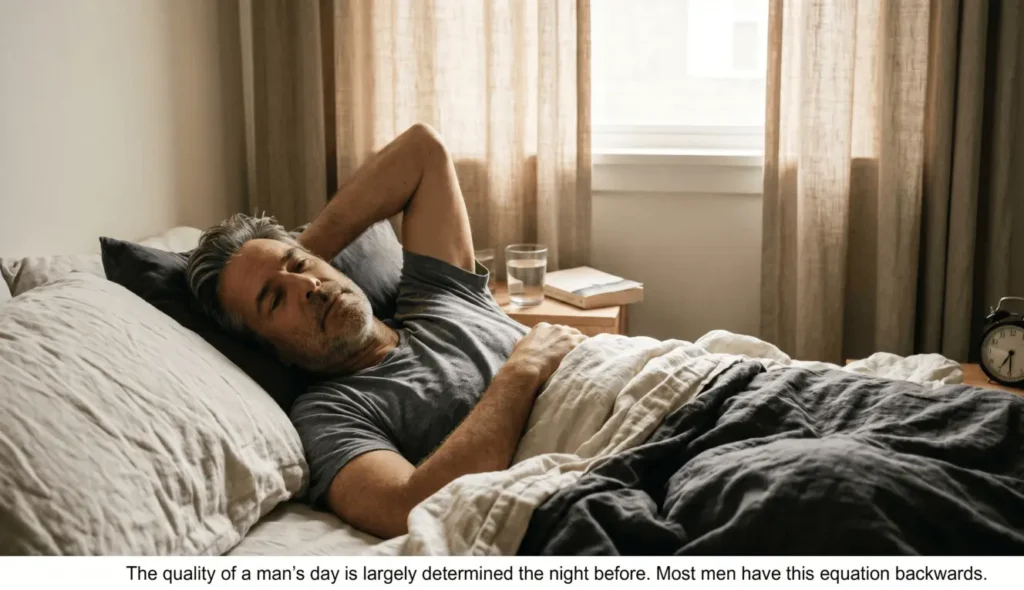
The Sleep Protocol Every High-Performing Man Over 50 Needs
Nobody warns you about what happens to sleep after 50.
In your 30s and 40s, poor sleep is a badge. You push through, you compensate with coffee, you recover on weekends. The system bends but does not break. Then somewhere in the early 50s, the rules change. The margin disappears. A bad night stops being an inconvenience and starts being a two-day recovery. The afternoon wall arrives earlier. The mental sharpness that used to return after a second cup of coffee starts requiring more than caffeine can provide.
This is not weakness. It is biology. And it is almost entirely addressable.
The men who sleep well through their 50s and 60s are not sleeping well by accident or by genetic luck. They have built a set of deliberate practices around rest that the men around them simply have not. The gap between them is not medication or supplements. It is protocol.
Why Sleep Changes After 50
Understanding what is actually happening makes the protocol make more sense.
The brain’s production of melatonin, the hormone that initiates sleep onset, declines with age. Men in their 50s produce measurably less melatonin than they did in their 30s, which means the natural signal to sleep arrives later, more weakly, and dissipates faster. This is why older men tend to wake earlier and find it harder to return to sleep after waking in the night.
At the same time, the proportion of deep sleep, the slow-wave stage where physical recovery, immune function, and memory consolidation primarily occur, decreases with age. A man sleeping seven hours at 55 is often getting significantly less restorative deep sleep than he was getting from the same seven hours at 35.
The architecture of sleep changes, not just the duration.
Cortisol patterns also shift. Older men tend to have higher baseline cortisol in the evening, which competes directly with the relaxation required for quality sleep onset. The combination of lower melatonin and higher evening cortisol creates a window that is narrower and more fragile than it used to be.
None of this is irreversible. All of it responds to behavior.
[→ Link: Post 4 - The Lost Art of Male Vitality]
The Foundation: Consistency Over Everything Else
The single most impactful sleep behavior is the one most men resist because it requires giving something up.
A consistent sleep and wake schedule, seven days a week, within thirty minutes of the same time regardless of what happened the night before, is the highest-leverage intervention in sleep science. More impactful than any supplement, any mattress upgrade, any white noise machine.
The reason is architectural. The body’s circadian system is not flexible. It is a biological clock that runs on light and timing cues. Irregular schedules, sleeping in on weekends, staying up late on Fridays, fragment the circadian rhythm in ways that compound across weeks. The system never fully synchronizes. Sleep quality suffers every night as a result.
Men who commit to a consistent schedule for thirty consecutive days consistently report that the quality of their sleep improves more than they expected, and that the discipline of keeping to it becomes easier rather than harder as the weeks pass.
The body finds the rhythm. The discipline is just in holding it long enough for that to happen.
Temperature Is the Variable Most Men Ignore
The body needs to drop its core temperature by approximately one to two degrees Fahrenheit to initiate and maintain quality sleep. This is not a preference. It is a physiological requirement.
Most American bedrooms run too warm for optimal sleep. The research-backed target range is between 65 and 68 degrees Fahrenheit. Men sleeping in rooms above 70 degrees are working against their own biology every night without realizing it.
Practical adjustments that make a measurable difference: lowering the thermostat before bed, using breathable natural fiber bedding rather than synthetic materials, avoiding hot showers immediately before sleep, and keeping the room dark and well-ventilated.
A warm shower or bath taken ninety minutes before bed, counterintuitively, actually helps. The subsequent drop in core body temperature as the body cools after the bath mimics and accelerates the natural pre-sleep cooling process. The timing matters. Immediately before bed, it disrupts. Ninety minutes before, it assists.
The Two-Hour Wind-Down Window
High-performing men who sleep well treat the two hours before bed with the same intentionality they bring to the first hour of the morning.
The nervous system does not shift from full activation to rest on command. It requires a transition. The two hours before bed are that transition window, and most men spend them doing exactly the things that prevent quality sleep.
Bright overhead lighting keeps cortisol elevated. Screens with high blue light content suppress melatonin production at the precise moment the body is trying to produce it. Stimulating content, whether news, intense drama, or work email, keeps the stress response activated. Alcohol, which many men use as a wind-down tool, actually fragments sleep architecture in the second half of the night and suppresses deep sleep significantly.
What works instead: dimmed or warm-toned lighting in the evening hours. A genuine stop time for work-related thinking. Reading physical books or low-stimulation content. A consistent pre-sleep routine that signals to the nervous system that the day is finished.
The routine itself matters less than its consistency. The body learns the sequence and begins preparing for sleep in anticipation of it.
[→ Link: Post 5 - Morning Habits of Men Who Age Like They Mean It]
Managing the Night Waking Problem
Waking in the middle of the night and struggling to return to sleep is one of the most common complaints among men over 50. It is also one of the most addressable.
Night waking is most commonly driven by one of three causes: cortisol spikes from unresolved stress, blood sugar drops in the early morning hours, or the need to urinate. Each has a different response.
For stress-driven waking, the intervention happens before bed. Men who practice even ten minutes of deliberate decompression, journaling, slow breathing, or structured reflection on the day, report significantly fewer stress-driven night wakings than men who transition directly from activity to bed.
For blood sugar-related waking, which often happens between two and four in the morning, the lever is evening nutrition. Large, high-carbohydrate meals close to bedtime create a glucose and insulin cycle that can result in a low blood sugar response several hours later. Moderate, earlier evening meals tend to reduce this pattern.
For urination-driven waking, fluid timing matters more than fluid volume. Shifting the bulk of daily hydration to morning and afternoon hours, and tapering off in the two hours before bed, reduces nighttime waking without requiring reduction in overall hydration.
The Role of Light in Anchoring Sleep Quality
Morning light and evening light are both levers. Most men know about avoiding screens before bed. Fewer understand the morning side of the equation.
Bright light exposure in the first thirty to sixty minutes of waking, ideally natural outdoor light, sets the circadian anchor for the entire day. It determines when melatonin begins to rise in the evening, which determines how easily sleep comes that night. The morning and evening are connected by a single biological loop, and the quality of sleep tonight is partially determined by how that loop was anchored this morning.
Men who get morning light consistently report falling asleep more easily in the evening, which is the expected result of a well-anchored circadian rhythm rather than a coincidence.
The other side of this: men who work primarily indoors under artificial lighting and do not get meaningful outdoor light exposure during the day often find that their melatonin timing drifts later over weeks, making it progressively harder to fall asleep at a consistent time. The fix is not an evening intervention. It is a morning one.
Key Takeaways
The Sleep Variable Most Men Have Not Checked
Sleep is a system. When it starts deteriorating after 50, there is often a physical factor contributing to it that sits outside the behavioral protocol entirely. A factor that affects energy, recovery, and drive in ways that compound across months.
Two minutes is enough to find out if it applies to you.