
Review · Vision health
VisiFlora review: a gut-eye story wrapped around a hidden blend
VisiFlora is a one-capsule eye support supplement sold with a "gut-eye connection" pitch. We transcribed the label, checked the ingredients on PubMed and compared the doses with the research. The ingredient list looks familiar. The amounts are the problem.
Our verdict: 2 / 5
| Ingredient evidence | 2.5 | Lutein, bilberry and a combination with astaxanthin have trials in healthy adults; several others were studied only in people under eye care, as eye drops, or not at all in people |
|---|---|---|
| Dosing vs. research | 1.5 | Vitamins and minerals are far below the AREDS amounts; the whole 351 mg blend is smaller than the bilberry dose alone in its trial |
| Label transparency | 1.5 | Fourteen ingredients share one proprietary blend with no individual amounts; the sales page says 22 ingredients, the label lists 21 |
| Value and refund terms | 2.5 | $49 to $79 per bottle, smallest order two bottles; one-time payment; 60-day refund on returned bottles, minus shipping |
Worth considering if you want a single small capsule with a broad mix of eye-related nutrients, you already get decent amounts of vitamins C and E from your diet, and you accept that you cannot know how much lutein or bilberry you are getting.
Probably skip it if you want doses that match the published trials, or if the gut-eye "LPS toxin" explanation is what drew you in. We could not find a human study showing that this formula, or any of its ingredients, changes gut toxins reaching the eye.
Before anything else: blurry vision, new floaters, flashes of light, eye discharge or trouble seeing at night are reasons to book an eye exam, not to start a supplement. The investigators behind the large AREDS trial advised dilated eye examinations for people older than 55 [1].
Smallest order $158, from $49 per bottle, 60-day refund policy from the seller
See the current VisiFlora packages, shipping and refund termsOpens the seller's page. It may start with a long video or letter; the packages and refund terms are usually further down. We may earn a commission.
Came here for VisiFlora? The highest-rated eyes label we checked is Vision 20, 3.6 out of 5.
What VisiFlora is
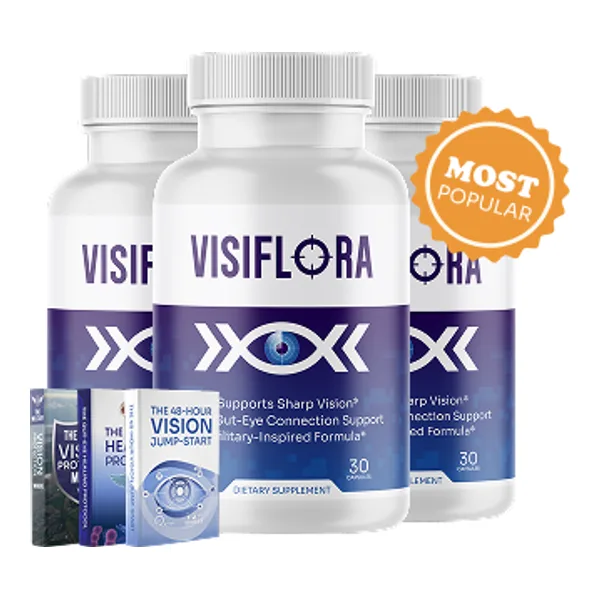
VisiFlora is a capsule supplement whose label says it is distributed by PhytoThrive Labs of Aurora, Colorado. The serving is one capsule a day, and a bottle holds 30. ClickBank is named as the retailer on the website, and the package buttons lead to a ClickBank checkout. It is sold in 2, 3 and 6-bottle packages as a one-time purchase. There is no single-bottle option on the page we saw.
The sales page calls it "precision vision support that starts in the gut." Its story is that bacterial fragments called LPS (lipopolysaccharides) leak from the gut and harm the eye, and that the formula helps "neutralize" them while feeding the retina. The page leans on a military and pilot theme.
What is on the label
The Supplement Facts panel appears on the contact page of the VisiFlora website. The vendor's affiliate terms do not allow us to reuse its images, so we describe it here. Per capsule:
- Disclosed amounts: vitamin A 450 mcg RAE (as beta carotene), vitamin C 90 mg, vitamin E 15 mg (as DL-alpha tocopheryl acetate), zinc 11 mg (as zinc oxide), selenium 20 mcg, copper 0.9 mg (as copper gluconate) and chromium 15 mcg (as chromium picolinate).
- Proprietary blend, 351 mg in total: taurine, ginkgo biloba leaf, eyebright, grape seed extract, coleus forskohlii root, alpha lipoic acid, rutin, quercetin, bilberry fruit extract, saffron extract, lycopene, lutein from marigold, zeaxanthin and astaxanthin. No individual amounts are given.
That is 21 ingredients. The sales page advertises a "22-in-1" formula. It also lists "Vitamin A (Beta Carotene)" and "Zinc (11mg)" correctly, but describes a separate "gut-eye barrier complex" that on the label is simply part of the same blend.
The same contact page also shows a label for a different product, VisiBoost Pro, a fiber and probiotic blend. VisiFlora itself contains no probiotic and no fiber; its "gut" ingredients are antioxidants.
The formula next to the research
For each ingredient with relevant human research we compared the trial amount with what VisiFlora provides. For blend ingredients we can only give an upper limit: none can exceed 351 mg, and together they must all fit inside it.
| Ingredient | VisiFlora per day | Amount in trials | How it compares |
|---|---|---|---|
| Lutein + zeaxanthin | Not disclosed (in 351 mg blend) | 10 mg + 2 mg [3] [2]; 20 mg lutein [4] | Cannot be checked |
| Bilberry extract | Not disclosed | 480 mg/day [6] | The trial dose is larger than the entire blend |
| Astaxanthin | Not disclosed | 3 mg, with bilberry anthocyanins and lutein [5] | Cannot be checked |
| Saffron | Not disclosed | 20 mg/day [8] | Cannot be checked; trial population had a diagnosed eye condition |
| Vitamin C | 90 mg | 500 mg/day [1] | About a fifth |
| Vitamin E | 15 mg | 400 IU/day [1] | A small fraction |
| Zinc | 11 mg (zinc oxide) | 80 mg/day as zinc oxide [1] | About one seventh |
| Copper | 0.9 mg | 2 mg/day [1] | Under half |
| Vitamin A as beta carotene | 450 mcg RAE | 15 mg beta carotene in AREDS, later dropped [1] [2] | Much lower |
| Forskolin + rutin, eyebright, taurine, grape seed, quercetin, lycopene | Not disclosed | No oral trial in healthy eyes found | Cannot be compared |
Lutein and zeaxanthin: the right nutrients, an unknown amount
Lutein and zeaxanthin are yellow pigments that collect in the center of the retina as "macular pigment." This is the best-supported area in eye nutrition for healthy adults. In a one-year trial of 115 healthy young adults, 10 mg of lutein and 2 mg of zeaxanthin a day raised macular pigment and improved recovery from a bright flash and color contrast versus placebo; glare disability did not change significantly [3]. In a one-year trial of 120 professional drivers, 20 mg of lutein a day raised macular pigment and improved contrast and glare sensitivity in dim light, while visual acuity showed only a non-significant trend [4].
VisiFlora contains both pigments, which is a point in its favor. What we cannot tell is how much. With thirteen other ingredients sharing 351 mg, the label gives no way to judge whether it comes anywhere near 10 mg of lutein. For comparison, the iGenics label discloses 20 mg of lutein and 10 mg of zeaxanthin per serving.
Bilberry: the arithmetic does not work
The sales page says bilberry was "used by WWII pilots for clearer night vision." A systematic review of 12 placebo-controlled trials, mostly in people with normal eyesight, concluded that the evidence does not support bilberry improving normal night vision, and the four most recent randomized trials were negative [7]. The better-supported use is eye fatigue: in office workers aged 20 to 40, 480 mg of bilberry extract a day for eight weeks eased some measures of screen-related eye fatigue versus placebo, while near focusing did not change [6]. That trial dose is larger than VisiFlora's entire 351 mg blend, so VisiFlora cannot contain it.
Astaxanthin: one relevant trial, as part of a combination
The sales page calls astaxanthin "6,000x stronger than Vitamin C" and says it "helps sweep LPS from your retina." We found no human study supporting the second phrase. The most relevant trial we found gave 44 healthy Japanese adults with eye fatigue after screen work either placebo or capsules containing 36 mg of bilberry anthocyanins, 3 mg of astaxanthin and 5 mg of lutein for six weeks. The active group did better on a pupil response measure and on two focusing-related questionnaire items [5]. The study was funded by the ingredient suppliers, and because it tested a combination, it cannot show what astaxanthin does alone.
Saffron, ginkgo and coleus: research in people already under eye care
Saffron at 20 mg a day was tested in 100 adults over 50 with an early-to-moderate form of age-related macular change. Over three months, visual acuity improved by 0.69 letters on an eye chart compared with placebo, which is a small difference [8]. We found no comparable trial in people with healthy eyes.
The sales page says ginkgo and coleus forskohlii "help improve blood flow to the retina by 23%." We could not trace that figure to a publication. The oral forskolin research we found was an open, non-placebo study of 97 glaucoma patients already on maximum eye-drop therapy, where a forskolin and rutin tablet was linked to a further 10% drop in eye pressure over about a month [9]. That is a different population, a different outcome and a different measurement from retinal blood flow.
Eyebright and the rest of the blend
The sales page says eyebright has been "used for over 2,000 years to support healthy optic nerve function." The controlled human research we found used eyebright as eye drops. In 84 premature newborns with eye discharge, the drops did not beat saline placebo on the main outcome [10]. We found no oral trial on vision. For taurine, grape seed, quercetin, rutin, lycopene and the trace minerals selenium and chromium, we found no human trial on visual function in healthy adults.
What the marketing claims and what we could verify
The core claim is a gut-eye connection driven by LPS. Researchers do study a "gut-eye axis." Reviews describe links between gut bacteria and several eye conditions, mostly from animal work and observational studies, and call for more research before any approach can be recommended [11] [12]. Those reviews discuss probiotics, prebiotics and diet as possible future tools. They do not test the antioxidants in VisiFlora, which contains no probiotic at all.
- "Neutralize harmful LPS toxins": no human trial of VisiFlora or its blend measuring LPS was found.
- "22-in-1": the label we read lists 21 ingredients.
- "23%" retinal blood flow from ginkgo and coleus: not traceable to a publication.
- "Handled according to the USDA National Organic Program": the label carries no organic seal or claim.
- The FAQ says the charge appears under "BuyGoods," while the footer names ClickBank as the retailer and the checkout links go to ClickBank. Check your statement for either name.
We are not saying the gut-eye idea is wrong. It is an active research topic. We are saying the sales page presents it as settled and as something this capsule acts on, and we found no evidence for that.
Price, packages and refund policy
Each bottle holds 30 capsules, a 30-day supply. Prices on the VisiFlora website when we checked:
- 6 bottles: $49 each ($294 total), free US shipping, three digital e-books. About $1.63 a day.
- 3 bottles: $59 each ($177 total), free US shipping, three digital e-books.
- 2 bottles: $79 each ($158 total), plus a shipping fee ($9.95 to US addresses per the shipping policy), three digital e-books.
The refund policy gives 60 days from delivery. You must send all items back to the company's Aurora, Colorado warehouse at your own cost, and the refund excludes shipping fees. For context, iGenics costs $39 to $59 a bottle and lets you buy a single bottle.
VisiFlora packages on the seller's site
6 bottles, 180-day supply
$49/bottle
$294 total · Free US shipping
Lowest price per bottle
Includes 3 digital e-books
Check the 6-bottle price3 bottles, 90-day supply
$59/bottle
$177 total · Free US shipping
Includes 3 digital e-books
Check the 3-bottle price2 bottles, 60-day supply
$79/bottle
$158 total · +$9.95 US shipping
Includes 3 digital e-books
Check the 2-bottle priceButtons open the seller's VisiFlora website, where you choose your supply and complete the order. Prices as listed on the seller's site on October 23, 2026; the price shown at checkout is final.Orders are covered by a 60-day refund policy from the seller (see their terms). We may earn a commission.
Safety
The individual ingredients were generally well tolerated in the trials above, with adverse events similar to placebo [6] [8]. Hidden blend amounts make safety harder to judge. Points for men over 50:
- Blood thinners and ginkgo. A meta-analysis of 18 trials found no clinically relevant effect of standardized ginkgo extract on clotting tests [13], and in 12 healthy men ginkgo did not change the effect of a single warfarin dose [14]. Ginkgo is still a common caution before surgery and with anticoagulants, so tell your doctor.
- Alpha lipoic acid and blood sugar. A review of 37 published cases described a rare autoimmune reaction linked to alpha lipoic acid that caused low blood sugar, with a median age of 61 [15]. VisiFlora also contains chromium. If you take medication for blood sugar, ask your doctor before starting it.
- Beta carotene and smoking. In AREDS2, more lung cancers were seen in the beta carotene group, mostly in former smokers [2]. VisiFlora's amount is far lower than in that trial, but current and former smokers may want to mention it to their doctor.
Results vary from person to person. Talk to your doctor before starting VisiFlora, especially if you take prescription medication, and see an eye doctor for any new or worsening vision symptoms. If your eye doctor has recommended an AREDS2-type formula, VisiFlora is not a substitute: its zinc, vitamin C and vitamin E are far below those amounts, and its lutein amount is unknown.
What we liked and what gave us pause
Liked
- Includes lutein and zeaxanthin, the best-studied eye nutrients for healthy adults
- One capsule a day
- Moderate zinc and copper that are easier to combine with a multivitamin
- One-time payment, no subscription
Gave us pause
- Key eye ingredients hidden in a 351 mg proprietary blend
- Bilberry cannot reach its trial dose inside that blend
- Gut-eye LPS mechanism not supported by any trial we found
- "22-in-1" claim versus 21 ingredients on the label
- Two-bottle minimum and a refund that excludes shipping
Frequently asked questions
Where can I buy VisiFlora?
The sales page says VisiFlora is sold only through its own website, with checkout handled by ClickBank. Listings on marketplaces may not be genuine or covered by the refund policy.
How long before I notice anything?
Results vary. The lutein trials we cite ran for a full year, and the bilberry and astaxanthin trials ran six to eight weeks. A few days is too short to judge any eye supplement.
Can VisiFlora replace glasses or an eye exam?
No. It is a dietary supplement. Changes in vision deserve an eye exam, and you should not change any treatment your eye doctor prescribed without talking to them.
How is it different from iGenics?
Both include lutein, zeaxanthin, bilberry, saffron and ginkgo. iGenics discloses every dose, including 20 mg of lutein and 480 mg of bilberry, and costs less per bottle. VisiFlora adds astaxanthin, eyebright, coleus and a gut-eye pitch, but hides its amounts in a blend.
Want to look at the sales page yourself? The link below opens the VisiFlora website, where you can read their full presentation and choose a package.
Visit the VisiFlora websiteHow we reviewed VisiFlora
We read the VisiFlora sales page, refund and shipping policies, the vendor's affiliate terms and the Supplement Facts label shown on its contact page. We searched PubMed for human trials of each ingredient on visual function and eye comfort, and compared the trial amounts with the label. We did not test the product on people, and nobody at Stark Verve is a medical professional. Read our editorial policy to learn how we choose and update reviews. Stark Verve earns a commission if you buy through our links; that never changes what we write about the evidence.
References
- Age-Related Eye Disease Study Research Group. A randomized, placebo-controlled, clinical trial of high-dose supplementation with vitamins C and E, beta carotene, and zinc for age-related macular degeneration and vision loss: AREDS report no. 8. Arch Ophthalmol. 2001;119(10):1417-36. PMID 11594942
- Age-Related Eye Disease Study 2 Research Group. Lutein + zeaxanthin and omega-3 fatty acids for age-related macular degeneration: the AREDS2 randomized clinical trial. JAMA. 2013;309(19):2005-15. PMID 23644932
- Hammond BR, Fletcher LM, Roos F, Wittwer J, Schalch W. A double-blind, placebo-controlled study on the effects of lutein and zeaxanthin on photostress recovery, glare disability, and chromatic contrast. Invest Ophthalmol Vis Sci. 2014;55(12):8583-9. PMID 25468896
- Yao Y, Qiu QH, Wu XW, Cai ZY, Xu S, Liang XQ. Lutein supplementation improves visual performance in Chinese drivers: 1-year randomized, double-blind, placebo-controlled study. Nutrition. 2013;29(7-8):958-64. PMID 23360692
- Kizawa Y, Sekikawa T, Kageyama M, Tomobe H, Kobashi R, Yamada T. Effects of anthocyanin, astaxanthin, and lutein on eye functions: a randomized, double-blind, placebo-controlled study. J Clin Biochem Nutr. 2021;69(1):77-90. PMID 34376917
- Ozawa Y, et al. Bilberry extract supplementation for preventing eye fatigue in video display terminal workers. J Nutr Health Aging. 2015;19(5):548-54. PMID 25923485
- Canter PH, Ernst E. Anthocyanosides of Vaccinium myrtillus (bilberry) for night vision: a systematic review of placebo-controlled trials. Surv Ophthalmol. 2004;49(1):38-50. PMID 14711439
- Broadhead GK, Grigg JR, McCluskey P, Hong T, Schlub TE, Chang AA. Saffron therapy for the treatment of mild/moderate age-related macular degeneration: a randomised clinical trial. Graefes Arch Clin Exp Ophthalmol. 2019;257(1):31-40. PMID 30343354
- Vetrugno M, et al. Oral administration of forskolin and rutin contributes to intraocular pressure control in primary open angle glaucoma patients under maximum tolerated medical therapy. J Ocul Pharmacol Ther. 2012;28(5):536-41. PMID 22731245
- Meier-Girard D, et al. Euphrasia eye drops in preterm neonates with ocular discharge: a randomized double-blind placebo-controlled trial. Front Pediatr. 2020;8:449. PMID 32850558
- Donabedian P, Dawson E, Li Q, Chen J. Gut microbes and eye disease. Ophthalmic Res. 2022;65(3):245-253. PMID 34915517
- Campagnoli LIM, Varesi A, Barbieri A, Marchesi N, Pascale A. Targeting the gut-eye axis: an emerging strategy to face ocular diseases. Int J Mol Sci. 2023;24(17):13338. PMID 37686143
- Kellermann AJ, Kloft C. Is there a risk of bleeding associated with standardized Ginkgo biloba extract therapy? A systematic review and meta-analysis. Pharmacotherapy. 2011;31(5):490-502. PMID 21923430
- Jiang X, et al. Effect of ginkgo and ginger on the pharmacokinetics and pharmacodynamics of warfarin in healthy subjects. Br J Clin Pharmacol. 2005;59(4):425-32. PMID 15801937
- Li Z, Su Y, Yi D, Wu C, Fang W, Wang C. Analysis of the clinical characteristics of insulin autoimmune syndrome induced by alpha-lipoic acid. J Clin Pharm Ther. 2021;46(5):1295-1300. PMID 33821530