
Review · Vision health
iGenics review: what the research says about all twelve ingredients
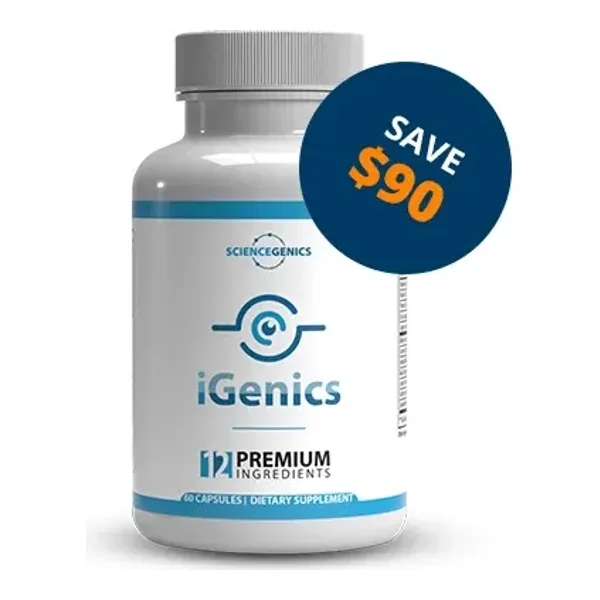
iGenics is a two-capsule eye support supplement from Science Genics. We lined up each ingredient and dose with the human trials on PubMed. The carotenoid dose is one of the better ones we have seen. A few other parts of the label and the sales page need a closer look.
Our verdict: 3.3 / 5
| Ingredient evidence | 3 | Lutein and zeaxanthin have placebo-controlled trials in healthy eyes; bilberry has one eye-fatigue trial; most other evidence comes from people with diagnosed eye conditions |
|---|---|---|
| Dosing vs. research | 3 | Lutein, zeaxanthin, bilberry, saffron, vitamin C and copper meet study amounts; vitamin E, zinc and ginkgo fall well short |
| Label transparency | 4 | Every dose disclosed; a vitamin E figure that looks like a unit error and a zinc line that names the wrong mineral form |
| Value and refund terms | 3 | $39 to $59 per bottle, one-time payment; refund window stated as 60 days in the terms and 180 days on the sales page |
Worth considering if you spend long hours on screens or driving, want a lutein and zeaxanthin supplement at the amounts used in visual performance trials, and like having bilberry and saffron in the same capsule.
Probably skip it if you are looking for the full AREDS vitamin and mineral amounts your eye doctor may have recommended, or if you expect sharper eyesight within a week. The research does not support that timeline.
Before anything else: book a dilated eye exam if you have not had one recently. Changes in vision after 50 have many causes, some need treatment, and a supplement cannot tell you which one you have. Sudden blurring, flashes, a curtain over part of your vision or eye pain need same-day care.
Smallest order $59, from $39 per bottle, 60-day refund policy from the seller
See the current iGenics packages, shipping and refund termsOpens the seller's page. It may start with a long video or letter; the packages and refund terms are usually further down. We may earn a commission.
Came here for iGenics? The highest-rated eyes label we checked is Vision 20, 3.6 out of 5.
What iGenics is
iGenics is a capsule supplement made for Science Genics, a company the label places in Dallas, Texas. It is sold through Digistore24 on the official website in 1, 3 and 6-bottle packages as a one-time purchase. Each bottle holds 60 capsules, and the serving is two capsules once a day, ideally 20 to 30 minutes before a meal.
The sales letter is long and built around a story. Its central idea is that a "chronic proinflammatory environment" (it calls this CPE) damages the eyes and that the formula lets them "rebuild" so people see more clearly, sometimes within seven days. We return to those claims below. The product itself is a fairly conventional eye formula: two carotenoids, three botanicals with eye research, turmeric with black pepper, and five vitamins and minerals.
What is on the label
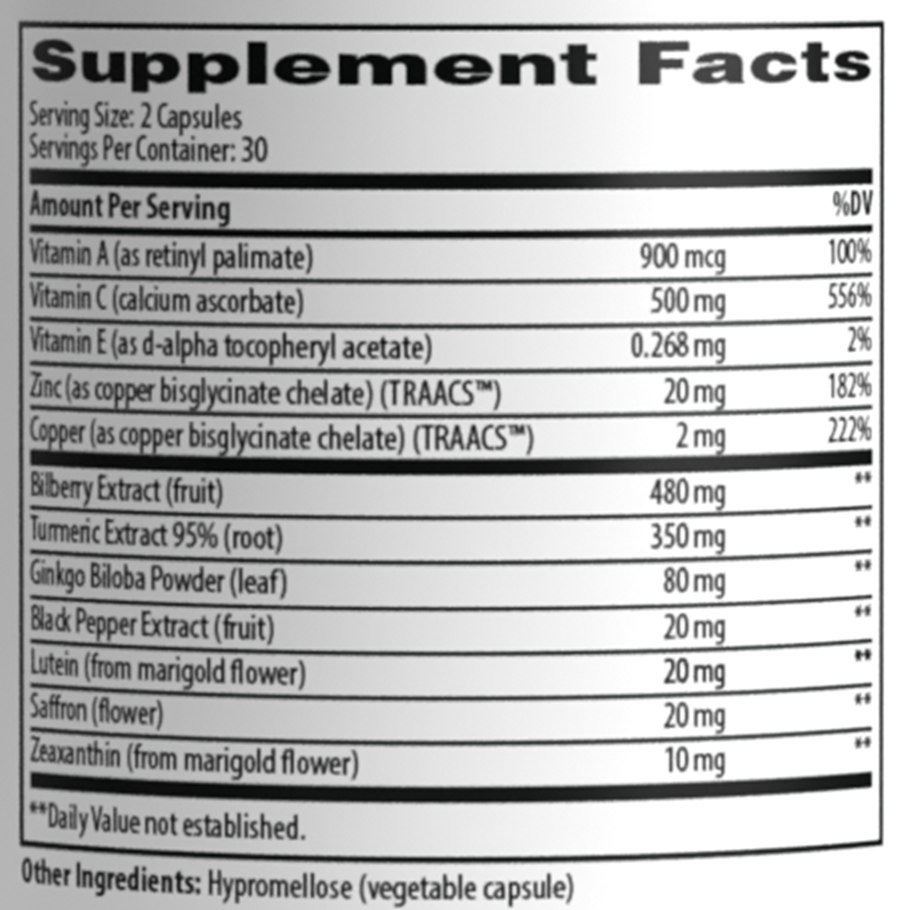
Every ingredient has its own dose, and the only other ingredient is the vegetable capsule. That is better than most products in this category, and better than the sales page itself suggests when it calls the formula a "proprietary blend." Two lines stand out. Vitamin E is listed at 0.268 mg, which is 2% of the Daily Value. And the zinc line names "copper bisglycinate chelate" as its form, which looks like a copy error from the copper line below it.
The formula next to the research
For each ingredient we looked for human trials on visual function or eye comfort and compared the amount studied with the amount in a daily serving of iGenics.
| Ingredient | iGenics per day | Amount in research | How it compares |
|---|---|---|---|
| Lutein | 20 mg | 10 mg/day [1] [2] [4] | Twice the trial amount |
| Zeaxanthin | 10 mg | 2 mg/day [1] [2] [4] | Five times the trial amount |
| Bilberry extract | 480 mg | 480 mg/day [7] | Same amount; anthocyanin content not stated |
| Saffron | 20 mg | 20 mg/day [9] [10] | Same amount; trials were in people with a diagnosed eye condition |
| Ginkgo biloba | 80 mg leaf powder | 120 to 160 mg/day of extract [11] [12] | Lower, and powder is a different material from extract |
| Vitamin C | 500 mg | 500 mg/day [5] | Same as AREDS |
| Vitamin E | 0.268 mg | 400 IU/day [5] | About a thousandth of AREDS as printed |
| Zinc | 20 mg | 80 mg/day [5] | A quarter of AREDS |
| Copper | 2 mg | 2 mg/day [5] | Same as AREDS |
| Vitamin A | 900 mcg (retinyl palmitate) | AREDS used 15 mg beta carotene [5] | A different ingredient |
| Turmeric extract, black pepper extract | 350 mg, 20 mg | No human vision trial found | Cannot be compared |
Lutein and zeaxanthin: the strongest part of the formula
Lutein and zeaxanthin are yellow plant pigments that collect in the center of the retina, where they form what researchers call macular pigment. This is where the best evidence for healthy eyes sits. In a one-year trial of 115 healthy young adults, 10 mg of lutein plus 2 mg of zeaxanthin a day raised macular pigment and improved recovery after a bright flash and color contrast compared with placebo, although glare disability did not change significantly [1]. In the CREST trial, 105 adults with healthy eyes and low macular pigment took a carotenoid formula (10 mg lutein, 2 mg zeaxanthin and 10 mg meso-zeaxanthin) or placebo for 12 months, and contrast sensitivity improved in the active group [2]. A smaller six-month trial in 48 young adults with at least six hours of daily screen time found better visual performance and fewer reports of eye strain and eye fatigue with 24 mg a day of the three carotenoids [3].
iGenics provides 20 mg of lutein and 10 mg of zeaxanthin, at or above those amounts. Two caveats apply. Most of these participants were younger than our readers, and the improvements were measured with lab instruments. They are real, modest changes, and they do not show that anyone will stop needing glasses.
About the "AREDS-2" label
The sales page says the vitamin and mineral amounts follow the National Eye Institute's AREDS studies. Some of them do. AREDS used 500 mg of vitamin C, 400 IU of vitamin E, 15 mg of beta carotene, 80 mg of zinc and 2 mg of copper in 3,640 people aged 55 to 80 [5]. AREDS2 later added 10 mg of lutein and 2 mg of zeaxanthin and found that removing beta carotene or lowering zinc made no apparent difference [4].
iGenics matches AREDS on vitamin C and copper and exceeds AREDS2 on lutein and zeaxanthin. Zinc is a quarter of the original amount. Vitamin E is the puzzle. Using the standard conversion for natural vitamin E, 400 IU works out to about 268 mg, so "0.268 mg" may be a unit slip on the label. As printed, though, it is about a thousandth of the AREDS dose, and the 2% Daily Value printed next to it agrees with the smaller number. We could not confirm which is right.
Context matters here too. The AREDS formulas were tested in people whose eye doctors had already found specific age-related changes in the retina. In people without those changes, a Cochrane review of five large trials with 76,756 participants found that vitamin E and beta carotene supplements did not lower the chance of developing them [6]. If your eye doctor has recommended an AREDS2 formula, iGenics is not a like-for-like substitute.
Bilberry: one relevant trial, at the same dose
The sales page describes a trial of 281 office workers. The paper itself says 281 workers were screened, 88 were enrolled and 80 completed it. They were 20 to 40 years old and took 480 mg a day of bilberry extract or placebo for eight weeks. After a screen-work session, the bilberry group showed less decline on one objective test of visual fatigue and reported less eye heaviness, discomfort and fatigue, while near focusing did not differ [7]. iGenics uses the same amount, but the label does not state the anthocyanin content, so we cannot tell whether the extract is comparable.
The story about pilots eating bilberry jam for night vision is popular. A systematic review of 12 placebo-controlled trials, mostly in healthy people, concluded that the evidence does not support bilberry improving normal night vision [8].
Saffron and ginkgo: research in a different group of people
Saffron at 20 mg a day, the iGenics amount, has been tested in two randomized trials. In both, the participants already had a diagnosed retinal condition. In the larger one (100 adults over 50), three months of saffron improved visual acuity by an average of 0.69 letters on an eye chart compared with placebo, a small change [9] [10]. We found no comparable trial in people with healthy eyes.
The ginkgo studies on the sales page also involved patients under specialist care for a diagnosed optic nerve condition. One small crossover trial used 120 mg a day of a ginkgo extract for four weeks [11]. The long-term study the page describes as showing continuing "visual improvements" was a retrospective review of 42 patients taking 160 mg of extract a day, and what it reported was a slower rate of decline [12]. iGenics contains 80 mg of ginkgo leaf powder, which is less than those amounts and is a different material from a concentrated extract.
Turmeric and black pepper
Turmeric extract (350 mg, 95% curcuminoids) and black pepper extract (20 mg) are there for inflammation and absorption, according to the sales page. We found no human trial of turmeric on vision or eye comfort in people with healthy eyes. The research the sales page cites for it is laboratory work. These two ingredients matter more for the safety section than for the benefit case.
What the marketing claims and what we could verify
The sales page says the eyes create "a brand-new set of eyes" about every seven days through DNA replication, that CPE stops this, and that iGenics can sharpen vision in as little as seven days. We searched PubMed and could not find a publication that supports a seven-day renewal of the eye or a supplement effect on vision within a week. The trials above ran from four weeks to more than six years, and the healthy-eye trials measured changes over months.
A few other statements did not match their sources or each other:
- It says "virtually every" lutein and zeaxanthin study used 10 mg of zeaxanthin. The AREDS2, Hammond and CREST trials all used 2 mg [4] [1] [2].
- One paragraph prices a single bottle at $69, while the price table and the Digistore24 order form show $59.
- The 3-bottle offer is labelled both "free shipping" and "+$9.99 shipping" in the same box.
- The refund promise appears as 180 days, as "180 days (2 full months)" and as a 60-day guarantee in the terms of use.
None of this changes what is in the bottle. It does mean we would rely on the label and the published research rather than on the sales letter.
Price, packages and refund policy
One bottle lasts 30 days. Prices on the official site when we checked:
- 6 bottles: $39 each ($234 total), free US shipping, two e-books and one bottle of the seller's Intelligen supplement included. About $1.30 a day.
- 3 bottles: $49 each ($147 total), plus shipping, two e-books included.
- 1 bottle: $59, plus $9.99 shipping.
Every package is a one-time payment. The order form also offers optional shipping insurance as an unticked add-on. On the refund window, the sales page and FAQ say 180 days with no need to return bottles, while the terms of use say 60 days. We list 60 days because it is the shorter written term. Keep your order email and ask Science Genics to confirm the window if you plan to use it. Because the healthy-eye carotenoid trials ran six to twelve months, a short trial run tells you little, so think about cost over several months.
iGenics packages on the official site
6 bottles, 180-day supply
$39/bottle
$234 total · Free US shipping
Lowest price per bottle
Includes 2 e-books and 1 bottle of the seller's Intelligen supplement
Check the 6-bottle price3 bottles, 90-day supply
$49/bottle
$147 total · +$9.99 US shipping
Includes 2 e-books
Check the 3-bottle priceButtons open the seller's iGenics website, where you choose your supply and complete the order. Prices as listed on the seller's site on October 23, 2026; the price shown at checkout is final.Orders are covered by a 60-day refund policy from the seller (see their terms). We may earn a commission.
Safety
In the trials above, lutein, zeaxanthin, bilberry and saffron were generally well tolerated, with adverse events similar to placebo [7] [10]. A few points deserve attention for men over 50:
- Blood thinners and ginkgo. A meta-analysis of 18 trials found no clinically relevant effect of standardized ginkgo extract on clotting tests [13]. Ginkgo is still a common caution with blood thinners and before surgery, so tell your doctor you take it.
- Turmeric and the liver. The US Drug-Induced Liver Injury Network described ten cases of liver injury linked to turmeric products, appearing one to four months after starting; three of the products tested also contained black pepper extract [15]. Stop and call your doctor if you notice dark urine, yellowing skin or eyes, or unusual fatigue.
- Black pepper extract and medications. In laboratory studies, piperine blocked CYP3A4 and P-glycoprotein, two systems the body uses to clear many prescription drugs [14]. If you take prescription medication, ask your pharmacist before adding this formula.
- Doubling up. iGenics contains 100% of the Daily Value for vitamin A and 20 mg of zinc. Count these if you also take a multivitamin or an eye vitamin.
Results vary from person to person. Talk to your doctor before starting iGenics, especially if you take medication, and see an eye doctor for any new or worsening vision symptoms. AREDS investigators themselves recommended dilated eye exams for people over 55 [5].
What we liked and what gave us pause
Liked
- Lutein and zeaxanthin at or above trial amounts
- Bilberry and saffron at their studied doses
- Every dose on the label; no fillers listed
- One-time purchase, no subscription
Gave us pause
- Vitamin E and zinc well below the AREDS amounts the page cites
- Ginkgo as a low-dose powder
- Seven-day and CPE claims we could not verify
- Refund window stated two different ways
- No published trial of the iGenics formula itself
Frequently asked questions
Where can I buy iGenics?
On the official website, through the Digistore24 checkout. The seller says it is not sold on Amazon or in stores, so third-party listings may not be genuine or covered by the refund policy.
How long before I notice anything?
Results vary. The healthy-eye carotenoid trials measured changes after six to twelve months, and the bilberry trial ran eight weeks. Judging any eye supplement after a week is too early.
Can iGenics replace my glasses or my eye doctor's advice?
No. It is a dietary supplement. Keep your regular eye exams, and do not swap a formula your eye doctor recommended without asking them first.
Is it a subscription?
No. Each package is a one-time payment.
Want to look at the seller's page yourself? The link below opens the iGenics website, where you can read their full presentation and choose a package.
Visit the iGenics websiteHow we reviewed iGenics
We read the iGenics sales page, the terms of use, the Digistore24 order forms and the Supplement Facts label from the seller's affiliate resources. We then searched PubMed for human trials of each ingredient on visual function and eye comfort and compared the studied amounts with the label. We did not test the product on people, and nobody at Stark Verve is a medical professional. Read our editorial policy to learn how we choose and update reviews. Stark Verve earns a commission if you buy through our links; that never changes what we write about the evidence.
References
- Hammond BR, Fletcher LM, Roos F, Wittwer J, Schalch W. A double-blind, placebo-controlled study on the effects of lutein and zeaxanthin on photostress recovery, glare disability, and chromatic contrast. Invest Ophthalmol Vis Sci. 2014;55(12):8583-9. PMID 25468896
- Nolan JM, et al. Enrichment of macular pigment enhances contrast sensitivity in subjects free of retinal disease: Central Retinal Enrichment Supplementation Trials, Report 1. Invest Ophthalmol Vis Sci. 2016;57(7):3429-39. PMID 27367585
- Stringham JM, Stringham NT, O'Brien KJ. Macular carotenoid supplementation improves visual performance, sleep quality, and adverse physical symptoms in those with high screen time exposure. Foods. 2017;6(7):47. PMID 28661438
- Age-Related Eye Disease Study 2 Research Group. Lutein + zeaxanthin and omega-3 fatty acids for age-related macular degeneration: the AREDS2 randomized clinical trial. JAMA. 2013;309(19):2005-15. PMID 23644932
- Age-Related Eye Disease Study Research Group. A randomized, placebo-controlled, clinical trial of high-dose supplementation with vitamins C and E, beta carotene, and zinc for age-related macular degeneration and vision loss: AREDS report no. 8. Arch Ophthalmol. 2001;119(10):1417-36. PMID 11594942
- Evans JR, Lawrenson JG. Antioxidant vitamin and mineral supplements for preventing age-related macular degeneration. Cochrane Database Syst Rev. 2017;7:CD000253. PMID 28756617
- Ozawa Y, et al. Bilberry extract supplementation for preventing eye fatigue in video display terminal workers. J Nutr Health Aging. 2015;19(5):548-54. PMID 25923485
- Canter PH, Ernst E. Anthocyanosides of Vaccinium myrtillus (bilberry) for night vision: a systematic review of placebo-controlled trials. Surv Ophthalmol. 2004;49(1):38-50. PMID 14711439
- Falsini B, et al. Influence of saffron supplementation on retinal flicker sensitivity in early age-related macular degeneration. Invest Ophthalmol Vis Sci. 2010;51(12):6118-24. PMID 20688744
- Broadhead GK, et al. Saffron therapy for the treatment of mild/moderate age-related macular degeneration: a randomised clinical trial. Graefes Arch Clin Exp Ophthalmol. 2019;257(1):31-40. PMID 30343354
- Quaranta L, et al. Effect of Ginkgo biloba extract on preexisting visual field damage in normal tension glaucoma. Ophthalmology. 2003;110(2):359-62. PMID 12578781
- Lee J, Sohn SW, Kee C. Effect of Ginkgo biloba extract on visual field progression in normal tension glaucoma. J Glaucoma. 2013;22(9):780-4. PMID 22595937
- Kellermann AJ, Kloft C. Is there a risk of bleeding associated with standardized Ginkgo biloba extract therapy? A systematic review and meta-analysis. Pharmacotherapy. 2011;31(5):490-502. PMID 21923430
- Bhardwaj RK, et al. Piperine, a major constituent of black pepper, inhibits human P-glycoprotein and CYP3A4. J Pharmacol Exp Ther. 2002;302(2):645-50. PMID 12130727
- Halegoua-DeMarzio D, et al. Liver injury associated with turmeric, a growing problem: ten cases from the Drug-Induced Liver Injury Network (DILIN). Am J Med. 2023;136(2):200-206. PMID 36252717