
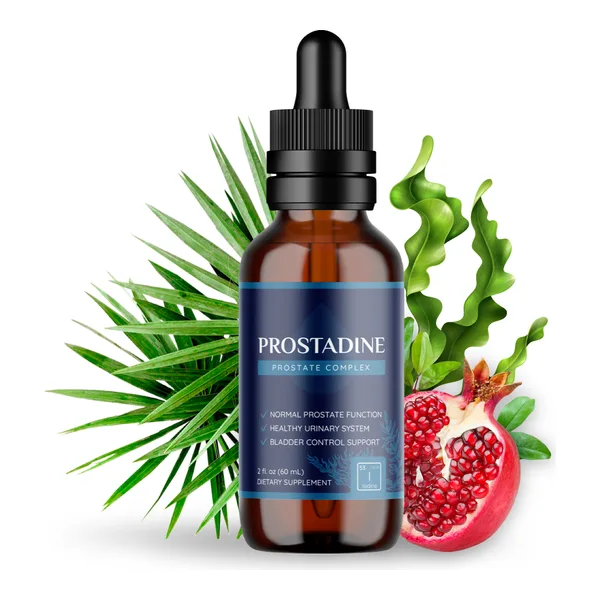
Review · Urinary health
Prostadine review: what the research says about the formula and the hard water story
Prostadine is a liquid prostate formula sold through Digistore24. Its sales page blames minerals in tap water for prostate trouble. We looked for that research, checked each ingredient on PubMed, and tried to find out how much of each one is in a serving.
Our verdict: 1.6 / 5
| Ingredient evidence | 1.5 | Saw palmetto has high-certainty evidence of little to no benefit; one new trial on a seaweed extract; the rest untested for urinary symptoms |
|---|---|---|
| Dosing vs. research | 1 | No doses are published, so nothing can be compared with the trials |
| Label transparency | 1 | No Supplement Facts panel on the sales page; iodine amount not stated |
| Value and refund terms | 3 | $49 to $79 per bottle; 60-day refund policy, all bottles must be returned at your cost |
Worth considering if you prefer a liquid you can stir into coffee or juice, you have no thyroid condition, your doctor is comfortable with a product that contains several iodine sources, and you accept that you are buying a formula whose doses are not published.
Probably skip it if you want to know exactly what you are taking, you take thyroid medication, or the hard water explanation is what convinced you. We could not find a study behind it.
Before anything else: new or changing urinary symptoms deserve a conversation with your doctor. They can have several causes, and some need medical care.
Smallest order $158, from $49 per bottle, 60-day refund policy from the seller
See the current Prostadine packages, shipping and refund termsOpens the seller's page. It may start with a long video or letter; the packages and refund terms are usually further down. We may earn a commission.
Came here for Prostadine? The highest-rated prostate and urinary label we checked is TitanFlow, 3.6 out of 5.
What Prostadine is
Prostadine comes in a 60 mL dropper bottle. The suggested serving is two full droppers (2 mL) a day, taken by mouth or mixed into a drink, so one bottle lasts about 30 days. Orders are processed by Digistore24. The website does not name the company behind the product; the refund page lists a returns address in Tallmadge, Ohio.
The sales page names nine ingredients: nori, wakame, kelp, bladderwrack, saw palmetto, pomegranate extract, iodine, shilajit and neem. Four of them are seaweeds, and seaweeds are themselves sources of iodine, so iodine shows up in the formula several times over.
The label we could not find
For every review we transcribe the Supplement Facts panel and compare each dose with the trials. For Prostadine we could not do that. The sales page, its help pages and the product images we checked show the ingredient names and short benefit phrases, but no Supplement Facts panel, no amount per serving and no extract ratios.
This matters more than usual here. A 2 mL daily serving is a small volume, and the formula contains iodine from at least five sources. Without the numbers, nobody outside the company can say whether any ingredient is present at an amount that was ever studied, or how much iodine a daily serving delivers. We scored label transparency accordingly.
The formula next to the research
Since doses are missing, the table compares what is known about each ingredient with what Prostadine discloses.
| Ingredient | Prostadine per day | What the research used | Human evidence for urinary symptoms |
|---|---|---|---|
| Saw palmetto | Not disclosed | 320 to 960 mg/day of extract [1] [2] | Strong evidence of little to no benefit [3] |
| Wakame (fucoidan) | Not disclosed ("extract") | 1,000 mg/day of purified fucoidan [4] | One 90-day trial, 95 men, positive on symptom scores |
| Pomegranate | Not disclosed | 8 oz of juice a day [6] | None found; trials looked at other outcomes |
| Shilajit | Not disclosed | 250 mg twice a day [8] | One small 1997 report, no placebo group described [9] |
| Iodine | Not disclosed | Not applicable | None found |
| Kelp, bladderwrack, nori | Not disclosed | Not applicable | None found |
| Neem | Not disclosed | Not applicable | None found |
Saw palmetto: the best-studied ingredient, and the results are flat
Saw palmetto is the most tested plant for men's urinary symptoms. In a one-year trial of 225 men over 49 with moderate to severe symptoms, 320 mg a day did no better than placebo on symptom scores, urine flow or prostate size [1]. The CAMUS trial raised the dose to three times the standard amount over 72 weeks in 369 men, and saw palmetto still did no better than placebo on any outcome [2]. The 2023 Cochrane review pooled 27 studies with 4,656 men and concluded, with high certainty, that saw palmetto alone provides little to no benefit for urinary symptoms [3]. The Prostadine sales page itself lists the 2006 trial among its references.
Wakame: the one ingredient with a fresh, positive trial
Wakame (Undaria pinnatifida) is the source of fucoidan, a seaweed compound. A randomized, placebo-controlled trial published in 2026 gave 95 men aged 45 to 80 with moderate prostate enlargement either 1,000 mg a day of a purified wakame fucoidan or placebo for 90 days. Symptom scores fell by 3.4 points with fucoidan versus 0.9 points with placebo, and urinary quality of life improved. Urine flow, leftover urine volume and PSA did not differ between groups [4].
Two caveats: it is a single study planned with employees of the company that makes the extract, and it tested a purified extract at a known dose. Prostadine lists "wakame extract" in a 2 mL liquid serving without saying how much, or how much fucoidan it holds, so the trial tells us little about this product.
Pomegranate: research on other questions
The pomegranate studies cited on the sales page did not measure urinary symptoms. One was an uncontrolled phase II study of 8 ounces of pomegranate juice a day in men whose PSA was rising after prostate cancer treatment; it tracked how fast PSA climbed [6]. Another was a four-week crossover pilot on erectile function in 53 men, which did not reach statistical significance [7]. A review by the same research group describes the evidence for pomegranate in prostate enlargement as mainly laboratory and animal work [5]. None of this supports a claim about urine flow, and neither study used a dropper extract.
Shilajit: studied for testosterone
Shilajit is a mineral-rich resin used in Ayurvedic practice. In a 90-day placebo-controlled trial, healthy men aged 45 to 55 taking 250 mg twice a day had higher total and free testosterone than the placebo group [8]. The only prostate-related human report we found was a 1997 Ukrainian study of 38 men on a shilajit preparation for six months; its abstract describes no control group [9].
Kelp, bladderwrack, nori, neem and iodine
We searched PubMed for human trials of kelp, bladderwrack, nori, iodine or neem on urinary symptoms in men and found none. The sources the sales page offers for these ingredients are mostly laboratory reviews of seaweed compounds, studies of iodine used as a disinfectant in bladder irrigation, cell studies and consumer health articles.
About the "toxic minerals in water" claim
The core story on the Prostadine sales page is that a recent Harvard study found minerals in hard tap water building up inside the prostate and urinary system, the way scale builds up in pipes, and that this buildup enlarges the prostate. The formula is presented as a way to flush those minerals out.
We could not verify any part of this. The sales page does not name the Harvard study or link to it, and none of the roughly 30 sources on its own reference list is a study of hard water and the prostate. We searched PubMed for water hardness, hard water and drinking water minerals together with prostate enlargement and urinary symptoms and found no study connecting them. Here is the closest research we did find:
- A UK Biobank analysis of nearly 448,000 adults followed for about 13 years linked water hardness, measured as calcium carbonate concentration, to the risk of several cancers. The overall pattern was U-shaped: people with hard water had a lower overall cancer risk than people with soft water, and only very hard water was linked to a slightly higher one [13]. It is observational, it did not look at prostate size or urinary symptoms, and it cannot show cause and effect.
- A small crossover study in 18 people with a history of kidney stones found that drinking hard bottled water raised urinary calcium compared with soft water [14]. It measured kidney stone risk factors only.
We also found no study showing that seaweed, iodine or any other Prostadine ingredient removes minerals from the prostate. One PubMed link on the sales page goes to a 1984 paper about parasites in the bile duct [15], which has no connection to water minerals or the prostate. Our conclusion: the hard water mechanism is a marketing explanation that we could not trace to a publication, and we gave it no weight in our score.
The iodine question
This is the part of the formula we would most want a doctor to weigh in on. Seaweeds vary enormously in iodine. In one analysis of commercial seaweeds, content ranged from about 16 micrograms per gram in nori to more than 8,000 micrograms per gram in a kelp product, and the authors noted the adult tolerable upper intake level of 1,100 micrograms a day [10]. A Norwegian survey of 96 seaweed products found that seaweed supplements delivered anywhere from 5 to 5,600 micrograms of iodine per daily dose, that a single portion of 54 products would exceed the upper limit, and that labels were often inadequate or inaccurate [11]. Doctors have also described a 70-year-old woman with no prior thyroid disease who developed temporary thyroid overactivity after taking kelp tablets [12].
Prostadine combines kelp, bladderwrack, wakame, nori and added iodine, and does not say how much iodine a serving contains. A small 2 mL serving may well be modest, but we cannot confirm that. If you have a thyroid condition, take thyroid medication, or already use a multivitamin or other iodine source, ask your doctor before trying it.
Other marketing claims we noticed
The sales page also says Prostadine is made in an "FDA-approved facility." The FDA does not approve facilities that make dietary supplements; it registers and inspects them. Its customer and review counts could not be checked, and we do not use customer stories to judge a product.
Price, packages and refund policy
One bottle lasts 30 days. The packages on the official site when we checked:
- 6 bottles: $49 each ($294 total), free US shipping, two digital guides included. About $1.63 a day.
- 3 bottles: $69 each ($207 total), free US shipping.
- 2 bottles: $79 each ($158 total), plus $9.99 shipping.
Each purchase is a one-time payment. The refund policy gives you 60 days, but the terms are stricter than many in this category: you must send back all bottles, opened or not, and return shipping is at your expense. The refund page counts the 60 days from your order in one paragraph and from delivery in another, so we would plan around the shorter reading. Since the only positive trial on a Prostadine ingredient ran 90 days, a full test of the product would extend past the refund window.
Prostadine packages on the official site
6 bottles, 180-day supply
$49/bottle
$294 total · Free US shipping
Lowest price per bottle
Includes 2 digital guides
Check the 6-bottle priceButtons open the seller's Prostadine website, where you choose your supply and complete the order. Prices as listed on the seller's site on October 23, 2026; the price shown at checkout is final.Orders are covered by a 60-day refund policy from the seller (see their terms). We may earn a commission.
Safety
In the trials above, saw palmetto had side effects similar to placebo [1] [3], and the wakame fucoidan was well tolerated [4]. The open question is iodine, discussed above. Talk to your doctor before starting Prostadine if you take any prescription medication, especially thyroid medication or blood thinners, and seek medical care if your urinary symptoms are new, getting worse, or come with pain, blood or fever.
What we liked and what gave us pause
Liked
- Wakame, whose fucoidan extract beat placebo on symptom scores in a 2026 trial
- Liquid format for people who dislike capsules
- One-time purchase, no subscription
- Ingredient names listed openly
Gave us pause
- No Supplement Facts panel and no doses on the sales page
- Several iodine sources with no stated iodine amount
- Hard water mechanism not traceable to any study
- Saw palmetto, which high-certainty evidence finds of little to no benefit
- Refund requires returning every bottle at your own shipping cost
Frequently asked questions
Where can I buy Prostadine?
On the official website, with orders processed by Digistore24. The seller's affiliate rules bar promotion on Amazon, eBay and similar marketplaces, so listings there may not be genuine or covered by the refund policy.
How long before I notice anything?
Results vary from person to person. The one positive trial on a Prostadine ingredient saw a difference from placebo at 60 days, and the saw palmetto trials ran up to 72 weeks without finding one. A week or two is too early to judge any product in this category.
Does Prostadine replace medication from my doctor?
No. Prostadine is a dietary supplement. Do not stop or change a prescription without talking to your doctor.
Does filtering my water matter for my prostate?
We found no published research showing that hard water causes prostate enlargement or urinary symptoms, or that softening or filtering water changes them. If you have questions about your water, your local utility publishes its quality reports.
Is it a subscription?
No. According to the sales page, every package is a one-time payment.
Want to look at the official page yourself? The link below opens the Prostadine website, where you can read their full presentation and choose a package.
Visit the official Prostadine websiteHow we reviewed Prostadine
We read the official sales page, its refund, shipping and reference pages, and looked for a Supplement Facts panel, which we did not find. We searched PubMed for human trials of each ingredient on urinary symptoms in men, opened every study cited here, and searched separately for any research behind the hard water claim. We did not test the product on people, and nobody at Stark Verve is a medical professional. Read our editorial policy to learn how we choose and update reviews. Stark Verve earns a commission if you buy through our links; that never changes what we write about the evidence.
References
- Bent S, et al. Saw palmetto for benign prostatic hyperplasia. N Engl J Med. 2006;354(6):557-66. PMID 16467543
- Barry MJ, et al. Effect of increasing doses of saw palmetto extract on lower urinary tract symptoms: a randomized trial. JAMA. 2011;306(12):1344-51. PMID 21954478
- Franco JV, et al. Serenoa repens for the treatment of lower urinary tract symptoms due to benign prostatic enlargement. Cochrane Database Syst Rev. 2023;6:CD001423. PMID 37345871
- Wimmer BC, et al. Fucoidan from Undaria pinnatifida improves benign prostatic hyperplasia symptoms in men: a randomized, double-blind, placebo-controlled study. Res Rep Urol. 2026;18:597883. PMID 42488927
- Kroeger N, Belldegrun AS, Pantuck AJ. Pomegranate extracts in the management of men's urologic health: scientific rationale and preclinical and clinical data. Evid Based Complement Alternat Med. 2013;2013:701434. PMID 23589721
- Pantuck AJ, et al. Phase II study of pomegranate juice for men with rising prostate-specific antigen following surgery or radiation for prostate cancer. Clin Cancer Res. 2006;12(13):4018-26. PMID 16818701
- Forest CP, Padma-Nathan H, Liker HR. Efficacy and safety of pomegranate juice on improvement of erectile dysfunction in male patients with mild to moderate erectile dysfunction: a randomized, placebo-controlled, double-blind, crossover study. Int J Impot Res. 2007;19(6):564-7. PMID 17568759
- Pandit S, et al. Clinical evaluation of purified Shilajit on testosterone levels in healthy volunteers. Andrologia. 2016;48(5):570-5. PMID 26395129
- Andriukhova NN. The treatment of benign prostatic hyperplasia using the Mumie-Vitas preparation [in Russian]. Lik Sprava. 1997;(6):129-32. PMID 9589956
- Teas J, et al. Variability of iodine content in common commercially available edible seaweeds. Thyroid. 2004;14(10):836-41. PMID 15588380
- Aakre I, et al. Commercially available kelp and seaweed products: valuable iodine source or risk of excess intake? Food Nutr Res. 2021;65. PMID 33889064
- Gherbon A, et al. Transient hyperthyroidism following the ingestion of complementary medications containing kelp seaweed: a case report. Medicine (Baltimore). 2019;98(37):e17058. PMID 31517826
- Yang H, et al. Association of domestic water hardness with all-cause and cause-specific cancers: evidence from 447,996 UK Biobank participants. Environ Health Perspect. 2024;132(6):67008. PMID 38889166
- Bellizzi V, et al. Effects of water hardness on urinary risk factors for kidney stones in patients with idiopathic nephrolithiasis. Nephron. 1999;81 Suppl 1:66-70. PMID 9873217
- Choi TK, et al. Severe acute pancreatitis caused by parasites in the common bile duct. J Trop Med Hyg. 1984;87(5):211-4. PMID 6530710