
Review · Urinary health
TitanFlow review: what the research says about every ingredient
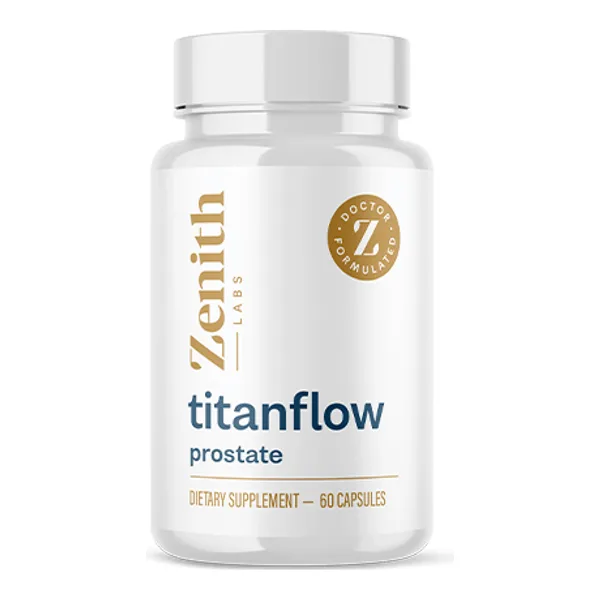
TitanFlow is a men's urinary support supplement from Zenith Labs. We compared each ingredient and dose with the published trials. Some of it holds up well. Some of it does not.
Our verdict: 3.6 / 5
| Ingredient evidence | 3 | Two ingredients with supportive Cochrane reviews; the rest weak or untested for urinary symptoms |
|---|---|---|
| Dosing vs. research | 2.5 | Pygeum matches study doses; beta-sitosterol and lycopene fall well short |
| Label transparency | 4.5 | Every ingredient and dose disclosed; no proprietary blend |
| Value and refund terms | 4.5 | $39 to $69 per month; 180-day refund policy |
Worth considering if you have already tried saw palmetto, want a formula built around pygeum, and like the idea of testing it for a few months with a long refund window behind you.
Probably skip it if you want an ingredient list that matches the trial doses across the board, or if you are expecting the "urethra strength" effect described on the sales page. We could not find research behind that claim.
Before anything else: new or changing urinary symptoms deserve a conversation with your doctor. They can have several causes, and some need medical care.
Smallest order $69, from $39 per bottle, 180-day refund policy from the seller
See the current TitanFlow packages, shipping and refund termsOpens the seller's page. It may start with a long video or letter; the packages and refund terms are usually further down. We may earn a commission.
What TitanFlow is
TitanFlow is a capsule supplement sold by Zenith Labs, a Colorado company, through ClickBank. The daily serving is two capsules. It is sold only on the official website in 1, 3 and 6-bottle packages, as a one-time purchase with no subscription.
The sales page presents it as a way to "support healthy urinary flow" in men over forty. Its central idea is that weak urethra walls, more than the prostate itself, explain a slow or interrupted stream. We come back to that claim below.
The formula next to the research
This is the core of our review. For each ingredient we found the human trials on urinary symptoms in men and compared the amount used there with the amount in a daily serving of TitanFlow.
| Ingredient | TitanFlow per day | Amount in trials | How it compares |
|---|---|---|---|
| Pygeum bark extract | 100 mg (4:1 extract) | 100 mg/day [5] | Same amount; different extract type |
| Beta-sitosterol | 30 mg ("complex") | 60 to 130 mg/day [7] [8] | Half to a quarter of trial doses |
| Pumpkin seed oil | 500 mg | 320 to 720 mg/day of oil [2] [3] | Within range, but results vs. placebo were not significant |
| Lycopene | about 1.9 mg (37.5 mg of a 5% extract) | 15 to 25 mg/day [9] | Roughly 8 to 13 times lower |
| Broccoli sprout extract | 50 mg (sulforaphane not stated) | No urinary-symptom trial found | Cannot be compared |
Pygeum: the strongest ingredient in the formula
Pygeum is a bark extract from an African cherry tree. A Cochrane review pooled 18 randomized trials with 1,562 men and found that pygeum users were about twice as likely to report overall symptom improvement as men on placebo, with 19% less nighttime urination and 23% better peak urine flow on average [4]. In a 263-man trial, 100 mg a day for 60 days improved urination measures in 66% of men versus 31% on placebo [5].
The caveats: most trials were small and short (about two months on average), and they used a standardized extract. TitanFlow lists a 4:1 extract, and we cannot tell from the label whether it is equivalent.
Beta-sitosterol: good evidence, low dose
Beta-sitosterol is a plant sterol. Its Cochrane review of four placebo-controlled trials (519 men) found about 3.9 mL/s better peak flow than placebo across all four, and a 4.9-point better symptom score in the two trials that used the standard scale [6]. Those trials used 60 mg [7] and 130 mg a day [8]. TitanFlow provides 30 mg of a "beta-sitosterol complex" without stating its purity, so the dose is at best half of what was studied.
Pumpkin seed oil: popular, but the capsule results are mixed
Pumpkin seeds have a long history in men's health, and the research is the most surprising part of this review. In the largest trial, GRANU (1,431 men, 12 months), a capsule pumpkin seed extract did no better than placebo. Only the group eating 10 grams of whole seeds a day showed a modest edge [1]. A smaller trial of 320 mg a day of pumpkin seed oil found that men's symptoms improved over a year, but the improvement was not statistically different from placebo [2]. A third trial compared the oil with a prescription drug, without a placebo group, and the drug did better [3].
Lycopene and broccoli sprouts: supporting players
Lycopene, the red pigment in tomatoes, was studied at 15 mg a day in one small six-month trial with favorable results [9], but a systematic review concluded the evidence is too limited to support or refute it [10]. TitanFlow's amount is far below the trial dose. For broccoli sprout extract we found no human trial on urinary symptoms; the closest trial looked at prostate tissue markers and measured no urinary outcomes [11].
What TitanFlow leaves out, and why that may be a plus
Most prostate formulas are built around saw palmetto. TitanFlow does not contain it. That is a reasonable choice: two large, well-run trials found saw palmetto no better than placebo, even at triple the usual dose [12] [13], and the 2023 Cochrane review of 27 trials concluded it provides little to no benefit for urinary symptoms [14]. If you have tried a saw palmetto product without noticing much, the research suggests that was not bad luck.
About the "urethra strength" claim
The TitanFlow sales page says research shows that weak urethra walls drive flow problems and that the formula helps strengthen them. Some third-party articles attribute this to Johns Hopkins and cite a "20%" flow improvement from pumpkin seed oil.
We searched PubMed and could not find a published study linking pumpkin seed oil or any TitanFlow ingredient to urethra wall strength. The verified pumpkin seed oil trial on flow found a 15% improvement from baseline that was not significant against placebo [2], and the 23% peak-flow figure in the literature belongs to pygeum [4]. We are not saying the idea is wrong. We are saying we could not verify it, so we do not rely on it in this review.
Price, packages and refund policy
One bottle lasts 30 days. Prices on the official site when we checked:
- 6 bottles: $39 each ($234 total), free US shipping, two digital guides included. About $1.30 a day.
- 3 bottles: $59 each ($177 total), plus shipping, two digital guides included.
- 1 bottle: $69, plus shipping.
Every package is covered by a 180-day refund policy, which Zenith Labs says applies even to empty bottles. Because most of the ingredient trials ran two to twelve months, a 90-day supply is the shortest test that resembles the research, and the long refund window makes that test lower-risk.
TitanFlow packages on the official site
6 bottles, 180-day supply
$39/bottle
$234 total · Free US shipping
Lowest price per bottle
Includes 2 digital guides from Zenith Labs
Check the 6-bottle price3 bottles, 90-day supply
$59/bottle
$177 total · +$9.95 US shipping
Includes 2 digital guides from Zenith Labs
Check the 3-bottle priceButtons open the seller's TitanFlow website, where you choose your supply and complete the order. Prices as listed on the seller's site on October 23, 2026; the price shown at checkout is final.Orders are covered by a 180-day refund policy from the seller (see their terms). We may earn a commission.
Safety
In the trials above, the ingredients were generally well tolerated, with side effects similar to placebo. Pygeum can occasionally cause mild stomach upset [4]. The NIH's complementary health center notes there is limited safety data on lycopene supplements. Talk to your doctor before starting TitanFlow if you take blood thinners or any prescription medication, and especially if your urinary symptoms are new, getting worse, or come with pain, blood or fever.
What we liked and what gave us pause
Liked
- Built around pygeum, the ingredient with the most supportive review, at the trial amount
- No saw palmetto
- Every dose disclosed; no proprietary blend
- 180-day refund policy and no subscription
Gave us pause
- Beta-sitosterol and lycopene well below trial doses
- Pumpkin seed oil capsules have not beaten placebo
- Marketing claim about urethra strength we could not verify
- No published trial of the full formula
Frequently asked questions
Where can I buy TitanFlow?
Only on the official Zenith Labs website. It is not sold in stores, and Zenith Labs does not authorize sales on Amazon or eBay, so third-party listings may not be genuine or covered by the refund policy.
How long before I notice anything?
Results vary from person to person. The trials of these ingredients lasted from two months to a year, so judging any supplement in this category after a week or two is too early.
Does TitanFlow replace medication from my doctor?
No. TitanFlow is a dietary supplement. Do not stop or change a prescription without talking to your doctor.
Is it a subscription?
No. According to Zenith Labs, every package is a one-time payment.
Want to look at the official page yourself? The link below opens the TitanFlow website, where you can read their full presentation and choose a package.
Visit the official TitanFlow websiteHow we reviewed TitanFlow
We read the official sales page and Supplement Facts label, searched PubMed for human trials of each ingredient on urinary symptoms in men, and compared the amounts used in those trials with the label. We did not test the product on people, and nobody at Stark Verve is a medical professional. Read our editorial policy to learn how we choose and update reviews. Stark Verve earns a commission if you buy through our links; that never changes what we write about the evidence.
References
- Vahlensieck W, et al. Effects of pumpkin seed in men with lower urinary tract symptoms due to benign prostatic hyperplasia in the one-year, randomized, placebo-controlled GRANU study. Urol Int. 2015;94(3):286-95. PMID 25196580
- Hong H, Kim CS, Maeng S. Effects of pumpkin seed oil and saw palmetto oil in Korean men with symptomatic benign prostatic hyperplasia. Nutr Res Pract. 2009;3(4):323-7. PMID 20098586
- Zerafatjou N, et al. Pumpkin seed oil (Cucurbita pepo) versus tamsulosin for benign prostatic hyperplasia symptom relief: a single-blind randomized clinical trial. BMC Urol. 2021;21:147. PMID 34666728
- Wilt T, et al. Pygeum africanum for benign prostatic hyperplasia. Cochrane Database Syst Rev. 2002;(1):CD001044. PMID 11869585
- Barlet A, et al. Efficacy of Pygeum africanum extract in the medical therapy of urination disorders due to benign prostatic hyperplasia. Wien Klin Wochenschr. 1990;102(22):667-73. PMID 1702916
- Wilt T, et al. Beta-sitosterols for benign prostatic hyperplasia. Cochrane Database Syst Rev. 2000;(2):CD001043. PMID 10796740
- Berges RR, et al. Randomised, placebo-controlled, double-blind clinical trial of beta-sitosterol in patients with benign prostatic hyperplasia. Lancet. 1995;345:1529-32. PMID 7540705
- Klippel KF, et al. A multicentric, placebo-controlled, double-blind clinical trial of beta-sitosterol (phytosterol) for the treatment of benign prostatic hyperplasia. Br J Urol. 1997;80(3):427-32. PMID 9313662
- Schwarz S, et al. Lycopene inhibits disease progression in patients with benign prostate hyperplasia. J Nutr. 2008;138(1):49-53. PMID 18156403
- Ilic D, Misso M. Lycopene for the prevention and treatment of benign prostatic hyperplasia and prostate cancer: a systematic review. Maturitas. 2012;72(4):269-76. PMID 22633187
- Zhang Z, et al. Sulforaphane for the chemoprevention of prostate cancer: a randomized, double-blind, placebo-controlled trial of broccoli sprout extract. Nutr Cancer. 2020;72(1):74-87. PMID 31155953
- Bent S, et al. Saw palmetto for benign prostatic hyperplasia. N Engl J Med. 2006;354(6):557-66. PMID 16467543
- Barry MJ, et al. Effect of increasing doses of saw palmetto extract on lower urinary tract symptoms: a randomized trial. JAMA. 2011;306(12):1344-51. PMID 21954478
- Franco JV, et al. Serenoa repens for the treatment of lower urinary tract symptoms due to benign prostatic enlargement. Cochrane Database Syst Rev. 2023;6:CD001423. PMID 37345871