
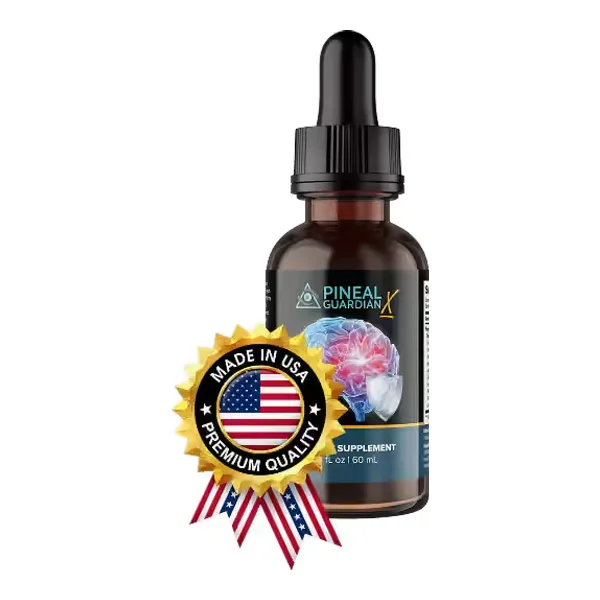
Review · Brain health
Pineal Guardian X review: the fluoride story next to the research
Pineal Guardian X is a liquid dropper formula marketed for memory and focus. Its sales pitch says fluoride clogs the pineal gland and that nine plant ingredients flush it out. We traced that story and every named ingredient to PubMed. A few ingredients have real, if small, memory studies behind them. The story itself mostly does not.
Our verdict: 1.8 / 5
| Ingredient evidence | 2 | Lion's mane, bacopa, spirulina and pine bark have small human memory trials; ginkgo failed in the largest trial; four ingredients have no human memory trial we could find |
|---|---|---|
| Dosing vs. research | 1 | No amounts published, so no ingredient can be compared with a study dose |
| Label transparency | 1 | No Supplement Facts panel on the sales page or the text version; even the serving is stated two ways |
| Value and refund terms | 3 | $39 to $69 per bottle and a 365-day refund promise, but the returns page has stricter wording |
Worth considering if you want to try lion's mane and bacopa in a liquid you take under the tongue, you are comfortable not knowing the amounts, and you plan to use the long refund window if you notice nothing.
Probably skip it if you want to see the dose of each ingredient before you buy, or if the fluoride and pineal gland explanation is the reason you were interested. We could not verify the studies the sales video describes.
Before anything else: memory changes in your fifties and sixties can have many causes, from sleep and medications to thyroid and vitamin B12 levels. New or worsening forgetfulness deserves a visit to your doctor, and a supplement should never delay that.
Smallest order $69, from $39 per bottle, 365-day refund policy from the seller
See the current Pineal Guardian X packages, shipping and refund termsOpens the seller's page. It may start with a long video or letter; the packages and refund terms are usually further down. We may earn a commission.
Came here for Pineal Guardian X? The highest-rated memory and focus label we checked is Synaptigen, 2.4 out of 5.
What Pineal Guardian X is
Pineal Guardian X is a liquid supplement sold through ClickBank at thepinealguardian.com. The site's shipping and returns page names Nutraville, with a return address in Tallmadge, Ohio. According to the sales video transcript, you place one full dropper under the tongue twice a day. The same transcript also says "just two drops" a day, which is a very different amount, and the site never settles which one is right.
The pitch runs like this: the pineal gland makes melatonin, melatonin protects the brain, fluoride from tap water and toothpaste builds up in the gland, and the formula "flushes" that fluoride so melatonin production returns. The video is narrated by a husband describing his wife's memory problems and a doctor called Dr. Harrison. We could not identify Dr. Harrison, and the site gives no full name, credentials or institution.
Where is the label?
We searched the main sales page, the text version of the video, and the site's policy pages. None shows a Supplement Facts panel. The sales page names nine ingredients with marketing descriptions, and that is all. We do not know the amount of any ingredient, the extract type, the liquid base, or how many milliliters a bottle holds.
That matters more than usual here. The research below used specific amounts, often grams per day. Without a label, every comparison has a blank in the middle, so we scored label transparency and dosing at 1 out of 5. If the seller publishes a full label, we will update this review. We also do not reproduce the seller's label image.
The formula next to the research
For each named ingredient we looked for human trials on memory or thinking in adults, and noted the amount used. The middle column is empty for a reason.
| Ingredient | Pineal Guardian X per day | Amount in human trials | What we found |
|---|---|---|---|
| Lion's mane (Yamabushitake) | Not disclosed | 3 g/day of dried mushroom powder [6] | Small positive trials in older adults |
| Bacopa monnieri | Not disclosed | 300 mg/day standardized extract [11] | Positive trial in adults over 55; meta-analysis supportive |
| Spirulina | Not disclosed | 1 g/day of a Spirulina maxima extract [10] | One 12-week trial, positive on some memory tests |
| French maritime pine bark | Not disclosed | 150 mg/day [13] | One trial; working memory improved |
| Ginkgo biloba | Not disclosed | 240 mg/day standardized extract [15] | No effect on decline in the largest trial |
| Moringa, tamarind, neem, chlorella | Not disclosed | No human memory trial found | Animal or lab work only, or nothing |
One practical point. The lion's mane trial alone used 3 grams of mushroom powder a day, and the spirulina trial used 1 gram of extract. Fitting amounts like those, plus seven other ingredients, into two dropperfuls of liquid would be unusual. We cannot say it is impossible without a label, but we would not assume trial-level doses.
Lion's mane: the best fit for the memory claim
Lion's mane is an edible mushroom sold in Japan as Yamabushitake. In a Japanese trial of 30 adults aged 50 to 80 with mild cognitive impairment, the group taking 3 grams a day of dried mushroom powder for 16 weeks scored higher than placebo on a cognitive scale at weeks 8, 12 and 16. Four weeks after stopping, the scores fell back [6]. A second Japanese trial ran 12 weeks with a fruiting-body supplement and found a benefit on one of three tests, the Mini Mental State Examination, but not on the other two [7]. A 49-week Taiwanese pilot in people with mild Alzheimer's disease used a different product, an erinacine-enriched mycelium, and reported better scores than placebo; four people left the study for stomach discomfort, nausea or rash [8].
A 2025 systematic review summed it up as promising, with a small pooled gain of about 1.2 points on the Mini Mental State Examination from the trials that measured it [9]. The studies are small, and the products differ, so the result depends on what form and how much is in the bottle.
Bacopa: steady, modest results
Bacopa is an Ayurvedic herb with one of the better research records in this category. In an Australian trial of 98 healthy adults over 55, 300 mg a day of a standardized extract for 12 weeks improved word-list learning and delayed recall compared with placebo. It also caused more stomach side effects, including cramps, nausea and more frequent stools [11]. A meta-analysis of nine trials of at least 12 weeks found faster attention and reaction time, and noted that the evidence still needs larger head-to-head trials [12].
Spirulina and pine bark: one trial each
For spirulina, the only human memory trial we found used 1 gram a day of a specific Spirulina maxima ethanol extract in 80 Korean adults with mild cognitive impairment. After 12 weeks, visual learning, visual working memory and vocabulary scores improved more than with placebo [10]. Pineal Guardian X lists "premium spirulina" without naming the species or extract, so we cannot match it to that study.
French maritime pine bark extract at 150 mg a day for three months improved working memory in 101 healthy adults aged 60 to 85 in an Australian trial [13]. That is a single study, and the label does not say whether this formula uses the same standardized extract.
Ginkgo: the large trials were disappointing
Ginkgo is the ingredient most people associate with memory, and it has also had the most rigorous testing. The Ginkgo Evaluation of Memory study gave 3,069 adults aged 75 and older either 120 mg of standardized extract twice a day or placebo, and followed them for a median of about six years. Ginkgo did not lower the rate of dementia [15], and it did not slow decline in memory, attention, language or executive function [16]. A Cochrane review of 36 trials called the evidence for a meaningful benefit "inconsistent and unreliable" [14]. We would not count ginkgo as a reason to buy this product.
Moringa, tamarind, neem and chlorella
We searched PubMed for human trials of these four on memory or thinking and found none. What exists is rat and mouse work, lab studies and computer modeling. The sales video describes human studies of moringa with brain scans, and a tamarind study in people; we could not locate either one.
The fluoride and pineal gland story: what checks out
Some pieces of the story are real. A small study of 11 cadavers of older people found fluoride concentrated in the pineal gland, at levels linked to the gland's calcium deposits [1]. Pineal calcification is common: a 2023 meta-analysis put it at about 62% of people studied, more often with age and in men [3]. Researchers at UT Health San Antonio have reviewed how calcification may reduce melatonin output and proposed, as a hypothesis, that the gland could be protected or rejuvenated [2]. In aged rats, a fluoride-free diet for four to eight weeks was followed by more pineal cells [4]. And the Harvard work on fluoride the video mentions does exist: a meta-analysis that linked high fluoride exposure to lower IQ scores in children [5].
What we could not verify
The leap from those findings to "this liquid flushes fluoride from your pineal gland" is where the trail ends. Specifically:
- The video describes a 12-week Kyoto University trial of lion's mane in the Journal of Pineal Research, with CT scans showing pineal tissue regrowth and lower fluoride. A PubMed search for lion's mane and the pineal gland returns no results at all.
- It describes a 106-person lion's mane trial with a 23% gain in cognitive scores. The 16-week trial we found had 30 participants [6].
- It describes a 120-person spirulina trial from the University of Hawaii measuring brain melatonin and new brain cells. We found no such study; measuring either in living people would be unusual.
- It says lion's mane raised melatonin in people in a study in the journal Molecules. The Molecules paper we found on the pineal gland is the review above, which tested no ingredient [2].
- We found no human study showing that any of the nine ingredients removes fluoride from the pineal gland or raises melatonin production.
The sales video and FAQ also go well beyond memory support, speaking of reversing serious memory diseases. No supplement has been shown to do that, and we do not repeat those claims here. The page's own disclaimer says the product is not intended to diagnose, treat or prevent any disease.
Price, packages and refund policy
One bottle is sold as a 30-day supply. Prices on the official site when we checked:
- 6 bottles: $39 each ($234 total), free US shipping, four digital bonuses (guides and audio tracks). About $1.30 a day.
- 3 bottles: $59 each ($177 total), plus $9.99 shipping, four digital bonuses.
- 1 bottle: $69, plus $9.99 shipping.
A pop-up on the sales page offers a fourth bottle free with the 3-bottle package. The order buttons we checked are one-time charges, and the sales page FAQ says there is no automatic billing.
The sales page promises a 365-day money-back guarantee, "less shipping and handling," that it says applies even to empty bottles. The site's shipping and returns page is stricter in places: it says sales are final once paid and that returned items must be unused and unopened, while a few lines later it repeats the 365-day, no-questions refund. Those statements do not fit together. If you order, keep your receipt and packaging, and contact the seller or ClickBank support in writing if you want a refund.
Pineal Guardian X packages on the official site
6 bottles, 180-day supply
$39/bottle
$234 total · Free US shipping
Lowest price per bottle
Includes 4 digital bonuses
Check the 6-bottle price3 bottles, 90-day supply
$59/bottle
$177 total · +$9.99 shipping
Includes 4 digital bonuses
Check the 3-bottle priceButtons open the seller's Pineal Guardian X website, where you choose your supply and complete the order. Prices as listed on the seller's site on October 23, 2026; the price shown at checkout is final.Orders are covered by a 365-day refund policy from the seller (see their terms). We may earn a commission.
Safety
Because the amounts are unknown, we can only speak to the named ingredients. Bacopa caused more stomach side effects than placebo in older adults [11], and lion's mane has been linked to stomach discomfort, nausea and rash in a minority of trial participants [8] [9]. A meta-analysis of 18 trials found no clear effect of standardized ginkgo extract on clotting measures [17], but ginkgo is still commonly flagged for people on blood thinners. Chlorella is rich in vitamin K, and a published case describes a man on warfarin whose clotting control changed after he started taking it [18].
Talk to your doctor before trying Pineal Guardian X if you take warfarin or another blood thinner, take medication for mood, blood pressure or blood sugar, or have surgery coming up. See your doctor promptly for new or worsening memory problems, confusion, or changes that family members notice. Results vary from person to person.
What we liked and what gave us pause
Liked
- Includes lion's mane and bacopa, two ingredients with small positive memory trials in older adults
- 365-day refund promise on the sales page
- One-time payments on the order buttons we checked
- Six-bottle price works out to about $1.30 a day
Gave us pause
- No Supplement Facts panel and two different serving sizes in the same video
- Studies described in the video that we could not find on PubMed
- Ginkgo failed to slow decline in the largest trial
- Four of nine ingredients have no human memory trial
- Refund wording on the returns page conflicts with the sales page
Frequently asked questions
Does Pineal Guardian X remove fluoride from the pineal gland?
We found no human study showing that it or any of its listed ingredients does. Fluoride does collect in the calcified pineal gland of older adults [1], but "flushing" it with a supplement has not been tested in people as far as we could find.
Does it contain melatonin?
Melatonin is not among the nine ingredients named on the sales page. The pitch is that the formula helps the body make its own melatonin, which we could not verify.
How long before I notice anything?
Results vary. The memory trials of lion's mane, bacopa and spirulina ran 12 to 16 weeks, and in one lion's mane trial the gains faded within four weeks of stopping [6]. Judging any memory supplement after a week or two is too early.
Where can I buy it?
On the official website through ClickBank. The seller's affiliate terms do not allow resale on Amazon or eBay, so listings there may not be genuine or covered by the refund policy.
Want to look at the seller's page yourself? The link below opens the Pineal Guardian X website, where you can watch the full presentation and choose a package.
Visit the Pineal Guardian X websiteHow we reviewed Pineal Guardian X
We read the sales page, the text version of the sales video, the site's terms and returns page, and the vendor's affiliate terms. We looked for a Supplement Facts label and did not find one. We searched PubMed for human trials of each named ingredient on memory and thinking, and for the specific studies the video describes. We did not test the product on people, and nobody at Stark Verve is a medical professional. Read our editorial policy to learn how we choose and update reviews. Stark Verve earns a commission if you buy through our links; that never changes what we write about the evidence.
References
- Luke J. Fluoride deposition in the aged human pineal gland. Caries Res. 2001;35(2):125-8. PMID 11275672
- Tan DX, Xu B, Zhou X, Reiter RJ. Pineal calcification, melatonin production, aging, associated health consequences and rejuvenation of the pineal gland. Molecules. 2018;23(2):301. PMID 29385085
- Belay DG, Worku MG. Prevalence of pineal gland calcification: systematic review and meta-analysis. Syst Rev. 2023;12(1):32. PMID 36879256
- Mrvelj A, Womble MD. Fluoride-free diet stimulates pineal growth in aged male rats. Biol Trace Elem Res. 2020;197(1):175-183. PMID 31713773
- Choi AL, Sun G, Zhang Y, Grandjean P. Developmental fluoride neurotoxicity: a systematic review and meta-analysis. Environ Health Perspect. 2012;120(10):1362-8. PMID 22820538
- Mori K, et al. Improving effects of the mushroom Yamabushitake (Hericium erinaceus) on mild cognitive impairment: a double-blind placebo-controlled clinical trial. Phytother Res. 2009;23(3):367-72. PMID 18844328
- Saitsu Y, et al. Improvement of cognitive functions by oral intake of Hericium erinaceus. Biomed Res. 2019;40(4):125-131. PMID 31413233
- Li IC, et al. Prevention of early Alzheimer's disease by erinacine A-enriched Hericium erinaceus mycelia pilot double-blind placebo-controlled study. Front Aging Neurosci. 2020;12:155. PMID 32581767
- Menon A, et al. Benefits, side effects, and uses of Hericium erinaceus as a supplement: a systematic review. Front Nutr. 2025;12:1641246. PMID 40959699
- Choi WY, et al. The effects of Spirulina maxima extract on memory improvement in those with mild cognitive impairment: a randomized, double-blind, placebo-controlled clinical trial. Nutrients. 2022;14(18):3714. PMID 36145090
- Morgan A, Stevens J. Does Bacopa monnieri improve memory performance in older persons? Results of a randomized, placebo-controlled, double-blind trial. J Altern Complement Med. 2010;16(7):753-9. PMID 20590480
- Kongkeaw C, et al. Meta-analysis of randomized controlled trials on cognitive effects of Bacopa monnieri extract. J Ethnopharmacol. 2014;151(1):528-35. PMID 24252493
- Ryan J, et al. An examination of the effects of the antioxidant Pycnogenol on cognitive performance, serum lipid profile, endocrinological and oxidative stress biomarkers in an elderly population. J Psychopharmacol. 2008;22(5):553-62. PMID 18701642
- Birks J, Grimley Evans J. Ginkgo biloba for cognitive impairment and dementia. Cochrane Database Syst Rev. 2009;(1):CD003120. PMID 19160216
- DeKosky ST, et al. Ginkgo biloba for prevention of dementia: a randomized controlled trial. JAMA. 2008;300(19):2253-62. PMID 19017911
- Snitz BE, et al. Ginkgo biloba for preventing cognitive decline in older adults: a randomized trial. JAMA. 2009;302(24):2663-70. PMID 20040554
- Kellermann AJ, Kloft C. Is there a risk of bleeding associated with standardized Ginkgo biloba extract therapy? A systematic review and meta-analysis. Pharmacotherapy. 2011;31(5):490-502. PMID 21923430
- Ohkawa S, et al. Warfarin therapy and chlorella [in Japanese]. Rinsho Shinkeigaku. 1995;35(7):806-7. PMID 8777808