
Review · Nails and skin
NanoDefense Pro review: a nanotechnology pitch, checked against the label and the research
NanoDefense Pro is a liquid you apply to your nails and the skin of your feet. It is not a pill. Its sales page leans on the idea that very small particles reach places other products cannot. We read the bottle, set it next to the sales page and went looking for human evidence.
Our verdict: 1.8 / 5
| Ingredient evidence | 1 | We found no human nail or foot trial for any of the actives; the support is lab dishes, animal models and drug-delivery reviews |
|---|---|---|
| Dosing vs. research | 1 | No concentration is printed for any active, and there are no human studies to compare against |
| Label transparency | 2 | Full ingredient list on the bottle, but no amounts, one undisclosed "complex", and the sales page names actives that are not on the label |
| Value and refund terms | 3 | $49 to $79 per 15 mL bottle; 180-day refund policy, but all bottles go back at your cost |
Worth considering if a doctor or podiatrist has already looked at your feet, you want a light cosmetic liquid for the nails and surrounding skin, and you are comfortable paying for an untested formula with a long refund window as your safety net.
Probably skip it if you are expecting the outcome the marketing implies. None of its actives has been tested on human nails in a published trial, the amounts are not disclosed, and prescription options have been studied in thousands of people.
Before anything else: thick, discolored, crumbling or painful nails deserve a visit to a doctor or podiatrist, who can find out what is actually going on. If you have diabetes or poor circulation in your legs, any change in your toenails or foot skin needs prompt professional attention.
Smallest order $158, from $49 per bottle, 180-day refund policy from the seller
See the current NanoDefense Pro packages, shipping and refund termsOpens the seller's page. It may start with a long video or letter; the packages and refund terms are usually further down. We may earn a commission.
Came here for NanoDefense Pro? The highest-rated nails and skin label we checked is Kerassentials, 2.1 out of 5.
What NanoDefense Pro is
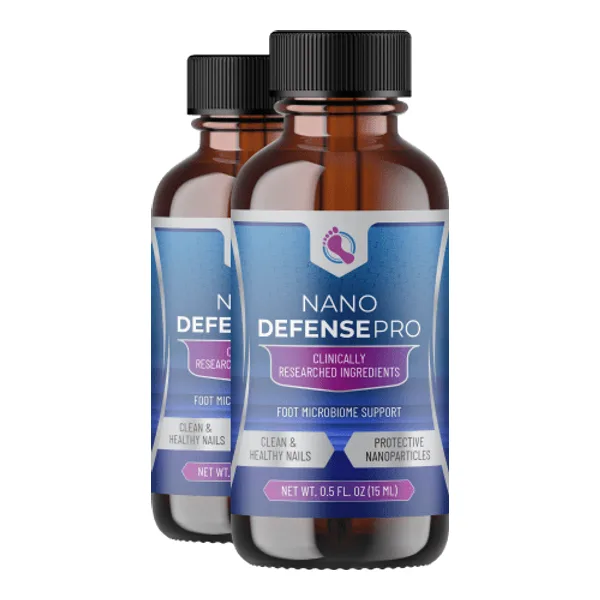
NanoDefense Pro comes in a 0.5 fl oz (15 mL) dropper bottle labeled "Foot Microbiome Support." It is topical: the label says it is for external use only and to call Poison Control if it is swallowed. The distributor printed on the label is NanoDefense Pro in Tallmadge, Ohio. It is sold through Digistore24 on the official website in 2, 3 and 6-bottle packages, as a one-time payment.
Because it is applied to the skin, the bottle carries a cosmetic-style ingredient list instead of a Supplement Facts panel. The label directions say to apply an appropriate amount to the area and massage it in until absorbed. The sales page FAQ gives a different instruction: apply it for 60 seconds a day. Neither says how many drops to use.
The sales copy is built around nanotechnology: particles about 1,000 times smaller than in regular topicals, said to reach deeper layers of nail and skin. We look at that claim below.
What the label says versus what the sales page says
The sales page names six highlighted ingredients: nano-silver, nano-curcumin, nano-quercetin, luteolin, deoxyribonuclease and Cape aloe. The label shown further down the same page lists 20 entries, in this order: deionized water, aloe barbadensis leaf juice, glycerin, cucumber fruit extract, chrysin, palmitoyl oligopeptide, N-hydroxysuccinimide, palmitoyl tetrapeptide-7, palmitoyl pentapeptide-3, steareth-20, polysorbate-20, carbomer, a phenoxyethanol and caprylyl glycol preservative, a turmeric root extract (70%), a quercetin extract (70%), luteolin from Sophora japonica, colloidal silver, serratiopeptidase, a "BioFresh Clean Complex (S)" and potassium sorbate.
- Deoxyribonuclease, an enzyme the sales page lists, does not appear on the label. The label has a different enzyme, serratiopeptidase.
- Cape aloe (Aloe ferox) does not appear on the label. The label lists Aloe barbadensis, the common aloe vera.
- Chrysin, cucumber extract and three cosmetic peptides are on the label but not mentioned on the sales page.
- The "BioFresh Clean Complex" is a trade name whose components are not listed.
The 70% figures on the turmeric and quercetin lines describe how concentrated those raw extracts are, not how much of the liquid they make up. US cosmetic labels generally list ingredients from most to least, and the plant extracts, silver and enzyme all sit behind water, aloe juice, glycerin, several peptides, thickeners and a preservative. We cannot tell the actual amounts, and the vendor does not say.
The formula next to the research
For each active, we searched PubMed for human studies on nails or foot skin. Here is what we found.
| Ingredient | In NanoDefense Pro | Best evidence we found | How it compares |
|---|---|---|---|
| Colloidal silver | Not stated | Lab dishes of nail and skin fungi [1]; a cow-hoof model where silver added nothing measurable [2] | No human nail data |
| Turmeric extract (curcumin) | Not stated (70% extract) | Lab studies only; known skin allergen [14] | No human nail data |
| Quercetin | Not stated (70% extract) | Yeast cultures and a mouse vaginal model, combined with a drug [3] | Different organism, site and setup |
| Serratiopeptidase | Not stated | Oral use in small, poor-quality trials for swelling and pain [9] | No topical or nail data |
| Luteolin, chrysin | Not stated | No human nail or foot trials found | Cannot be compared |
| Palmitoyl peptides | Not stated | Mostly supplier data and patents, few controlled trials [10] | Facial cosmetic ingredients, not nail actives |
Colloidal silver: active in a dish, unproven on a toenail
In a 2021 lab study, silver nanoparticles were tested against 30 isolates of the three fungi most often found on feet and nails. They stopped growth at a geometric mean concentration of about 4.8 micrograms per mL, which made them weaker than the prescription drugs terbinafine and itraconazole in the same dishes, though stronger than fluconazole [1]. In a 2022 nail model, researchers applied antifungal nanosuspensions to infected cow hooves, a stand-in for human nail, and found that adding colloidal silver did not significantly improve antifungal activity over the same formulas without it [2]. That study also contained a prescription antifungal drug, which NanoDefense Pro does not.
Turmeric and quercetin: plant compounds with lab data
The vendor's references for curcumin and quercetin are laboratory work, and we found no human nail trial of either. The quercetin study cited by the vendor used yeast (Candida) taken from women with vaginal infections, tested it in lab plates, and then gave quercetin with the drug fluconazole to mice [3]. Nail fungus is usually caused by a different group of fungi, and a vaginal mouse model says little about a toenail.
Serratiopeptidase: an oral enzyme with weak evidence
Serratiopeptidase is a protein-digesting enzyme mostly taken by mouth in some countries for swelling after surgery or injury. A 2013 systematic review found 24 clinical studies, judged most of them methodologically poor and small, and concluded the evidence was insufficient to support its use as a pain reliever or health supplement, with little safety data [9]. A 2020 review cited by the vendor also calls for more safety data [8]. We found no study of serratiopeptidase applied to nails or foot skin.
Peptides, chrysin, luteolin and cucumber
The three palmitoyl peptides are common in face creams. A review of facial products for sensitive skin found that support for these peptides comes mainly from patents and supplier brochures, with few randomized placebo-controlled studies [10]. We found no human nail or foot trials for chrysin, luteolin or cucumber extract. Aloe juice and glycerin are moisturizing bases.
The nanotechnology claims
Across the sales page and the vendor's affiliate materials, the pitch has three parts: fungi hide inside a protective layer, ordinary products cannot get through the nail, and nano-sized ingredients can.
- The protective layer. This part has a real basis. Fungi can form biofilms, communities held together by a matrix they produce [4], and podiatry researchers describe biofilms in some fungal nail infections, with no standard approach to them yet [5].
- The nail barrier. Also real. The nail plate is thick, dense keratin, and getting anything through it to the nail bed is a well-known problem for every topical product [6].
- Nano ingredients as the answer. This is where verification stops. A 2023 review of nano-sized delivery systems for nails presents them as an emerging research area, with most formulations at the laboratory stage [7]. NanoDefense Pro publishes no particle size, no penetration test and no study of its own formula. We found no evidence on PubMed that this product's ingredients are nanoparticles or that they reach the nail bed.
The vendor's reference list includes conference papers on silver for keeping spacecraft drinking water clean. They concern water systems, not nails, and we found nothing linking NanoDefense Pro to a space agency.
One claim stood out for a different reason. The sales FAQ says all ingredients "have been proven to be safe in clinical trials." The label on the same page carries a warning that the safety of this product has not been determined. Both cannot be right, and we give more weight to the label.
How this compares with what a doctor can offer
Prescription options for confirmed nail fungus have been tested in large randomized trials. In the LION study, 496 adults with lab-confirmed toenail fungus took terbinafine tablets or itraconazole for 12 to 16 weeks. At 72 weeks, lab tests were fungus-free in 76% to 81% of the terbinafine groups and 38% to 49% of the itraconazole groups [11]. Among adults 65 and over in two phase 3 trials of a prescription topical solution, efinaconazole 10% applied daily for 48 weeks, 13.6% had a completely clear nail with negative lab tests at week 52, against 3.6% on the inactive solution, and 59% had negative lab tests [12]. Even tested drugs work slowly, and they carry side effects and interactions, so that choice belongs with your doctor.
Diagnosis also matters. Not every thick or discolored nail is fungal, and a lab test settles the question. For men with diabetes, the stakes are higher: in a Dutch primary care cohort of 48,212 people with diabetes followed for a median of about 10 years, nail fungus was linked to a higher risk of foot ulcers even after adjusting for other factors [13]. A bottle bought online should never delay that conversation.
Price, packages and refund policy
The official site sells one 15 mL bottle as a 30-day supply. Prices when we checked:
- 6 bottles (sold as 3 + 3): $294 total, about $49 a bottle, free US shipping, plus three digital guides.
- 3 bottles (sold as 2 + 1): $207 total, $69 a bottle, free US shipping.
- 2 bottles: $158 total, $79 a bottle, plus $9.99 shipping.
There is no single-bottle option. The FAQ describes the 6-bottle bonus as two guides while the order section shows three. The refund policy gives 180 days; its first paragraph counts from the order date and its step-by-step section from delivery, so use the earlier date to be safe. To claim it, you email support and mail back all bottles, opened or not, with the packing slip, at your own cost. A six-month window is long enough to see real nail growth, which is a genuine point in its favor.
NanoDefense Pro packages on the official site
6 bottles, 180-day supply
$49/bottle
$294 total · Free US shipping
Lowest price per bottle
Sold as 3 + 3 bottles; includes 3 digital guides
Check the 6-bottle price3 bottles, 90-day supply
$69/bottle
$207 total · Free US shipping
Sold as 2 + 1 bottles
Check the 3-bottle priceButtons open the seller's NanoDefense Pro website, where you choose your supply and complete the order. Prices as listed on the seller's site on October 23, 2026; the price shown at checkout is final.Orders are covered by a 180-day refund policy from the seller (see their terms). We may earn a commission.
Safety
NanoDefense Pro is for external use only. Its own label warns against contact with eyes, using it on wounds, damaged or irritated skin, bandaging over it, or using it with a heating pad. Turmeric and curcumin are recognized contact allergens: a review of eleven studies concluded that curcumin, despite its anti-inflammatory properties, can cause allergic skin reactions [14]. Repeated skin contact with silver can cause localized argyria, a benign but unwanted blue-gray staining of the skin, most often seen with regular exposure to small silver particles [15]. Test a small area first and stop if you notice redness, itching or blistering.
On interactions: because this is a topical product, we found no published reports on PubMed of drug interactions from applying these ingredients to the skin or nails. That is an absence of data, not proof of safety, and the label itself says safety has not been determined. If you have diabetes, neuropathy or poor circulation, check with your doctor or podiatrist before using any foot product, since the label's own warning against use on damaged skin matters most for feet that heal slowly. Talk to your doctor too if you take prescription medication or are using a prescribed nail treatment. New or worsening symptoms, spreading redness, swelling, pain or discharge need medical care. Results vary from person to person.
What we liked and what gave us pause
Liked
- Full ingredient list on the bottle
- Clear external-use warnings on the label
- 180-day refund window, long for this category
- One-time payment with no subscription
Gave us pause
- No human nail or foot trial for any active ingredient
- No amounts for any active, plus an undisclosed "complex"
- Sales page and label list different enzymes and aloe species
- "Proven safe" on the sales page versus "safety not determined" on the label
- Nanoparticle claims with no published particle size or penetration data
- Return shipping on you, no single-bottle option
Frequently asked questions
Is NanoDefense Pro a pill or a topical?
Topical. It is a liquid applied to the nails and skin, and the label warns against swallowing it.
Where can I buy NanoDefense Pro?
On the official website. The vendor's affiliate terms rule out listings on Amazon, eBay and similar marketplaces, so third-party listings may not be genuine or covered by the refund policy.
How long before I notice anything?
Results vary. Toenails grow slowly, and the prescription trials above ran close to a year before measuring results. The vendor's own refund page suggests at least three months.
Can it replace a prescription nail treatment?
No. NanoDefense Pro is a cosmetic topical product with no published human trials. If a doctor has prescribed something, do not stop or swap it without asking them.
Is it a subscription?
No. According to the official site, every package is a one-time payment.
Want to read the official page yourself? The link below opens the NanoDefense Pro website, where you can see the full presentation, the label and the packages.
Visit the official NanoDefense Pro websiteHow we reviewed NanoDefense Pro
We read the official sales page, its FAQ, refund policy, reference list and affiliate page, and the ingredient label shown on the site. The vendor does not grant general permission to reuse its images, so we describe the label in words instead of reproducing it. We then searched PubMed for human studies of each active ingredient on nails and foot skin, for research behind the biofilm and nanotechnology claims, for large trials of prescription options and for safety reports. We did not test the product on people, and nobody at Stark Verve is a medical professional. Read our editorial policy to learn how we choose and update reviews. Stark Verve earns a commission if you buy through our links; that never changes what we write about the evidence.
References
- Mahmoudi S, Vahidi M, Malekabad ES, et al. In vitro antifungal activity of green synthesized silver nanoparticles in comparison to conventional antifungal drugs against Trichophyton interdigitale, Trichophyton rubrum and Epidermophyton floccosum. Infect Disord Drug Targets. 2021;21(3):370-4. PMID 32669080
- Al-Obaidi H, Petraityte I, Hibbard T, et al. Antifungal nanosuspensions with surfactants and silver for the treatment of onychomycosis. Eur J Pharm Biopharm. 2022;179:194-205. PMID 36099971
- Gao M, Wang H, Zhu L. Quercetin assists fluconazole to inhibit biofilm formations of fluconazole-resistant Candida albicans in in vitro and in vivo antifungal managements of vulvovaginal candidiasis. Cell Physiol Biochem. 2016;40(3-4):727-42. PMID 27915337
- Mitchell KF, Zarnowski R, Andes DR. Fungal super glue: the biofilm matrix and its composition, assembly, and functions. PLoS Pathog. 2016;12(9):e1005828. PMID 27685086
- Castillo C, Masi MF, Mishko A, et al. Biofilms and the nail unit. Clin Podiatr Med Surg. 2021;38(4):529-33. PMID 34538430
- Phan K, Kaur K, Wright K, et al. The penetrance of topical nail therapy: limitations and current enhancements. Clin Podiatr Med Surg. 2021;38(4):535-40. PMID 34538431
- Abd-Elsalam WH, Abouelatta SM. Contemporary techniques and potential transungual drug delivery nanosystems for the treatment of onychomycosis. AAPS PharmSciTech. 2023;24(6):150. PMID 37421509
- Jadhav SB, Shah N, Rathi A, Rathi V, Rathi A. Serratiopeptidase: insights into the therapeutic applications. Biotechnol Rep (Amst). 2020;28:e00544. PMID 33134103
- Bhagat S, Agarwal M, Roy V. Serratiopeptidase: a systematic review of the existing evidence. Int J Surg. 2013;11(3):209-17. PMID 23380245
- Resende DISP, Ferreira MS, Sousa-Lobo JM, Sousa E, Almeida IF. Usage of synthetic peptides in cosmetics for sensitive skin. Pharmaceuticals (Basel). 2021;14(8):702. PMID 34451799
- Evans EG, Sigurgeirsson B. Double blind, randomised study of continuous terbinafine compared with intermittent itraconazole in treatment of toenail onychomycosis. The LION Study Group. BMJ. 1999;318(7190):1031-5. PMID 10205099
- Lipner SR, Gupta AK, Joseph WS, et al. Efficacy and safety of efinaconazole 10% topical solution for treatment of onychomycosis in older adults: a post hoc analysis of two phase 3 randomised trials. Mycoses. 2025;68(5):e70069. PMID 40396391
- Watjer RM, Heckmans KM, Eekhof JA, et al. Association between onychomycosis and ulcerative complications in patients with diabetes: a longitudinal cohort study in Dutch general practice. BMJ Open. 2024;14(4):e076441. PMID 38658014
- Chaudhari SP, Tam AY, Barr JA. Curcumin: a contact allergen. J Clin Aesthet Dermatol. 2015;8(11):43-8. PMID 26705440
- Beutler BD, Lee RA, Cohen PR. Localized cutaneous argyria: report of two patients and literature review. Dermatol Online J. 2016;22(11):13030/qt4wm1j7pt. PMID 28329568