Review · Nails and skin
Kerassentials review: what is in the bottle and what the nail research shows
Kerassentials is a brush-on oil for toenails, fingernails and the skin around them. It is not a pill. We read the label, looked up the human studies behind its main ingredients and set them next to the treatments a doctor can prescribe.
Our verdict: 2.1 / 5
| Ingredient evidence | 2 | One older trial of pure tea tree oil on toenails; most other ingredients have lab data or uncontrolled case series only |
|---|---|---|
| Dosing vs. research | 1.5 | Only undecylenic acid has a stated strength (5%); tea tree oil strength unknown, while the toenail trial used it undiluted |
| Label transparency | 2.5 | Full ingredient list published, but one percentage only, and the sales page shows 8 of the 17 ingredients |
| Value and refund terms | 2.5 | $49 to $79 per 15 mL bottle; 60 days from delivery, all bottles must be returned at your cost |
Worth considering if your doctor or podiatrist has looked at your nails, you want a cosmetic oil for dry, rough nails and cuticles, and you are prepared to apply it several times a day for months.
Probably skip it if you are hoping for the result the sales page describes. The research on these ingredients is thin, the formula itself has never been studied, and prescription options have far stronger evidence.
Before anything else: thick, yellow, crumbling or painful nails are worth a visit to a doctor or podiatrist. Many of them turn out to be something other than fungus, and if you have diabetes or poor circulation in your feet, any nail or skin change on your feet deserves prompt professional care.
Smallest order $158, from $49 per bottle, 60-day refund policy from the seller
See the current Kerassentials packages, shipping and refund termsOpens the seller's page. It may start with a long video or letter; the packages and refund terms are usually further down. We may earn a commission.
What Kerassentials is
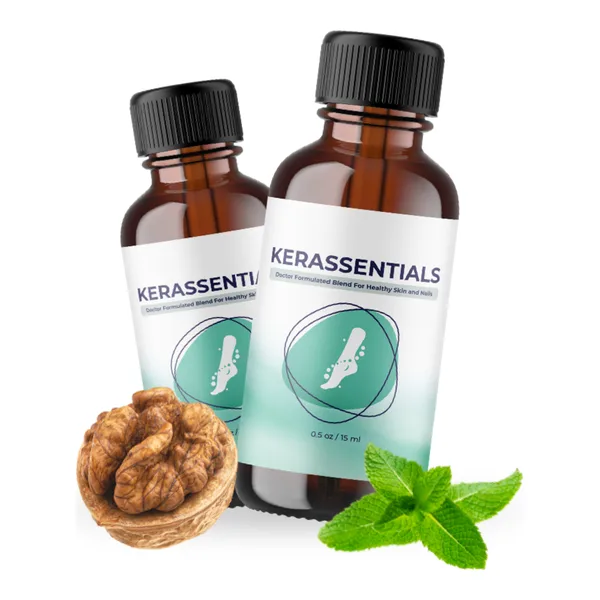
Kerassentials is a 0.5 fl oz (15 mL) bottle of oil with a brush in the cap. The label calls it a "Doctor Formulated Blend For Healthy Skin and Nails" but the sales page we read does not name the doctor. It lists the distributor as Kerassentials in Aurora, Colorado. It is sold through Digistore24 on the official website in 2, 3 and 6-bottle packages, as a one-time payment.
Because it goes on the skin, there is no Supplement Facts panel. The bottle carries an ingredients list, with a caution to use it externally only, keep it away from the eyes and get medical help if it is swallowed. The label directions are to brush it on the nail four times a day, work it into the cuticle with a cotton swab, and file the nail surface with an emery board so the oil can soak in.
The sales page builds its story around nail fungus, itching and odor, and around the idea that fungus becomes resistant when people stop other products too early. We look at those claims below. Our job here is narrower: what the ingredients are, what has been measured in people, and whether the price and terms make sense.
The label next to the research
The label shown on the official page lists 17 ingredients. Only one has a strength printed on it: undecylenic acid at 5%. The second ingredient is mineral oil, and most of the rest are plant oils. The sales page itself highlights eight ingredients, so if you only read the page you would miss mineral oil, canola, walnut, jojoba, chia, menthol, camphor, clove and manuka, all of which are on the bottle. US cosmetic labels usually list ingredients from most to least, so tea tree oil, in fifth place behind two carrier oils, is unlikely to be present at a high concentration. We cannot confirm the amount.
| Ingredient | In Kerassentials | What was used in human studies | How it compares |
|---|---|---|---|
| Undecylenic acid | 5% | 25% in over-the-counter foot solutions tested on nails in the lab [11]; mixed with other agents in an uncontrolled nail study [9] | One fifth of the lab-tested strength |
| Tea tree oil | Not stated (5th of 17) | 100% oil twice daily for 6 months on toenails [3]; 25% to 50% on skin between the toes [5] | Almost certainly far weaker than the nail trial |
| Menthol and camphor | Not stated | A mentholated chest rub in an 18-person case series [8] | Different product, no control group |
| Vitamin E and essential oils | Vitamin E acetate, lavender, lemongrass, clove, manuka (amounts not stated) | A nail oil with vitamin E plus lime, oregano and tea tree oils, 20 people, no control group [7] | Different oils, so the result does not transfer |
| Almond, flaxseed, canola, walnut, jojoba, chia oils, aloe | Not stated | No human nail trials found | Carrier and moisturizing oils |
Tea tree oil: the ingredient with real human data
The best-known study is a 1994 double-blind trial in 117 people with toenail fungus confirmed by lab culture. They brushed on either undiluted (100%) tea tree oil or a 1% clotrimazole solution twice a day for six months, with regular nail trimming. At six months, cultures were fungus-free in 18% of the tea tree group and 11% of the clotrimazole group, and about 60% in each group showed partial or full improvement in how the nail looked [3]. In short, pure tea tree oil performed about as well as a weak over-the-counter antifungal, and most nails did not clear.
A second trial is often quoted for its 80% success rate. That study used a cream combining 5% tea tree oil with 2% butenafine, an antifungal drug, against a placebo cream [4]. Because the drug was in the same cream, the result cannot be credited to tea tree oil. On the skin between the toes, 25% and 50% tea tree oil solutions beat placebo over four weeks, and 64% of the 50% group had negative lab tests versus 31% on placebo [5]. Skin is easier to reach than the nail plate, so those results do not carry over to thick toenails.
A 2022 systematic review of alternative remedies for nail fungus found five tea tree oil reports in total and concluded that large, randomized, placebo-controlled trials are needed before these remedies can be recommended [6].
Undecylenic acid: an established foot ingredient at a low strength
Undecylenic acid is a fatty acid long used in athlete's foot products. A Cochrane review of topical foot products found that undecanoates (this family of compounds) lowered the risk of failure for fungal skin infections of the foot compared with placebo, while the evidence for toenails was much sparser [10]. A 2024 lab study placed several products on human nail clippings: over-the-counter solutions with 25% undecylenic acid inhibited fungus far less through the nail than the prescription solution efinaconazole [11]. Kerassentials contains 5%.
The sales page's own reference list includes a 2008 pilot study where 154 people used undecylenic acid together with cyanoacrylate (a nail glue), hydroquinone and repeated nail trimming for a year. Negative cultures ranged from 100% in mild cases to 35% in severe ones [9]. There was no comparison group, the mix was different, and the concentration is not given in the abstract, so it tells us little about Kerassentials.
Menthol, camphor and the other oils
Menthol and camphor appear because of a 2011 case series in which 18 people applied a mentholated chest rub to their toenails for 48 weeks. Five (28%) had normal-looking nails with negative lab tests, ten improved partly and three did not change [8]. It had no control group and used a different product. The closest study to Kerassentials as a whole is an Italian open study of a nail oil made of vitamin E with lime, oregano and tea tree oils: 20 patients, once-daily use for six months, and the authors reported complete clearance in 78.5% after a year [7]. It was small, unblinded and had no comparison group, and its oils differ from these. For lavender, lemongrass, clove, manuka, flaxseed and almond oil we found lab experiments but no human nail trials.
How this compares with what a doctor can prescribe
This matters because the alternatives have been studied far more thoroughly. A Cochrane review of 56 trials with 12,501 people found high-quality evidence that the prescription solution efinaconazole 10% was more effective than its inactive vehicle at fully clearing toenails, and moderate-quality evidence for tavaborole. Even so, the reviewers noted that complete clearance rates with topical products are relatively low, and most trials ran 48 to 52 weeks [1]. A separate Cochrane review of 48 trials found high-quality evidence that oral terbinafine and azole tablets outperform placebo, with terbinafine probably doing better than azoles [2]. Those drugs have their own side effects and drug interactions, which is exactly why the choice belongs with your doctor.
Diagnosis comes first. A 2026 clinical review in the Journal of the American Academy of Dermatology reports that physical trauma, often from footwear or toe shape, is the most common cause of damaged-looking toenails, ahead of fungus, and that lab confirmation is needed [12]. In people with diabetes, nail fungus is linked to higher risk of secondary infection, foot ulcers and, in advanced cases, amputation [13]. A bottle of oil should never delay that check.
What the marketing claims vs. what we could verify
- "Dec 2023, New Scientific Discovery." The page does not say what the discovery is or where it was published, and we found no study of the Kerassentials formula on PubMed.
- Stopping other products early makes fungus stronger. The page attributes this to CDC scientists. Antifungal resistance is a real research topic, but we could not trace this specific chain of events to a publication, and the page offers no direct citation for it.
- Ingredient benefit lists. The page and its FAQ describe several oils as acting directly against fungus. Its own reference list is made up mostly of lab studies, reviews and case series. The human trials we could verify are summarized above, and none tested this product.
- Results within weeks. The sales FAQ suggests early changes, while the contact page says around 9 to 12 weeks. Toenails grow slowly, and the trials above lasted 6 to 12 months.
We also found inconsistencies on the official site. The sales FAQ says to apply the oil every day after a shower, while the label says four times a day. The contact page says the charge will appear on your card statement under a ClickBank descriptor, but the checkout we saw runs through Digistore24. None of these is a safety issue, but together they suggest the site copy has not been kept in step with the product.
Price, packages and refund policy
The official site sells a 15 mL bottle as a 30-day supply. Prices when we checked:
- 6 bottles (sold as 3 + 3): $294 total, about $49 a bottle, free US shipping, plus three digital guides and an unspecified gift.
- 3 bottles (sold as 2 + 1): $207 total, $69 a bottle, free US shipping.
- 2 bottles: $158 total, $79 a bottle, plus $9.99 shipping.
There is no single-bottle option. The refund policy gives you 60 days from delivery. To claim it you email support and then mail back all the bottles, empty or not, at your own cost. The refund page itself advises using the product for at least three months before judging it, which does not fit inside a 60-day window. If you want to test it, mark the deadline on a calendar.
Kerassentials packages on the official site
6 bottles, 180-day supply
$49/bottle
$294 total · Free US shipping
Lowest price per bottle
Sold as 3 + 3 bottles; includes 3 digital guides and a gift
Check the 6-bottle price3 bottles, 90-day supply
$69/bottle
$207 total · Free US shipping
Sold as 2 + 1 bottles
Check the 3-bottle priceButtons open the seller's Kerassentials website, where you choose your supply and complete the order. Prices as listed on the seller's site on October 23, 2026; the price shown at checkout is final.Orders are covered by a 60-day refund policy from the seller (see their terms). We may earn a commission.
Safety
Kerassentials is for external use only. Essential oils can irritate the skin or cause allergic reactions: in the tea tree oil foot trial, about 4% of users developed moderate to severe dermatitis that cleared after stopping [5], and allergic reactions have been reported from tea tree oil used on toenails [14] and from an undecylenic acid nail solution [15]. Try a small area first and stop if you notice redness, blistering or itching. Do not apply it to broken skin or open wounds.
If you have diabetes, neuropathy or poor circulation, check with your doctor or podiatrist before filing your nails or using any foot product, because small skin injuries on the feet can become serious. Talk to your doctor too if you take prescription medication or are using a prescribed nail treatment. New or worsening symptoms, spreading redness, swelling, pain or discharge need medical care, not a cosmetic oil. Results vary from person to person.
What we liked and what gave us pause
Liked
- Full ingredient list on the label, with the undecylenic acid strength stated
- Includes tea tree oil, the plant oil with the most human nail data
- Simple brush applicator for a topical routine
- One-time payment with no subscription
Gave us pause
- No published study of the formula itself
- Undecylenic acid at 5%, tea tree oil at an unknown and likely low strength
- Headline claims we could not trace to a publication
- 60-day refund window, return shipping on you, no single-bottle option
- Conflicting directions and billing details across the official site
Frequently asked questions
Is Kerassentials taken by mouth?
No. It is an oil brushed onto the nails and surrounding skin. The label warns against swallowing it.
Where can I buy Kerassentials?
On the official website. The vendor's affiliate terms rule out listings on Amazon, eBay and similar marketplaces, so third-party listings may not be genuine or covered by the refund policy.
How long before I notice anything?
Results vary. Toenails grow slowly, and the nail studies we reviewed ran from six months to a year. Judging any nail product after a few weeks is too early, which is also why the 60-day refund window is tight.
Can it replace a prescription nail treatment?
No. Kerassentials is a cosmetic topical product. Prescription solutions and tablets have far stronger evidence. If a doctor has prescribed something, do not stop or swap it without asking them.
Is it a subscription?
No. According to the official site, every package is a one-time payment.
Want to read the official page yourself? The link below opens the Kerassentials website, where you can see the full presentation, the label and the packages.
Visit the official Kerassentials websiteHow we reviewed Kerassentials
We read the official sales page, its FAQ, refund and contact pages, and the ingredient label shown on the site. The vendor does not grant general permission to reuse its images, so we describe the label in words instead of reproducing it. We then searched PubMed for human studies of the main ingredients on nails and foot skin, Cochrane reviews of nail treatments, and safety reports. We did not test the product on people, and nobody at Stark Verve is a medical professional. Read our editorial policy to learn how we choose and update reviews. Stark Verve earns a commission if you buy through our links; that never changes what we write about the evidence.
References
- Foley K, Gupta AK, Versteeg S, et al. Topical and device-based treatments for fungal infections of the toenails. Cochrane Database Syst Rev. 2020;1(1):CD012093. PMID 31978269
- Kreijkamp-Kaspers S, Hawke K, Guo L, et al. Oral antifungal medication for toenail onychomycosis. Cochrane Database Syst Rev. 2017;7(7):CD010031. PMID 28707751
- Buck DS, Nidorf DM, Addino JG. Comparison of two topical preparations for the treatment of onychomycosis: Melaleuca alternifolia (tea tree) oil and clotrimazole. J Fam Pract. 1994;38(6):601-5. PMID 8195735
- Syed TA, Qureshi ZA, Ali SM, et al. Treatment of toenail onychomycosis with 2% butenafine and 5% Melaleuca alternifolia (tea tree) oil in cream. Trop Med Int Health. 1999;4(4):284-7. PMID 10357864
- Satchell AC, Saurajen A, Bell C, Barnetson RS. Treatment of interdigital tinea pedis with 25% and 50% tea tree oil solution: a randomized, placebo-controlled, blinded study. Australas J Dermatol. 2002;43(3):175-8. PMID 12121393
- Nickles MA, Lio PA, Mervak JE. Complementary and alternative therapies for onychomycosis: a systematic review of the clinical evidence. Skin Appendage Disord. 2022;8(4):269-79. PMID 35983465
- Alessandrini A, Starace M, Bruni F, Piraccini BM. An open study to evaluate effectiveness and tolerability of a nail oil composed of vitamin E and essential oils in mild to moderate distal subungual onychomycosis. Skin Appendage Disord. 2020;6(1):14-8. PMID 32021856
- Derby R, Rohal P, Jackson C, et al. Novel treatment of onychomycosis using over-the-counter mentholated ointment: a clinical case series. J Am Board Fam Med. 2011;24(1):69-74. PMID 21209346
- Rehder P, Nguyen TT. A new concept in the topical treatment of onychomycosis with cyanoacrylate, undecylenic acid, and hydroquinone. Foot Ankle Spec. 2008;1(2):93-6. PMID 19825699
- Crawford F, Hollis S. Topical treatments for fungal infections of the skin and nails of the foot. Cochrane Database Syst Rev. 2007;(3):CD001434. PMID 17636672
- Elabbasi A, Kadry A, Joseph W, et al. Transungual penetration and antifungal activity of prescription and over-the-counter topical antifungals: ex vivo comparison. Dermatol Ther (Heidelb). 2024;14(9):2495-507. PMID 39133361
- Ricardo JW, Dominguez-Cherit J, Haneke E, et al. Evaluation and management of mechanical and structural nail disorders: a clinical review. J Am Acad Dermatol. 2026;94(5):1493-503. PMID 41242632
- Gupta AK, Liddy A, Magal L, et al. Onychomycosis in diabetics: a common infection with potentially serious complications. Life (Basel). 2025;15(8):1285. PMID 40868932
- Lauriola MM, Sena P, De Bitonto A, Corazza M. Allergic contact dermatitis due to "therapeutic uses" of tea tree oil on the lips and toenails. Dermatitis. 2021;32(3):e40-e41. PMID 33332860
- Ochando-Ibernón G, Schneller-Pavelescu L, Vergara de Caso EF, Silvestre-Salvador JF. Allergic contact dermatitis caused by undecylenic acid in an antifungal nail solution. Contact Dermatitis. 2019;80(5):313-4. PMID 30537336