
Review · Blood sugar support
Gut Glucose review: what the label and research show
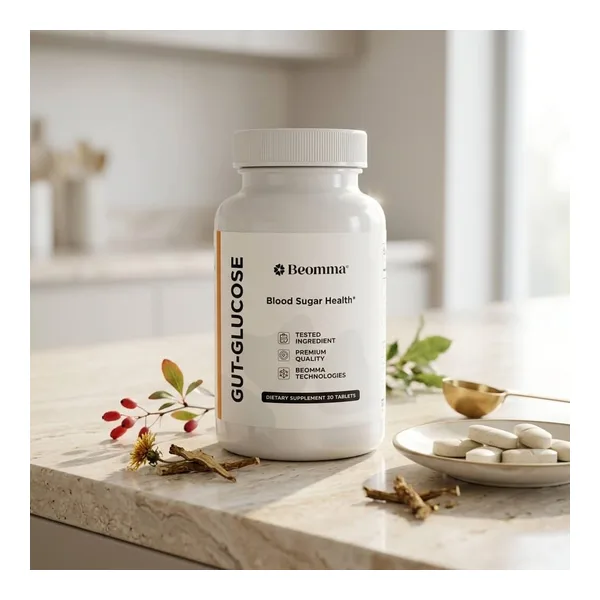
GutGlucose is a chewable supplement marketed for healthy blood sugar support. We reviewed its public label, seller claims, pricing and human research. The key limitation is simple: the formula lists ten ingredients in one 458 mg blend without telling buyers how much of each it contains.
Our verdict: 1.9 / 5
| Ingredient evidence | 2.5 | Some relevant human research exists for individual botanicals, but findings do not establish this formula. |
|---|---|---|
| Dosing vs. research | 1 | The 458 mg blend is split across ten ingredients without individual amounts. |
| Label transparency | 1.5 | Ingredients are listed, but their doses are hidden in a proprietary blend. |
| Value and refund terms | 2.5 | Prices are clear; the seller describes a 60-day return process requiring return shipment. |
Worth considering if you want a chewable format and are comfortable evaluating a blend whose ingredient amounts are not disclosed.
Probably skip if you want to compare each dose with clinical research, or if you expect evidence for the finished GutGlucose product. We could not identify a trial of this formula.
Results vary. Talk with your doctor before using supplements, especially if you take medication or have a medical condition. New or worsening symptoms deserve medical care. This review does not suggest that a supplement treats diabetes.
Smallest order $178, from $49 per bottle, 60-day refund policy from the seller
See the current Gut Glucose Blood Sugar packages, shipping and refund termsOpens the seller's page. It may start with a long video or letter; the packages and refund terms are usually further down. We may earn a commission.
Came here for Gut Glucose Blood Sugar? The highest-rated blood sugar label we checked is GlucoBerry, 3.6 out of 5.
What GutGlucose is
The seller describes GutGlucose as a plant-based chewable tablet. Its Ingredients & Label page lists a serving as one tablet and 30 servings per container. The Supplement Facts panel groups ten components into a 458 mg proprietary blend. It also lists natural flavors, stearic acid, magnesium stearate, silicon dioxide and stevia as other ingredients. There is a notable presentation difference: the SmartAdv tracking page we fetched presents a distinct order page, while gutglucose.com publishes this detailed label and return information. We could not establish from the public pages whether every offer route currently supplies the exact same presentation or product version, so check the seller's current package and label details before purchase.
The seller identifies Eagle Labs, Inc. as distributor and says the product is made in the USA with globally sourced ingredients. Those are seller statements, not independently audited claims in this review. The public product page says the blend is intended to support glucose metabolism, energy and gut wellness. We treat those as marketing descriptions, not demonstrated outcomes.
The formula beside the research
Human research on an ingredient can inform a question, but it does not establish the effect of this finished formula. A useful comparison also needs the amount and form in the product. GutGlucose gives neither individual quantities nor a standardized extract strength for the ingredients in its proprietary blend.
| Label ingredient | Human research we checked | Can we compare dose? |
|---|---|---|
| Berberine HCl | Clinical trial and meta-analysis literature exists, largely in people with diagnosed metabolic conditions. [1] [2] | No. Its quantity and formulation within the blend are not disclosed. |
| Ceylon cinnamon | A systematic review examined cinnamon trials, but the studies used different preparations and reported mixed measures. [3] | No. The label does not report the amount. |
| Banaba corosolic acid | A review discusses the limited efficacy and safety literature for banaba and corosolic acid. [4] | No. Corosolic acid standardization is not given. |
| Olive leaf oleuropein | A small crossover trial in middle-aged overweight men studied olive leaf polyphenols and insulin sensitivity. [5] | No. The trial preparation and dose cannot be matched to this blend. |
| Saffron, fucoxanthin, fucoidan, kudzu flower and citrus sinensis | The evidence we located is varied in population, preparation and outcome; some is indirect or concerns other health questions. [6] [7] [8] | No. Individual amounts are not given. |
Berberine: studied, but not enough information to assess this serving
Berberine has been studied in human trials and pooled analyses. Those studies provide context about specific preparations and doses; they do not show that an unspecified amount in a multi-ingredient chewable produces the same effects. The label does not say whether berberine represents most of the blend or only a small fraction. That prevents a responsible dose comparison. [1] [2]
Cinnamon and banaba: familiar ingredients, uncertain match
Cinnamon research varies by species, preparation and amount. The product specifies Ceylon cinnamon, while much of the literature cannot be directly mapped to this undisclosed blend. Banaba and corosolic acid have a smaller evidence base, and the review literature itself calls for more controlled research. The label does not disclose corosolic acid content or a standardization percentage. [3] [4]
Olive leaf and seaweed components
In one crossover study, middle-aged overweight men took a defined olive leaf polyphenol preparation. That is relevant as preliminary ingredient research, but the GutGlucose label provides no oleuropein quantity, so readers cannot tell whether the product resembles the trial. [5] Seaweed research is similarly hard to transfer: the label includes both fucoxanthin and fucoidan, while studies differ in material, dose and endpoint. One paper involving both compounds studied fatty liver outcomes, not this product or a general blood sugar claim. [7] [8]
What we could verify about the marketing
The seller says the botanicals are “traditionally used” to support glucose metabolism and references peer-reviewed literature. We verified that PubMed contains human research about some individual ingredients, including berberine, cinnamon, banaba and olive leaf. We did not find a published clinical trial testing GutGlucose itself. More importantly, a reference to ingredient research cannot confirm the product's dose when individual amounts are concealed.
We also could not connect the phrase “strengthens gut health and the microbiome” on the sales page to a clinical trial of this formula. This is an area where broad marketing language can outrun product-specific evidence. The practical uncertainty is substantial because buyers cannot inspect the amount of each component.
Price, packages and return terms
The SmartAdv listing gives these package prices. The sales page fetched through the supplied tracking route displayed the same price-per-bottle amounts and described a 60-day money-back guarantee. We assume 30 days per bottle because the seller label states 30 servings and the directions are one tablet daily.
- 6 bottles: $49 each, $294 total, free US shipping, about 180 days.
- 3 bottles: $79 each, $237 total, free US shipping, about 90 days.
- 2 bottles: $89 each, $178 total, shipping extra, about 60 days.
The seller's return policy allows a request within 60 days of delivery. It instructs customers to contact support, obtain return authorization and ship product back; return shipping is the customer's responsibility unless goods arrived damaged or incorrect. Original shipping is non-refundable. Review the current terms before ordering because conditions may change.
GutGlucose package options
6 bottles, 180-day supply
$49/bottle
$294 total · Free US shipping
Lowest price per bottle
Check the 6-bottle priceButtons open the seller's Gut Glucose Blood Sugar website, where you choose your supply and complete the order. Prices as listed on the seller's site on October 23, 2026; the price shown at checkout is final.Orders are covered by a 60-day refund policy from the seller (see their terms). We may earn a commission.
Safety and interactions
The available label warns people with a medical condition to consult a physician and advises against exceeding the suggested serving. Because the blend hides amounts and includes several botanicals, the label is not enough to assess an individual's risk. Berberine is the ingredient that makes a medication review especially important: it may affect blood glucose and can interact with medicines. Do not combine it with glucose-lowering medication or change prescribed treatment without clinician guidance. Berberine can also cause digestive effects. The blend includes cinnamon and other botanicals, which add uncertainty about combined use.
Pregnant or nursing people and children under 18 are advised by the seller not to use it without a physician's direction. Men over 50 who use prescription medication should show the full label to a pharmacist or clinician before starting. Talk with your doctor about supplements, particularly with medication use, and seek medical care for new or worsening symptoms.
What we liked and what gave us pause
Liked
- Serving size and total blend weight are stated.
- The seller publishes a list of all blend ingredients.
- Package totals and return instructions are accessible.
Gave us pause
- Ten ingredients share 458 mg with no individual amounts.
- There is no product-specific clinical trial we could verify.
- Ingredient studies cannot establish the product's effect or dose adequacy.
- The return process requires authorization and customer-paid shipping in ordinary cases.
Frequently asked questions
Does GutGlucose treat diabetes?
No supplement review can establish that, and this product should not be used to treat or replace care for a medical condition. Talk with your healthcare professional about blood sugar concerns.
Can I tell whether the ingredients match study doses?
No. The seller publishes a combined 458 mg amount but not the amount of each ingredient.
How long does one bottle last?
The label says 30 servings and recommends one chewable tablet daily, so one bottle represents about 30 days if followed as directed.
Is there a product trial?
We did not find a published human trial of the GutGlucose finished formula in the records we checked.
Want to review the seller's current product details? Use the link below to see its presentation and package choices.
View GutGlucose detailsHow we reviewed GutGlucose
We read the seller's public ingredients page, label text, package details and return policy, then checked PubMed records for research relevant to the listed ingredients. We did not test the product on people, and nobody at Stark Verve is a medical professional. The evidence score reflects ingredient research, not proof about this product. Stark Verve may earn a commission if you purchase through our links; that does not change our assessment. See our editorial policy.
References
- Yin J, Xing H, Ye J. Efficacy of berberine in patients with type 2 diabetes mellitus. Metabolism. 2008;57(5):712-7. PMID 18442638
- Lan J, et al. Meta-analysis of the effect and safety of berberine in the treatment of type 2 diabetes mellitus, hyperlipemia and hypertension. J Ethnopharmacol. 2015;161:69-81. PMID 25498346
- Allen RW, et al. Cinnamon use in type 2 diabetes: an updated systematic review and meta-analysis. Ann Fam Med. 2013;11(5):452-9. PMID 24019277
- Stohs SJ, Miller H, Kaats GR. A review of the efficacy and safety of banaba (Lagerstroemia speciosa L.) and corosolic acid. Phytother Res. 2012;26(3):317-24. PMID 22095937
- de Bock M, et al. Olive (Olea europaea L.) leaf polyphenols improve insulin sensitivity in middle-aged overweight men: a randomized, placebo-controlled, crossover trial. PLoS One. 2013;8(3):e57622. PMID 23516412
- López-Ramos A, et al. Effect of Fucoxanthin on Metabolic Syndrome, Insulin Sensitivity, and Insulin Secretion. J Med Food. 2023;26(7):521-527. PMID 37405785
- Łagowska K, et al. Effects of dietary seaweed on obesity-related metabolic status: a systematic review and meta-analysis of randomized controlled trials. Nutr Rev. 2025;83(2):e116-e130. PMID 38749056
- Shih PH, et al. Fucoidan and Fucoxanthin Attenuate Hepatic Steatosis and Inflammation through Modulation of Leptin/Adiponectin Axis. Mar Drugs. 2021;19(3):148. PMID 33809062