Review · Skin health
Neotonics review: a probiotic gummy, a big skin promise, and a thin label
Neotonics is sold as a gut and skin gummy that speeds up "skin cell turnover." We read the label, looked up every ingredient on PubMed, and compared the doses with the studies. The gut side has a little support. The skin side mostly does not.
Our verdict: 2 / 5
| Ingredient evidence | 1.5 | Some gut research on the probiotic species; no human skin trial for any ingredient taken by mouth |
|---|---|---|
| Dosing vs. research | 1.5 | The whole herbal blend weighs 430 mg; inulin alone was studied at 3 to 20 g a day |
| Label transparency | 2 | Probiotic count stated, strain not; nine herbs hidden in a proprietary blend |
| Value and refund terms | 3 | $49 to $69 a month; 60-day refund from delivery, return postage on you |
Worth considering if you want an easy daily probiotic for digestive regularity, you like gummies more than capsules, and you are comfortable paying a premium for a product whose skin benefits are unproven.
Probably skip it if your main goal is drier, thinner or more wrinkled skin. No ingredient in this gummy has been tested by mouth for skin hydration, elasticity or wrinkles in people, and the herbal doses are far too small to match any study we found. Also skip it if you watch added sugar closely or prefer to know the amount of every ingredient.
Before anything else: a rash, a changing mole, a sore that will not heal, or new digestive symptoms such as blood in the stool, weight loss or a lasting change in bowel habits deserve a visit to your doctor, not a supplement.
Smallest order $69, from $49 per bottle, 60-day refund policy from the seller
See the current Neotonics packages, shipping and refund termsOpens the seller's page. It may start with a long video or letter; the packages and refund terms are usually further down. We may earn a commission.
What Neotonics is
Neotonics is a chewable gummy sold through Digistore24 on the official website. The label says it is distributed by NeoTonics of Aurora, Colorado. The daily serving is one 3.3 g gummy, and a bottle holds 30. It is sold in 1, 3 and 6-bottle packages as a one-time payment; the site's FAQ says there are no recurring charges.
The marketing is aimed squarely at women. The vendor's own affiliate page describes the target customer as women aged 30 and up, and the 6-bottle bonuses are guides on cellulite and hair. So why review it for men over 50? Because the claims it makes, healthier-looking skin and smoother digestion, apply to us too. After 50, skin gets drier and thinner and holds moisture less well, and bowel habits often slow. If you have seen this product advertised, you deserve to know what is actually in it.
We describe the label in words because the seller does not grant permission to reproduce its images. The full label is on the official website.
What the label actually says
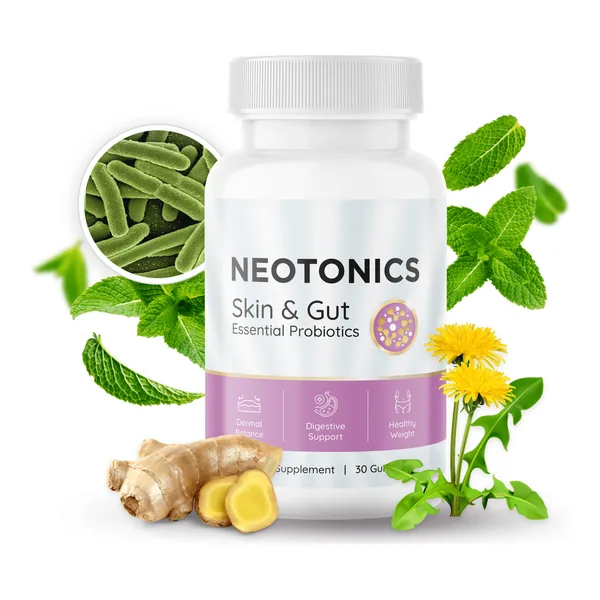
The Supplement Facts panel lists two active lines. The first is Bacillus coagulans at 500 million CFU (colony-forming units), with no strain named. The second is a "Proprietary Gut Health Blend" of 430 mg that contains nine botanicals: babchi, dandelion, fennel, fenugreek, inulin, lemon balm, organic Ceylon ginger, organic lion's mane and slippery elm bark.
Two details matter. First, the nine blend ingredients are printed in alphabetical order. Labels normally list blend ingredients from most to least by weight, so alphabetical order tells us nothing about how much of each is there. Second, the gummy base matters too: each piece has 3 g of carbohydrate, including 2 g of added sugar, with corn syrup and sugar listed first among the other ingredients. That is small, but it is daily.
The sales page and the label agree on the ingredient names and the count of nine plant ingredients plus a probiotic. We did not find a mismatch there. The sales page does not show the label itself; we found it on the site's references page.
The formula next to the research
For each ingredient we looked for human trials on gut function or skin, and compared the amount studied with what one gummy could contain. Because the blend is 430 mg in total, any single herb is at most 430 mg, and almost certainly far less.
| Ingredient | Neotonics per day | Amount in studies | How it compares |
|---|---|---|---|
| Bacillus coagulans | 500 million CFU (strain not stated) | 1 billion CFU/day of a named strain [1]; 100 million CFU of another strain with 2 g of soy fiber [2] | In range, but results are strain specific and the strain is unknown |
| Inulin | Part of 430 mg blend | 3 to 20 g/day [7] | At least 7 times lower, likely far more |
| Lion's mane | Part of 430 mg blend | 3 g/day of dry powder [14] | At least 7 times lower; studied for memory, not skin or gut |
| Babchi | Part of 430 mg blend | Skin trial used a topical cream of one compound [8] | Cannot be compared; oral use carries safety questions |
| Ginger | Part of 430 mg blend | Fresh ginger juice in a gut microbiome study [12] | Different form; no skin outcomes |
| Fenugreek | Part of 430 mg blend | 2% of diet by weight in mice [13] | Animal data only |
| Dandelion, fennel, lemon balm, slippery elm | Part of 430 mg blend | No human skin or gut trial found | Cannot be compared |
Bacillus coagulans: the one ingredient with some gut research
Bacillus coagulans is a spore-forming probiotic, which helps it survive heat and stomach acid better than many other strains. It has the most relevant human research in the formula, and some of it involves people our age. In a crossover trial of 36 men and women aged 65 to 80, a named strain at 1 billion CFU a day for 28 days modestly raised levels of Faecalibacterium prausnitzii, a gut bacterium associated with a healthy gut lining, compared with placebo [1]. In 297 Japanese adults who tended toward constipation, a different strain at 100 million CFU, taken with 2 g of soy pulp fiber for two weeks, improved stool frequency and the feeling of complete emptying compared with the fiber alone in those who met the definition of functional constipation [2]. A small 8-week trial in adults with irritable bowel syndrome reported less abdominal pain and bloating, although the groups started out different and the author called the data preliminary [3].
The catch: probiotic results belong to specific strains, and the Neotonics label names only the species. We cannot tell whether the bacteria in the gummy are any of the strains that were studied.
Inulin: the right idea at a fraction of the dose
Inulin is a prebiotic fiber that feeds beneficial gut bacteria. A systematic review of 50 trials found that chicory inulin at 3 to 20 g a day reliably increased Bifidobacterium and improved bowel function in healthy people [7]. Neotonics shares 430 mg among nine ingredients. Even if the whole blend were inulin, it would be about one seventh of the lowest studied dose.
Babchi: a skin ingredient with a safety caveat
Babchi is the seed of Psoralea corylifolia. Its best-known compound, bakuchiol, did well in a 12-week trial of 44 adults: a 0.5% cream applied twice daily reduced wrinkle surface area and pigmentation, measured with facial imaging, about as much as a retinol cream, with less stinging [8]. That was a cream on the skin. We found no trial of babchi taken by mouth for skin appearance.
Taken by mouth, babchi seeds also contain psoralens, compounds that make skin more sensitive to sunlight. A severe sun reaction has been reported after use of the seeds [11], and case reports link the seeds to liver injury, including one fatal case of acute liver failure after seven months of a babchi-containing tablet [9] [10]. At least one of those cases involved more than ten times the usual traditional amount of seeds [9], and a share of a 430 mg blend is probably small. But because the label does not state the babchi dose, there is no way to judge your exposure.
The rest of the blend
Ginger juice changed gut bacteria composition in a crossover study of 123 healthy adults, but the study used fresh juice and measured no skin or symptom outcomes [12]. Fenugreek altered the gut bacteria of mice on a high-fat diet [13], which says little about people. Lion's mane has been studied for memory at about 3 g a day [14], a different goal and a much larger amount. For dandelion, fennel, lemon balm and slippery elm we found no human trial on skin or digestion that would apply here.
What the marketing claims, and what we could verify
The core claim on the sales page is that medical researchers have shown skin cell turnover is controlled by the gut, its microbiome and nutrient absorption, and that an aging gut slows turnover and ages the skin. We searched PubMed and could not find a publication showing that the gut controls skin cell turnover in people, or that any probiotic speeds it up. We are not saying the gut and skin are unrelated; researchers do study a "gut and skin" connection. We are saying the specific claim could not be traced to a study, so we give it no weight.
What does the human evidence on oral probiotics and skin look like? The best example we found used a different organism, Lactobacillus plantarum HY7714, at 10 billion CFU a day, twenty times the Neotonics count. In 110 adults aged 41 to 59 with dry skin and wrinkles, 12 weeks of that strain improved skin water content, elasticity and instrument-measured wrinkle depth compared with placebo [5]. That result does not transfer to a different species at a much lower dose. A 2023 meta-analysis of probiotics and sun-related skin aging found its positive results mainly in mice and cell studies, and called for more human trials [6]. The one study of Bacillus coagulans and skin aging we found was in mice [4].
We also checked the vendor's own reference list. Most entries are blog and magazine articles. The peer-reviewed ones cover inulin in children, a one-day dandelion diuretic study, lab and animal work, gut studies in adults (several in people with digestive conditions), and five case reports on diet therapy. None tests Neotonics or measures skin cell turnover.
One more detail: the FAQ says your card statement will show a ClickBank descriptor, while the checkout we traced runs through Digistore24. That looks like leftover text, but it is worth knowing if you are watching your statement.
Price, packages and refund policy
One bottle lasts 30 days. Prices on the official site when we checked:
- 6 bottles: $49 each ($294 total), two digital guides included. About $1.63 a day.
- 3 bottles: $59 each ($177 total).
- 1 bottle: $69.
The site's shipping policy lists free shipping within the United States; international orders pay $15.95. Refunds are available for 60 days, counted from the day the package is delivered. According to the refund page you must email support and send back all bottles, empty or not, and you pay the return postage. The refund page itself suggests using the product for at least three months before judging it, which is longer than the 60-day window. Keep that in mind if you buy only one or two bottles.
Neotonics packages on the official site
6 bottles, 180-day supply
$49/bottle
$294 total · Free US shipping
Lowest price per bottle
Includes 2 digital guides
Check the 6-bottle priceButtons open the seller's Neotonics website, where you choose your supply and complete the order. Prices as listed on the seller's site on October 23, 2026; the price shown at checkout is final.Orders are covered by a 60-day refund policy from the seller (see their terms). We may earn a commission.
Safety
In the trials above, Bacillus coagulans was generally well tolerated, with no treatment-related adverse events reported in the small irritable bowel study [3]. Fiber and probiotics can cause gas or bloating in the first weeks. The ingredient that deserves care is babchi: it has been linked to sun sensitivity and, in case reports, to liver injury [11] [9] [10]. Talk to your doctor before taking Neotonics if you have liver disease, take medications that affect the liver or make you sensitive to sunlight, take blood thinners or diabetes medication, have a weakened immune system, or are treated for any chronic condition. Stop and get medical advice if you notice yellowing of the skin or eyes, dark urine, or an unusual reaction to sun exposure. Results vary from person to person, and new or worsening skin or digestive symptoms deserve medical care.
What we liked and what gave us pause
Liked
- Bacillus coagulans has some human gut research, including in adults aged 65 to 80
- The label is published and states the probiotic count
- One-time purchase with free US shipping
- 60-day refund policy that accepts empty bottles
Gave us pause
- No human trial of any oral ingredient on skin outcomes
- Nine herbs in a 430 mg proprietary blend, listed alphabetically
- Probiotic strain not named
- Babchi taken by mouth carries safety questions, at an undisclosed dose
- The skin cell turnover claim could not be traced to a study
- 2 g of added sugar per gummy and a high price per gram of active ingredients
Frequently asked questions
Where can I buy Neotonics?
On the official website, which processes orders through Digistore24. The vendor does not allow its product on Amazon, eBay or similar marketplaces, so listings there may not be genuine or covered by the refund policy.
Will it help with wrinkles or dry skin?
We cannot say it will. No ingredient in Neotonics has been tested by mouth for skin hydration, elasticity or wrinkle depth in people. A different probiotic at a much higher dose showed measurable skin changes in one trial [5], but that result does not carry over to this product. Results vary, and skin changes have many causes, including sun exposure, which sunscreen addresses directly.
Can I take it with my medications?
Ask your doctor first, especially if you take prescription medication or have liver problems. Do not stop or change any prescription on your own.
Is it a subscription?
No. According to the vendor, every package is a one-time payment.
Want to read the vendor's presentation yourself? The link below opens the official Neotonics website, where you can see the full sales page and the packages.
Visit the official Neotonics websiteHow we reviewed Neotonics
We read the official sales page, FAQ, refund and shipping policies and the published Supplement Facts label, then searched PubMed for human trials of each ingredient on skin and gut outcomes and compared the amounts studied with the label. We did not test the product on people, and nobody at Stark Verve is a medical professional. This page is a review, and Stark Verve earns a commission if you buy through our links; that never changes what we write about the evidence. Read our editorial policy to learn how we choose and update reviews.
References
- Nyangale EP, et al. Bacillus coagulans GBI-30, 6086 modulates Faecalibacterium prausnitzii in older men and women. J Nutr. 2015;145(7):1446-52. PMID 25948780
- Minamida K, et al. Effects of dietary fiber with Bacillus coagulans lilac-01 on bowel movement and fecal properties of healthy volunteers with a tendency for constipation. Biosci Biotechnol Biochem. 2015;79(2):300-6. PMID 25338680
- Hun L. Bacillus coagulans significantly improved abdominal pain and bloating in patients with IBS. Postgrad Med. 2009;121(2):119-24. PMID 19332970
- Hiramoto K, et al. The effect of Bacillus coagulans induced interactions among intestinal bacteria, metabolites, and inflammatory molecules in improving natural skin aging. Dermatopathology (Basel). 2023;10(4):287-302. PMID 37873804
- Lee DE, et al. Clinical evidence of effects of Lactobacillus plantarum HY7714 on skin aging: a randomized, double blind, placebo-controlled study. J Microbiol Biotechnol. 2015;25(12):2160-8. PMID 26428734
- Jwo JY, Chang YT, Huang YC. Effects of probiotics supplementation on skin photoaging and skin barrier function: a systematic review and meta-analysis. Photodermatol Photoimmunol Photomed. 2023;39(2):122-131. PMID 36583287
- Nagy DU, et al. Effect of chicory-derived inulin-type fructans on abundance of Bifidobacterium and on bowel function: a systematic review with meta-analyses. Crit Rev Food Sci Nutr. 2023;63(33):12018-12035. PMID 35833477
- Dhaliwal S, et al. Prospective, randomized, double-blind assessment of topical bakuchiol and retinol for facial photoageing. Br J Dermatol. 2019;180(2):289-296. PMID 29947134
- Nam SW, et al. A case of acute cholestatic hepatitis associated with the seeds of Psoralea corylifolia (Boh-Gol-Zhee). Clin Toxicol (Phila). 2005;43(6):589-91. PMID 16255343
- Li A, et al. Acute liver failure associated with Fructus Psoraleae: a case report and literature review. BMC Complement Altern Med. 2019;19(1):84. PMID 30975110
- Mehta N, Arora V, Verma KK. Severe phototoxic reaction to Psoralea corylifolia seeds in a child with vitiligo. Contact Dermatitis. 2024;90(6):619-621. PMID 38387032
- Wang X, et al. Gut microbiota variation with short-term intake of ginger juice on human health. Front Microbiol. 2021;11:576061. PMID 33708178
- Bruce-Keller AJ, et al. Fenugreek counters the effects of high fat diet on gut microbiota in mice: links to metabolic benefit. Sci Rep. 2020;10(1):1245. PMID 31988303
- Mori K, et al. Improving effects of the mushroom Yamabushitake (Hericium erinaceus) on mild cognitive impairment: a double-blind placebo-controlled clinical trial. Phytother Res. 2009;23(3):367-72. PMID 18844328