Review · Weight management
Nagano Tonic review: a crowded scoop and thin doses
Nagano Tonic is a morning drink powder sold to adults who want help with weight management and energy. The label lists more than sixty ingredients. That sounds generous until you divide the scoop between them.
Our verdict: 2.1 / 5
| Ingredient evidence | 2 | Cinnamon, ginger and probiotics show small average effects in meta-analyses; the green tea Cochrane review found no clinically important change; others rely on pilots or unrelated outcomes |
|---|---|---|
| Dosing vs. research | 1 | Eleven herbs share 1.3 g, so most can only be present at a fraction of the amounts used in trials |
| Label transparency | 1.5 | Vitamins and minerals are dosed, but every botanical sits inside one of four blends; one featured ingredient is missing from the panel |
| Value and refund terms | 4 | $39 to $69 per bottle; 180-day refund, though you return the bottles at your own postage |
Worth considering if you want a low-calorie greens and fruit powder to add to a morning routine that already includes better eating and more movement, you like the taste of a flavored drink, and the long refund window makes a three-month trial feel low-risk.
Probably skip it if you are looking for a supplement with ingredients at the amounts used in weight research, or if the promise of awakening a "dormant metabolism" is what drew you in. We could not find evidence for either in this formula.
Before anything else: unexplained weight change, new fatigue or changes in appetite deserve a visit to your doctor. If you take prescription medication, check with your doctor or pharmacist before adding any herbal product.
Smallest order $69, from $39 per bottle, 180-day refund policy from the seller
See the current Nagano Tonic packages, shipping and refund termsOpens the seller's page. It may start with a long video or letter; the packages and refund terms are usually further down. We may earn a commission.
Came here for Nagano Tonic? The highest-rated weight label we checked is LeanBiome, 2.8 out of 5.
What Nagano Tonic is
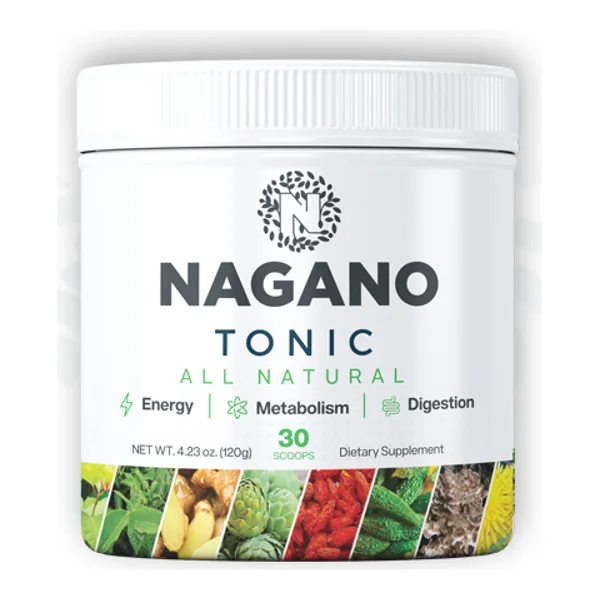
Nagano Tonic (also sold as Nagano Lean Body Tonic) is a flavored powder. One scoop of 4.6 grams goes into water or another drink each morning, and a bottle holds 30 scoops. It is sold through ClickBank on the seller's own websites in 1, 3 and 6-bottle packages, all as one-time payments. The label and site name no company beyond "Nagano Tonic," so we do not name a manufacturer here.
The sales story is built on Nagano, a mountain region of Japan described on the page as home to the leanest and longest-living people in the world. The product, the page says, uses herbs and nutrients from that diet to restart a "dormant metabolism." It is marketed to both men and women, and the FAQ says age does not matter, so it is not designed specifically for men over 50. We read it with that reader in mind.
What is on the label
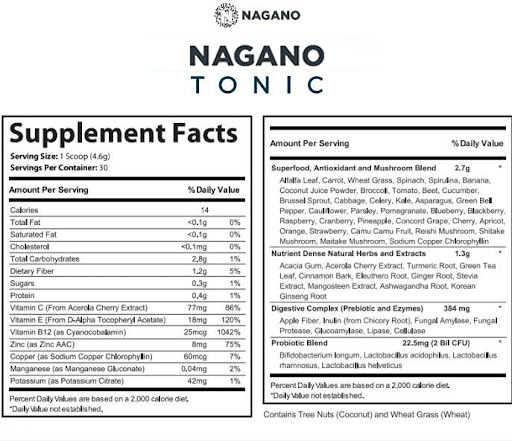
The panel has two halves. The left side lists amounts for seven vitamins and minerals: 77 mg of vitamin C from acerola, 18 mg of vitamin E, 25 mcg of vitamin B12, 8 mg of zinc, and small amounts of copper, manganese and potassium. These are ordinary multivitamin-range amounts.
The right side holds everything the marketing talks about, split into four blends with a total weight for each and no individual amounts:
- Superfood, Antioxidant and Mushroom Blend, 2.7 g: 35 items, from alfalfa, wheat grass and spinach to pomegranate, camu camu and reishi, shiitake and maitake mushrooms.
- Nutrient Dense Natural Herbs and Extracts, 1.3 g: acacia gum, acerola, turmeric, green tea leaf, cinnamon bark, eleuthero, ginger, stevia, mangosteen, ashwagandha and Korean ginseng.
- Digestive Complex, 384 mg: apple fiber, inulin and five enzymes.
- Probiotic Blend, 22.5 mg: four strains, 2 billion CFU.
Two points matter here. First, blends are listed in descending order by weight, and acacia gum (a thickener and fiber) is listed first in the herb blend, ahead of every herb the sales page promotes. Second, 35 foods sharing 2.7 grams works out to less than 80 mg each on average. That is a pinch of each, closer to a flavor and color base than to anything studied for weight.
The label and the sales page do not fully agree
The sales page features ten "key" ingredients. Comparing that list with the panel, we found these differences:
- Momordica charantia (bitter melon) is presented as a key ingredient, but it does not appear anywhere on the Supplement Facts panel we read.
- EGCG is named on the page. The label lists "green tea leaf" with no stated EGCG content, which is a different thing from a standardized EGCG extract.
- Cinnamon cassia on the page becomes "cinnamon bark" on the label, species unstated.
- Parts of the page still carry text naming a different product, which suggests reused sales copy.
None of this tells us the powder is mislabeled. It does tell us to trust the panel over the marketing, and the panel is what we reviewed.
The formula next to the research
For each ingredient with a plausible link to weight or energy, we looked for human trials on PubMed and compared the amount used there with what a scoop could contain.
| Ingredient | Nagano Tonic per day | Amount in trials | How it compares |
|---|---|---|---|
| Green tea | Part of a 1.3 g blend; EGCG not stated | 856.8 mg EGCG a day [3] | Cannot reach trial amount within the blend |
| Cinnamon | Part of a 1.3 g blend | Fat mass effects at 2 g a day or more [4] | Below the effective range |
| Ashwagandha root | Part of a 1.3 g blend | 600 mg a day of a standardized extract [6] | Would need almost half the blend |
| Eleuthero root | Part of a 1.3 g blend | 800 mg a day [10] | Unlikely within the blend |
| Ginger, ginseng, mangosteen | Part of a 1.3 g blend | Varies by trial [5] [7] [8] | Cannot be compared |
| Inulin | Part of a 384 mg complex | Daily supplement over 18 weeks [11] | Cannot be compared; the whole complex is under half a gram |
| Probiotics | 2 billion CFU, four strains | Various strains and doses [12] | Plausible range, small average effects |
Green tea: the best-known ingredient, and the weakest result
Green tea is the ingredient most people associate with metabolism. A Cochrane review of trials lasting at least 12 weeks found that outside Japan, green tea preparations changed weight by an average of 0.04 kg versus control across 532 participants, a difference the authors described as small and not likely to be clinically important [2]. A Taiwanese trial in 102 women with central obesity did find a modest drop (76.8 to 75.7 kg over 12 weeks), but it used 856.8 mg of EGCG a day [3]. A scoop of Nagano Tonic shares 1.3 grams among eleven herbs and does not state any EGCG content.
Cinnamon and ginger: modest pooled effects at real doses
A meta-analysis of 12 trials with 786 adults found cinnamon reduced body weight by about 1 kg on average compared with control, with fat mass changes seen at 2 grams a day or more for at least 12 weeks. Notably, the larger effects showed up in people under 50 [4]. A meta-analysis of 14 ginger trials with 473 overweight participants found a small reduction in body weight and waist-to-hip ratio, with no significant change in BMI [5]. Both are reasonable ingredients. Neither is likely to be present in a scoop at the amounts those trials used.
Ashwagandha, ginseng and mangosteen: small trials
In a double-blind trial of 52 adults under chronic stress, 300 mg of ashwagandha root extract twice a day for 8 weeks improved stress scores and food cravings, with secondary changes in body weight [6]. The ginseng study the seller cites followed 10 obese middle-aged Korean women for 8 weeks without a placebo group [7]. The mangosteen trial randomized 22 women with obesity and insulin resistance, all receiving behavioral therapy, and its main finding concerned insulin sensitivity [8]. None of these studied men over 50, and none tested this combination.
Fiber and probiotics: the most plausible support role
In 44 adults with prediabetes, an inulin supplement taken for 18 weeks alongside dietitian guidance was linked to more weight kept off during the maintenance phase than a cellulose control [11]. A meta-analysis of 15 probiotic trials (957 participants with overweight) found an average weight difference of 0.6 kg versus placebo over 3 to 12 weeks, which the authors called small [12]. Nagano Tonic's 2 billion CFU sits in a normal range for probiotic products, though the strains differ from trial to trial.
Camu camu and eleuthero: energy claims, different outcomes
The camu camu study listed on the sales page gave 20 male smokers 70 ml of juice a day (1,050 mg of vitamin C) for 7 days and measured oxidative stress and inflammation markers, with no weight outcome [9]. The eleuthero trial gave nine trained young men 800 mg a day for 8 weeks and measured cycling endurance [10]. Interesting findings, but neither speaks to weight management in older men.
About the "dormant metabolism" claim
The sales page says the formula targets a deep, sleeping part of the metabolism. We searched PubMed and found no study describing such a mechanism or linking these ingredients to it. What large-scale research does show is relevant to readers over 50: a pooled analysis of doubly labeled water measurements from people aged 8 days to 95 years found that size-adjusted daily energy expenditure stays stable from about 20 to 60 and declines after 60 [1]. Energy use does change with age, but we found no evidence that a powder wakes up a dormant part of metabolism. We also could not trace the claim that Nagano residents are the leanest population in the world to a publication tied to these ingredients.
Price, packages and refund policy
One bottle is a 30-day supply. Prices on the seller's site and ClickBank order forms when we checked:
- 6 bottles: $39 each ($234 total), free US shipping, three digital guides included. About $1.30 a day.
- 3 bottles: $59 each ($177 total), free US shipping, three digital guides included.
- 1 bottle: $69 plus $9.95 shipping ($78.95 at checkout).
All packages carry a 180-day refund policy measured from shipping. The refunds page asks you to email first, then mail back all bottles, opened or not, at your own postage. Those terms are fair for the category, and the per-day cost at the 6-bottle level is moderate. The catch is what you are paying for: mostly a multivitamin-level dose of a few vitamins plus small amounts of many plants.
Nagano Tonic packages on the seller's site
6 bottles, 180-day supply
$39/bottle
$234 total · Free US shipping
Lowest price per bottle
Includes 3 digital guides
Check the 6-bottle price3 bottles, 90-day supply
$59/bottle
$177 total · Free US shipping
Includes 3 digital guides
Check the 3-bottle priceButtons open the seller's Nagano Tonic website, where you choose your supply and complete the order. Prices as listed on the seller's site on October 23, 2026; the price shown at checkout is final.Orders are covered by a 180-day refund policy from the seller (see their terms). We may earn a commission.
Safety
At these blend sizes, the risk from any single herb is likely lower than in a full-dose product, but the label does not let anyone confirm amounts, so these notes apply:
- Green tea: a United States Pharmacopeia review linked concentrated green tea extracts to rare liver injury, with case reports at EGCG intakes from 140 mg to about 1,000 mg a day, and advised taking them with food [13]. In a small trial, drinking green tea for 14 days sharply lowered blood levels of the blood pressure drug nadolol [14].
- Ashwagandha: a case series from Iceland and the US described five people with liver injury attributed to ashwagandha supplements; all recovered or improved [15].
- Ginseng: in a randomized trial, American ginseng reduced the effect of the blood thinner warfarin in healthy volunteers [16]. Nagano Tonic contains Korean ginseng, a related species; ask your doctor if you take warfarin or another anticoagulant.
- Allergens and sugar control: the label lists coconut and wheat grass. If you manage blood sugar with medication, mention the cinnamon, ginseng and fiber to your doctor.
Stop using it and call your doctor if you notice dark urine, yellowing skin or eyes, or abdominal pain. Talk to your doctor before starting any weight management supplement if you take prescription medication, and seek care for unexplained weight change.
What we liked and what gave us pause
Liked
- A Supplement Facts panel is published, so buyers can see what they get
- Low calorie, easy to add to a morning drink
- Includes ingredients with some human weight research, such as cinnamon, ginger, inulin and probiotics
- 180-day refund policy and no subscription
Gave us pause
- Every herb, fiber and fruit amount is hidden in a blend
- Eleven herbs in 1.3 g leaves little room for trial-level doses
- Bitter melon on the sales page, missing from the label
- Metabolism mechanism we could not verify; no trial of the formula itself
Frequently asked questions
Is Nagano Tonic made for men over 50?
It is marketed to adults of any age and either sex. Nothing in the formula is tailored to older men, and the trials behind its ingredients mostly enrolled younger adults or women.
Will it make me lose weight?
We cannot say it will, and results vary. The pooled research on its better-studied ingredients shows average differences of around 1 kg or less versus control, at amounts this scoop likely does not reach. Eating patterns, activity, sleep and medical factors matter far more.
Where can I buy it?
Through the seller's websites, with checkout run by ClickBank. The vendor does not authorize sales on Amazon, eBay or other retail sites, so listings there may not be covered by the refund policy.
Does it replace advice or medication from my doctor?
No. It is a dietary supplement. Do not stop or change a prescription without talking to your doctor.
Want to read the full presentation yourself? The link below opens the Nagano Tonic sales page, where you can compare the label with our notes and choose a package.
Visit the Nagano Tonic websiteHow we reviewed Nagano Tonic
We read the sales page, the Supplement Facts panel, the refunds page and the vendor's affiliate terms, checked prices on the ClickBank order forms, and searched PubMed for human trials of each ingredient with a plausible link to weight or energy. We compared the amounts used in those trials with what the label allows. We did not test the product on people, and nobody at Stark Verve is a medical professional. Read our editorial policy to learn how we choose and update reviews. Stark Verve earns a commission if you buy through our links; that never changes what we write about the evidence.
References
- Pontzer H, et al. Daily energy expenditure through the human life course. Science. 2021;373(6556):808-812. PMID 34385400
- Jurgens TM, et al. Green tea for weight loss and weight maintenance in overweight or obese adults. Cochrane Database Syst Rev. 2012;12:CD008650. PMID 23235664
- Chen IJ, et al. Therapeutic effect of high-dose green tea extract on weight reduction: a randomized, double-blind, placebo-controlled clinical trial. Clin Nutr. 2016;35(3):592-9. PMID 26093535
- Mousavi SM, et al. Cinnamon supplementation positively affects obesity: a systematic review and dose-response meta-analysis of randomized controlled trials. Clin Nutr. 2020;39(1):123-133. PMID 30799194
- Maharlouei N, et al. The effects of ginger intake on weight loss and metabolic profiles among overweight and obese subjects: a systematic review and meta-analysis of randomized controlled trials. Crit Rev Food Sci Nutr. 2019;59(11):1753-1766. PMID 29393665
- Choudhary D, Bhattacharyya S, Joshi K. Body weight management in adults under chronic stress through treatment with ashwagandha root extract: a double-blind, randomized, placebo-controlled trial. J Evid Based Complementary Altern Med. 2017;22(1):96-106. PMID 27055824
- Song MY, Kim BS, Kim H. Influence of Panax ginseng on obesity and gut microbiota in obese middle-aged Korean women. J Ginseng Res. 2014;38(2):106-15. PMID 24748834
- Watanabe M, et al. Mangosteen extract shows a potent insulin sensitizing effect in obese female patients: a prospective randomized controlled pilot study. Nutrients. 2018;10(5):586. PMID 29747432
- Inoue T, et al. Tropical fruit camu-camu (Myrciaria dubia) has anti-oxidative and anti-inflammatory properties. J Cardiol. 2008;52(2):127-32. PMID 18922386
- Kuo J, et al. The effect of eight weeks of supplementation with Eleutherococcus senticosus on endurance capacity and metabolism in human. Chin J Physiol. 2010;53(2):105-11. PMID 21793317
- Guess ND, et al. A randomized controlled trial: the effect of inulin on weight management and ectopic fat in subjects with prediabetes. Nutr Metab (Lond). 2015;12:36. PMID 26500686
- Borgeraas H, et al. Effects of probiotics on body weight, body mass index, fat mass and fat percentage in subjects with overweight or obesity: a systematic review and meta-analysis of randomized controlled trials. Obes Rev. 2018;19(2):219-232. PMID 29047207
- Oketch-Rabah HA, et al. United States Pharmacopeia (USP) comprehensive review of the hepatotoxicity of green tea extracts. Toxicol Rep. 2020;7:386-402. PMID 32140423
- Misaka S, et al. Green tea ingestion greatly reduces plasma concentrations of nadolol in healthy subjects. Clin Pharmacol Ther. 2014;95(4):432-8. PMID 24419562
- Björnsson HK, et al. Ashwagandha-induced liver injury: a case series from Iceland and the US Drug-Induced Liver Injury Network. Liver Int. 2020;40(4):825-829. PMID 31991029
- Yuan CS, et al. Brief communication: American ginseng reduces warfarin's effect in healthy patients: a randomized, controlled trial. Ann Intern Med. 2004;141(1):23-7. PMID 15238367