
Review · Sleep and energy
Magnesium Breakthrough review: seven forms, one big dose
Magnesium Breakthrough is a capsule from BiOptimizers that combines seven forms of magnesium and is sold for sleep, stress and energy. We read the label, did the math on the dose, and compared it with the trials. The biggest issue we found is the amount, not the forms.
Our verdict: 2.9 / 5
| Ingredient evidence | 2.5 | Magnesium has small, inconsistent sleep and stress trials of low certainty; the other ingredients add little that has been studied |
|---|---|---|
| Dosing vs. research | 2.5 | 500 mg elemental matches one older-adult trial, but sits 150 mg above the NIH upper limit for supplements; the loading plan goes far higher |
| Label transparency | 3 | Total elemental magnesium disclosed; amounts of the seven forms hidden in a proprietary blend; page and label disagree in places |
| Value and refund terms | 3.5 | About $1.07 to $1.33 a day one-time; 365-day refund on unopened bottles; subscription is pre-selected |
Worth considering if your doctor has suggested magnesium, your kidneys are healthy, and you would rather buy one well-absorbed blend than several bottles. Taking one capsule instead of two keeps you under the NIH upper limit.
Probably skip it if you have reduced kidney function, take a tetracycline or quinolone antibiotic, a bisphosphonate, a diuretic or a proton pump inhibitor without having talked to your doctor, or you expect the fast, dramatic sleep changes the sales page describes. The trials do not show that.
Before anything else: poor sleep, constant fatigue or ongoing stress can have medical causes, including sleep apnea and medication side effects. New or worsening symptoms deserve a visit to your doctor.
Smallest order $40, from $32 per bottle, 365-day refund policy from the seller
See the current Magnesium Breakthrough packages, shipping and refund termsOpens the seller's page. It may start with a long video or letter; the packages and refund terms are usually further down. We may earn a commission.
What Magnesium Breakthrough is
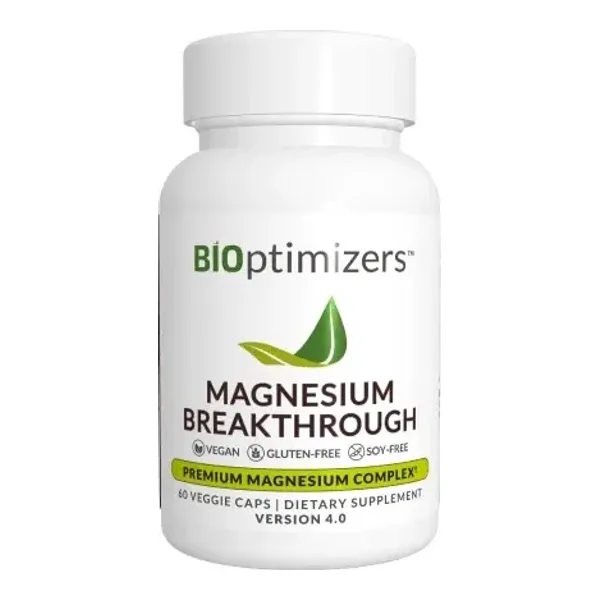
Magnesium Breakthrough is made for BiOptimizers USA Inc. of Reno, Nevada, which also sells it on its own website. The version we reviewed is labeled 4.2: 60 capsules per bottle, two per serving, taken with the evening meal.
The sales page argues that most magnesium products fail because they contain only one or two forms, and that getting "all 7 forms" makes the difference. It also offers a six-week "loading" plan. We look at both below.
The label, read closely
Per two-capsule serving (we describe the label in words because the vendor's partner terms do not cover its images; you can view it on the official site):
- Elemental magnesium: 500 mg (119% of the Daily Value), from 1,701 mg of a "Magnesium Proprietary Blend" of magnesium chelate, bisglycinate, Sucrosomial magnesium (as magnesium oxide), malate, orotate, taurate and citrate.
- Vitamin B6: 2 mg as pyridoxal-5-phosphate.
- Manganese: 1 mg as manganese citrate.
- Humic/fulvic monoatomic blend: 10 mg.
- Other ingredients: hypromellose capsule, microcrystalline cellulose, ascorbyl palmitate, and goMCT (medium chain triglycerides with gum acacia).
Elemental magnesium versus compound weight
A magnesium compound is magnesium bound to something else (glycine, citric acid, taurine), and only part of its weight is magnesium. Here, 1,701 mg of compounds supply 500 mg of actual magnesium, about 29% by weight. BiOptimizers states the elemental figure, the number that counts for both benefit and safety. Many labels do not.
What the label does not say is how much of each of the seven forms is inside. That is the downside of a proprietary blend. You cannot tell whether a form is present at a meaningful amount or a trace.
The formula next to the research
The trials used single forms at 250 to about 730 mg of elemental magnesium a day. No published trial has tested this seven-form blend.
| Ingredient | Per 2 capsules | Amount in trials | How it compares |
|---|---|---|---|
| Elemental magnesium (seven forms) | 500 mg | 250 to about 730 mg/day in sleep trials [6] [3] [5]; about 300 mg/day in stress trials [8] | Inside the trial range, but above the 350 mg NIH upper limit for supplements |
| Vitamin B6 (P5P) | 2 mg | 30 mg/day with magnesium in a stress trial [8] | About 15 times lower |
| Sucrosomial magnesium | Not disclosed | 350 mg single dose in a one-day absorption study [11] | Cannot be compared |
| Manganese citrate | 1 mg | No sleep trial found | Cannot be compared |
| Humic/fulvic blend | 10 mg | No human trial on magnesium uptake found | Cannot be compared |
Magnesium and sleep: modest, inconsistent and low certainty
The most recent systematic review, published in 2026, looked at twelve randomized trials of magnesium alone for sleep in adults. The findings were inconsistent across questionnaires, sleep EEG and wearables, and the certainty of evidence was rated low to very low. The authors concluded magnesium may help some subjective sleep measures in some adults but that the evidence does not support it as a routine sleep treatment [1].
A meta-analysis of three trials in 151 older adults found they fell asleep about 17 minutes sooner on magnesium than on placebo; total sleep time did not differ significantly, and all three trials had moderate to high risk of bias [2]. The individual trials:
- Older adults with insomnia (Iran): 46 people received 500 mg of elemental magnesium a day as magnesium oxide, or placebo, for eight weeks. Insomnia scores, sleep efficiency and time to fall asleep improved more with magnesium [3]. Same dose as Magnesium Breakthrough, different form.
- Adults over 51 with poor sleep (USA): 100 people took 320 mg of magnesium a day as citrate, or a placebo, for seven weeks. Sleep scores improved about equally in both groups [4].
- Healthy adults aged 60 to 80 (Germany): in a 12-person crossover trial, effervescent magnesium worked up to 30 mmol a day (about 730 mg elemental) for 20 days and increased slow-wave sleep on EEG compared with placebo [5].
- Adults with self-reported poor sleep (Germany): 155 people took 250 mg of elemental magnesium as bisglycinate or placebo. At four weeks the magnesium group's insomnia score fell slightly more (3.9 points versus 2.3), a small effect, and other psychological measures did not differ [6].
Taken together: a small edge over placebo in some trials, none in others. Results vary, and people with low magnesium intake may respond more.
Magnesium and stress
A 2017 systematic review of 18 studies found the evidence on magnesium and subjective anxiety "suggestive" in people prone to anxiety, but of poor quality, and noted that no study had used a validated stress measure [7]. A later trial in 264 stressed adults with low blood magnesium gave about 300 mg of magnesium a day as magnesium lactate, with or without 30 mg of vitamin B6, for eight weeks. Stress scores fell by roughly 45% in both groups; there was no placebo arm, B6 helped only the most stressed subgroup, and the trial was run by the products' maker [8]. Magnesium Breakthrough's 2 mg of B6 is far below the 30 mg used.
Do seven forms beat one?
The sales page says you need all seven forms because each reaches different tissues. We found no published study testing a multi-form blend against a single form, or showing form-specific tissue targeting in people.
What the research does show is narrower. In a 60-day controlled trial, 300 mg a day of magnesium citrate or amino acid chelate was absorbed better than magnesium oxide, which did no better than placebo on the measures used [10]. A review of absorption research concluded that the type of salt matters less than often thought, and that the dose and a person's existing magnesium status matter more. It also noted that smaller doses spread through the day are absorbed more efficiently than one large dose [9].
The sales page says Sucrosomial magnesium raised red blood cell magnesium more than glycinate and oxide. The published study, from the ingredient's maker, was a one-day crossover test of 350 mg doses: blood and urine magnesium beat oxide, and the red blood cell advantage was over bisglycinate only [11]. The label lists this form "as magnesium oxide," the compound the page calls a cheap form.
What the marketing claims versus what we could verify
- "9 out of 10 people" taking magnesium notice little change: no source given; we could not trace it.
- Feeling it "within 30 minutes" on an empty stomach: no trial we found measured this. The label itself says to take it with the evening meal, so the page and the bottle give different directions.
- "Monoatomic magnesium" that has never been in any product: we found no published research on this term. The label lists a 10 mg humic/fulvic blend.
- Headache help from magnesium threonate (FAQ): threonate is not on the label we reviewed.
- The footer "Label" link opens an older version 4.0 label (30 capsules, different B6 form and other ingredients), not the version 4.2 label shown in the page body. We used version 4.2.
The loading plan deserves a warning
The sales page recommends ramping up to five capsules a day for weeks three to six, then a maintenance dose of four capsules a day. At 250 mg of elemental magnesium per capsule, that is 1,250 mg and then 1,000 mg a day from the supplement alone. The cofounder's story mentions taking about 5 grams a day. The NIH Office of Dietary Supplements sets the upper limit for supplemental magnesium at 350 mg a day for adults (food magnesium does not count toward it) and notes that high supplement doses can cause diarrhea, nausea and cramping, with very high doses linked to low blood pressure and irregular heartbeat (NIH ODS magnesium fact sheet, updated January 2026). Even the label dose of two capsules goes 150 mg past that limit.
The plan's math is also off: a 60-capsule bottle at five a day lasts 12 days, not "a bottle a week." We do not recommend the loading plan without a doctor's guidance.
Price, subscription and refund policy
One bottle lasts 30 days at the label dose. The order buttons on the sales page start in Subscribe & Save mode. To buy once, uncheck the subscribe box on each package; the prices then change to the one-time amounts below.
One-time prices (Digistore24 order forms, checked October 23, 2026):
- 5 bottles: $160 ($32 each), free shipping to the US and Canada. About $1.07 a day.
- 3 bottles: $99 ($33 each), free US shipping. About $1.10 a day.
- 1 bottle: $40, plus shipping. About $1.33 a day.
Subscription terms, if you leave the box checked. These are recurring charges to your card until you cancel:
- 1 bottle: $35 charged today and $35 every month.
- 3 bottles: $87 charged today and $87 every 3 months.
- 5 bottles: $136 charged today and $136 every 5 months.
The Digistore24 order forms say the monthly plan can be cancelled monthly and the 3 and 5-bottle plans at the end of the current billing period. BiOptimizers' subscription policy says to cancel by calling its help desk at (800) 719-2467 (Monday to Friday, 10 AM to 8 PM Eastern) or emailing [email protected]. Cancel before the next billing date to avoid the next charge.
Refunds: 365 days, minus shipping. The first bottle counts as your trial; for a full refund on a multi-bottle order, return the rest unopened. Opening a second bottle means a prorated refund. Returns need an authorization number from the help desk and are offered only within the United States.
Magnesium Breakthrough one-time prices on the official site
5 bottles, 150-day supply
$32/bottle
$160 total · Free US and Canada shipping
Lowest price per bottle
One-time price; uncheck Subscribe & Save on the page to see it
Check the 5-bottle price3 bottles, 90-day supply
$33/bottle
$99 total · Free US shipping
One-time price; uncheck Subscribe & Save on the page to see it
Check the 3-bottle price1 bottle, 30-day supply
$40/bottle
$40 total · Shipping added at checkout
One-time price; uncheck Subscribe & Save on the page to see it
Check the 1-bottle priceButtons open the seller's Magnesium Breakthrough website, where you choose your supply and complete the order. Prices as listed on the seller's site on October 23, 2026; the price shown at checkout is final.Orders are covered by a 365-day refund policy from the seller (see their terms). We may earn a commission.
Safety
Magnesium from food is rarely a problem for healthy kidneys. Supplements are different, and men over 50 are more likely to face the situations below. Talk to your doctor or pharmacist first, especially if you take any prescription medication.
- Kidney function. The kidneys control magnesium balance. In older outpatients taking magnesium oxide, blood magnesium was highest in those with the weakest kidney function, and the authors advised caution when eGFR falls below 30 [15]. If you have kidney disease or have been told your kidney function is reduced, do not take magnesium supplements unless your doctor approves.
- Tetracycline and quinolone antibiotics (such as doxycycline or ciprofloxacin). Magnesium binds these drugs in the gut and can cut their absorption sharply. In one study, a magnesium and aluminum antacid taken shortly before ciprofloxacin reduced its absorption to about 15% of normal [13]. A drug-interaction review advises spacing magnesium-containing products about 4 hours before or 2 hours after these antibiotics [12].
- Oral bisphosphonates (such as alendronate) may be affected by the same binding, according to their prescribing information, so separate them as your pharmacist advises [12].
- Diuretics and proton pump inhibitors can change magnesium status, according to the NIH ODS. Long-term PPI use was linked to higher odds of low blood magnesium in a meta-analysis of observational studies [14]. Some diuretics increase magnesium loss while potassium-sparing types reduce it, so your doctor may want to check your levels rather than guess.
- Digestive effects. Loose stools are the most common complaint at higher doses; the sales page warns about it too.
What we liked and what gave us pause
Liked
- States elemental magnesium per serving
- Includes citrate and amino acid chelate, forms that absorbed better than oxide in a controlled trial
- One-time purchase is available and costs about a dollar a day in bundles
- 365-day refund window, longer than most
Gave us pause
- 500 mg serving above the NIH upper limit; the loading plan goes much higher
- Seven forms, but no amounts for each
- Subscription pre-selected on the order buttons
- Page and label disagree on directions, forms and label version
- No published trial of the blend itself
Frequently asked questions
Is Magnesium Breakthrough a subscription?
Only if you leave Subscribe & Save checked; the billing terms and how to cancel are in the price section above.
Is one capsule enough?
One capsule provides 250 mg of elemental magnesium, which stays under the 350 mg supplement limit and is the dose used in the bisglycinate sleep trial [6]. Ask your doctor what amount suits you, especially if you already take other supplements or antacids with magnesium.
How long before I notice anything?
Results vary. The trials ran from about three weeks to eight weeks, and several found only small differences from placebo. A month at a steady dose is a fairer test than a single night.
Can it replace a sleep medication or treatment from my doctor?
No. It is a dietary supplement. Do not stop or change a prescription without your doctor, and get persistent sleep problems checked.
Want to look at the official page yourself? The link below opens the Magnesium Breakthrough sales page, where you can view the label and choose a package. Remember to uncheck Subscribe & Save if you want a one-time order.
Visit the official Magnesium Breakthrough pageHow we reviewed Magnesium Breakthrough
We read the sales page and its version 4.2 label, opened every Digistore24 order form, read BiOptimizers' subscription and partner policies and the NIH ODS fact sheet, then searched PubMed for trials on magnesium for sleep, stress, absorption and drug interactions and compared them with the label. We did not test the product on people, and nobody at Stark Verve is a medical professional. Read our editorial policy to learn how we choose and update reviews. Stark Verve earns a commission if you buy through our links; that never changes what we write about the evidence.
References
- Lopresti AL, Smith SJ, Drummond PD. Magnesium supplementation for sleep in adults: a systematic review of randomized controlled trials. J Diet Suppl. 2026;23(5):553-581. PMID 42661485
- Mah J, Pitre T. Oral magnesium supplementation for insomnia in older adults: a systematic review and meta-analysis. BMC Complement Med Ther. 2021;21(1):125. PMID 33865376
- Abbasi B, et al. The effect of magnesium supplementation on primary insomnia in elderly: a double-blind placebo-controlled clinical trial. J Res Med Sci. 2012;17(12):1161-9. PMID 23853635
- Nielsen FH, Johnson LK, Zeng H. Magnesium supplementation improves indicators of low magnesium status and inflammatory stress in adults older than 51 years with poor quality sleep. Magnes Res. 2010;23(4):158-68. PMID 21199787
- Held K, et al. Oral Mg(2+) supplementation reverses age-related neuroendocrine and sleep EEG changes in humans. Pharmacopsychiatry. 2002;35(4):135-43. PMID 12163983
- Schuster J, et al. Magnesium bisglycinate supplementation in healthy adults reporting poor sleep: a randomized, placebo-controlled trial. Nat Sci Sleep. 2025;17:2027-2040. PMID 40918053
- Boyle NB, Lawton C, Dye L. The effects of magnesium supplementation on subjective anxiety and stress: a systematic review. Nutrients. 2017;9(5):429. PMID 28445426
- Pouteau E, et al. Superiority of magnesium and vitamin B6 over magnesium alone on severe stress in healthy adults with low magnesemia: a randomized, single-blind clinical trial. PLoS One. 2018;13(12):e0208454. PMID 30562392
- Schuchardt JP, Hahn A. Intestinal absorption and factors influencing bioavailability of magnesium: an update. Curr Nutr Food Sci. 2017;13(4):260-278. PMID 29123461
- Walker AF, et al. Mg citrate found more bioavailable than other Mg preparations in a randomised, double-blind study. Magnes Res. 2003;16(3):183-91. PMID 14596323
- Brilli E, et al. Magnesium bioavailability after administration of sucrosomial magnesium: results of an ex-vivo study and a comparative, double-blinded, cross-over study in healthy subjects. Eur Rev Med Pharmacol Sci. 2018;22(6):1843-1851. PMID 29630135
- Ogawa R, Echizen H. Clinically significant drug interactions with antacids: an update. Drugs. 2011;71(14):1839-64. PMID 21942976
- Nix DE, et al. Effects of aluminum and magnesium antacids and ranitidine on the absorption of ciprofloxacin. Clin Pharmacol Ther. 1989;46(6):700-5. PMID 2598571
- Srinutta T, et al. Proton pump inhibitors and hypomagnesemia: a meta-analysis of observational studies. Medicine (Baltimore). 2019;98(44):e17788. PMID 31689852
- Horibata K, et al. Relationship between renal function and serum magnesium concentration in elderly outpatients treated with magnesium oxide. Geriatr Gerontol Int. 2016;16(5):600-5. PMID 26081346