
Review · Gut health
GutOptim review: ten good ingredients, one very small scoop
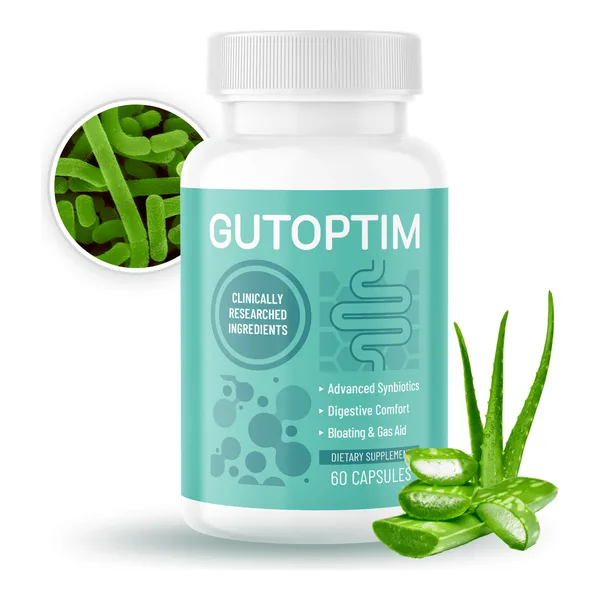
GutOptim is a two-capsule digestive supplement that mixes fibers, a clay, aloe and a probiotic. We transcribed its label and checked each ingredient against human trials on PubMed. The ingredient choices make sense. The amounts are the problem.
Our verdict: 2.1 / 5
| Ingredient evidence | 2.5 | Psyllium, pectin, prunes, flaxseed and glucomannan all have human trials on regularity; aloe and the probiotic have small ones; black walnut hull has none we could find |
|---|---|---|
| Dosing vs. research | 1 | The whole blend is 1.5 g a day; the trials used 4.5 g to 120 g of a single ingredient |
| Label transparency | 2 | All ten ingredients named, but in a proprietary blend with no individual amounts and no probiotic count |
| Value and refund terms | 3 | $49 to $69 a bottle, free US shipping, one-time purchase; 60-day refund, all bottles returned at your cost |
Worth considering if you want a small daily capsule that adds a little mixed fiber and a probiotic on top of an already decent diet, and you are comfortable paying for convenience over dose.
Probably skip it if your goal is the kind of change in regularity seen in fiber research. Those studies used about 10 g or more of fiber a day, or 80 to 100 g of prunes. GutOptim's whole daily blend is 1.5 g, and plain psyllium from a pharmacy delivers trial-sized amounts for far less money.
Before anything else: a change in bowel habits after 50, blood in the stool, unexplained weight loss, or ongoing belly pain deserves a visit to your doctor. Those signs need a medical look, not a supplement.
Smallest order $69, from $49 per bottle, 60-day refund policy from the seller
See the current GutOptim packages, shipping and refund termsOpens the seller's page. It may start with a long video or letter; the packages and refund terms are usually further down. We may earn a commission.
Came here for GutOptim? The highest-rated gut and digestion label we checked is Gut Save, 2.4 out of 5.
What GutOptim is
GutOptim is a capsule supplement sold through its own website, with orders processed by the retailer BuyGoods. The label lists GutOptim as the distributor, with an address in Aurora, Colorado. The serving is two capsules a day with a meal, and one bottle holds 60 capsules, a 30-day supply. Orders are one-time payments with no autoship, according to the FAQ.
The sales page describes it as a blend of "synbiotics" (fibers that feed gut bacteria, plus a probiotic) and bentonite clay, aimed at digestive comfort, bloating and gas. The video presentation opens with a much bigger idea: a parasite said to sit behind nearly all digestive trouble. We look at that claim further down.
What is on the label
The Supplement Facts panel lists a single proprietary blend of 1.5 g per two-capsule serving, containing psyllium husk, bentonite clay, black walnut hull, oat bran, flaxseed, plum fruit (Prunus domestica), aloe vera leaf, Lactobacillus acidophilus, apple pectin and glucomannan from konjac root. Other ingredients are gelatin, magnesium stearate and silicon dioxide, and the label flags tree nuts (walnut). It also carries a choking notice: take it with a full glass of liquid and avoid it if you have trouble swallowing.
Two things stood out. First, no individual amounts are given, and the probiotic has no strain name or colony count, so nobody outside the company knows how much of each ingredient you get. Second, the sales page does not match the label. The ingredient section lists nine items and leaves out psyllium, which is the first ingredient on the label. The same page says GutOptim has 10 ingredients in one spot and 9 in the FAQ. The label is what ships, so we review the label.
We are not reproducing the label image here because the vendor publishes no image permissions for affiliates. You can view it on the official site.
The formula next to the research
Because the blend is undisclosed, we cannot know any single dose. What we do know is the ceiling: no ingredient can exceed 1.5 g a day, and with ten sharing the space, most will be far lower. Here is what the human studies used.
| Ingredient | GutOptim per day | Amount in trials | How it compares |
|---|---|---|---|
| Psyllium husk | Undisclosed share of 1.5 g | Benefit clearest above 10 g/day of fiber [1] | At most about one seventh |
| Plum (prune) | Undisclosed share of 1.5 g | 80 to 120 g/day of whole prunes [4] [3] | Under 2% of the trial amount |
| Bentonite clay | Undisclosed share of 1.5 g | 9 g/day of a purified montmorillonite clay [6] | At most one sixth |
| Glucomannan | Undisclosed share of 1.5 g | 4.5 g/day [7] | At most one third |
| Apple pectin | Undisclosed share of 1.5 g | 24 g/day [8] | At most about 6% |
| Flaxseed | Undisclosed share of 1.5 g | 50 g/day of flaxseed flour [9] | At most 3% |
| Aloe vera leaf | Undisclosed share of 1.5 g | Varied preparations across three small trials [11] | Cannot be compared |
| L. acidophilus | No count stated | 2 x 10¹¹ CFU/day, two named strains [12] | Cannot be compared |
| Oat bran, black walnut hull | Undisclosed | Oat bran in a food-based trial; no human trial found for black walnut hull | Cannot be compared |
Psyllium and the fiber question
The best summary of fiber supplements for regularity is a 2022 meta-analysis of 16 randomized trials with 1,251 adults with chronic constipation. Overall, 66% of people on fiber responded, against 41% in control groups. Psyllium and pectin were the types with significant effects, and the benefit showed up mainly at doses above 10 g a day taken for at least four weeks. Fiber also increased gas [1]. That is the clearest yardstick for GutOptim, and its entire daily blend sits well under it.
Prunes: a strong food, a tiny capsule share
Prunes are one of the better studied foods for bowel function. In a 120-person, four-week trial in healthy adults with low fiber intake, 80 g and 120 g of prunes a day increased stool weight and frequency compared with water alone, with more flatulence [4]. In a crossover trial of 40 adults with constipation (37 of them women, average age 38), 100 g a day of prunes beat 22 g a day of psyllium on complete bowel movements and stool consistency over three weeks [3]. A systematic review called prunes promising but limited by few trials [5], and a 2024 meta-analysis found no clear difference between prunes and psyllium [2]. A whole prune weighs several grams, so a capsule share of 1.5 g cannot reproduce this.
Bentonite clay
The sales page calls this "a rare type of bentonite clay." The one controlled trial we found, which the vendor also lists, tested a purified clay called beidellitic montmorillonite at 3 g three times a day for eight weeks in 524 adults with irritable bowel syndrome. Across the whole group, relief of abdominal discomfort was not significantly better than placebo (51.7% vs 45.2%). In the constipation-predominant subgroup it was (49.4% vs 31.5%), while stool frequency did not change [6]. That is a specific pharmaceutical-grade clay at 9 g a day. GutOptim does not name its clay type or amount.
Glucomannan, pectin and flaxseed
Konjac glucomannan at 1.5 g three times a day raised weekly bowel movements from about 4.1 to 5.3 in a tiny diet-controlled study of seven constipated adults [7]. Apple-type pectin at 24 g a day shortened colon transit time over four weeks in 80 adults with slow-transit constipation [8]. Flaxseed flour at 50 g a day for four weeks improved constipation scores in 90 adults, comparable to or slightly better than a lactulose comparison group [9]. All three show the same pattern: the effects came from gram amounts many times larger than GutOptim's whole blend.
Oat bran and walnut
Oat bran baked into food helped 59% of frail nursing home residents (aged 57 to 100) stop using laxatives over 12 weeks in a small 30-person trial [10]. For walnuts, a feeding study in 18 adults with an average age of 53 found that 42 g a day of walnut kernels shifted gut bacteria toward butyrate producers [13]. That was the nut people eat. GutOptim uses black walnut hull, a different part of a different species, and we found no human trial of it for digestion.
Aloe vera and the probiotic
A meta-analysis of three small trials (151 people with irritable bowel syndrome) found aloe vera modestly better than placebo on symptom scores in the short term, with no aloe-related side effects reported [11]. For L. acidophilus, the most relevant trial gave 60 adults (mean age 37) a two-strain mix of L. acidophilus NCFM and Bifidobacterium lactis Bi-07 at 200 billion CFU a day for eight weeks; bloating improved compared with placebo [12]. Probiotic effects are strain-specific, and GutOptim names neither a strain nor a count, so that result cannot be carried over.
What the marketing claims vs. what we could verify
The video page headline says a "blue parasite" is behind 97% of digestive issues, and the FAQ says this parasite eats the colon's lining and makes stool pile up. We searched PubMed and could not find any study that supports a single parasite behind nearly all digestive complaints, or the 97% figure. The vendor's own reference page lists 15 sources; most are consumer health articles and a magazine piece about parasites, and only three are journal papers. Of those, one is the clay trial above, one is a cholesterol study of a probiotic mix, and one is about clay binding dietary fat. None tests GutOptim or links its ingredients to a parasite.
Other claims we could not verify: that the formula was "created by a top Swiss food scientist" (no name is given), that "all of the ingredients have been proven to be safe in clinical trials," and the customer and review counts on the page. Results vary from person to person, and nothing we found shows what this specific formula does.
Price, packages and refund policy
One bottle lasts 30 days at two capsules a day. Prices on the official order section when we checked:
- 6 bottles: $49 each ($294 total), free US shipping, two digital guides included. About $1.63 a day.
- 3 bottles: $59 each ($177 total), free US shipping, two digital guides included.
- 1 bottle: $69, free US shipping.
Shipping to Canada, the UK, Ireland, Australia and New Zealand costs $15.95. The refund policy gives you 60 days from delivery. You email support, then send back all bottles, opened or not, with the packing slip, and you pay the return postage. For comparison, a month of plain psyllium at trial-sized doses typically costs a fraction of one bottle.
GutOptim packages on the official site
6 bottles, 180-day supply
$49/bottle
$294 total · Free US shipping
Lowest price per bottle
Includes 2 digital guides
Check the 6-bottle price3 bottles, 90-day supply
$59/bottle
$177 total · Free US shipping
Includes 2 digital guides
Check the 3-bottle priceButtons open the seller's GutOptim website, where you choose your supply and complete the order. Prices as listed on the seller's site on October 23, 2026; the price shown at checkout is final.Orders are covered by a 60-day refund policy from the seller (see their terms). We may earn a commission.
Safety
At 1.5 g a day the fiber load is small, and the most likely side effects are the usual ones for fiber: gas and bloating, which went up in fiber and prune trials [1] [4]. Glucomannan swells strongly in water, and there are case reports of it lodging in the esophagus, especially in people with swallowing problems [15]. Take the capsules with a full glass of water, as the label says, and skip them if you have difficulty swallowing.
Fiber can change how some medicines are absorbed. A small study found psyllium taken at the same time as levothyroxine did not cause detectable malabsorption [14], but many doctors still advise spacing fiber and clay products a few hours away from thyroid pills and other medications, and clays bind many substances. Black walnut is a tree nut, so avoid GutOptim if you have a nut allergy. If you take any prescription medicine, have a bowel condition, or have had bowel surgery, talk to your doctor before starting. New or worsening digestive symptoms deserve medical care.
What we liked and what gave us pause
Liked
- Sensible ingredient picks: psyllium, pectin, prunes and glucomannan all have human research on regularity
- Every ingredient is named on the label
- No stimulant laxatives such as senna
- Free US shipping and no autoship
Gave us pause
- The whole daily blend is 1.5 g, far below trial doses for any of its fibers
- No individual amounts and no probiotic strain or count
- A parasite claim we could not trace to any study
- Sales page and label disagree on the ingredient list
- Refunds require returning every bottle at your own cost
Frequently asked questions
Where can I buy GutOptim?
On the official website, with checkout handled by BuyGoods. The vendor does not allow sales on Amazon, eBay or other retail and auction sites, so listings there may not be genuine or covered by the refund policy.
How long before I notice anything?
Results vary. Fiber trials that showed a difference ran at least four weeks, and at much higher doses [1]. Judging any fiber product after a few days is too early.
Can I just take psyllium instead?
Many people do. Psyllium was the fiber with the clearest results in the 2022 meta-analysis [1]. Ask your doctor what dose suits you, increase it slowly, and drink plenty of water.
Is it a subscription?
No. The official FAQ says each order is a one-time purchase with no autoship.
Want to read the label yourself? The link below opens the GutOptim website, where you can see the full presentation, the Supplement Facts panel and the packages.
Visit the GutOptim websiteHow we reviewed GutOptim
We read the video page, the text version of the presentation, the FAQ, the refund, shipping and reference pages, the vendor's affiliate terms and the Supplement Facts panel shown on the sales page. We then searched PubMed for systematic reviews and human trials of each ingredient with bowel or digestive outcomes, opened every study we cite, and compared trial doses with what the 1.5 g blend can hold. We also checked the journal papers on the vendor's reference list. We did not test the product on people, and nobody at Stark Verve is a medical professional. Read our editorial policy to learn how we choose and update reviews. Stark Verve earns a commission if you buy through our links; that never changes what we write about the evidence.
References
- van der Schoot A, Drysdale C, Whelan K, Dimidi E. The effect of fiber supplementation on chronic constipation in adults: an updated systematic review and meta-analysis of randomized controlled trials. Am J Clin Nutr. 2022;116(4):953-969. PMID 35816465
- van der Schoot A, Katsirma Z, Whelan K, Dimidi E. Systematic review and meta-analysis: foods, drinks and diets and their effect on chronic constipation in adults. Aliment Pharmacol Ther. 2024;59(2):157-174. PMID 37905980
- Attaluri A, Donahoe R, Valestin J, Brown K, Rao SS. Randomised clinical trial: dried plums (prunes) vs. psyllium for constipation. Aliment Pharmacol Ther. 2011;33(7):822-8. PMID 21323688
- Lever E, Scott SM, Louis P, Emery PW, Whelan K. The effect of prunes on stool output, gut transit time and gastrointestinal microbiota: a randomised controlled trial. Clin Nutr. 2019;38(1):165-173. PMID 29398337
- Lever E, Cole J, Scott SM, Emery PW, Whelan K. Systematic review: the effect of prunes on gastrointestinal function. Aliment Pharmacol Ther. 2014;40(7):750-8. PMID 25109788
- Ducrotte P, Dapoigny M, Bonaz B, Siproudhis L. Symptomatic efficacy of beidellitic montmorillonite in irritable bowel syndrome: a randomized, controlled trial. Aliment Pharmacol Ther. 2005;21(4):435-44. PMID 15709995
- Chen HL, Cheng HC, Wu WT, Liu YJ, Liu SY. Supplementation of konjac glucomannan into a low-fiber Chinese diet promoted bowel movement and improved colonic ecology in constipated adults: a placebo-controlled, diet-controlled trial. J Am Coll Nutr. 2008;27(1):102-8. PMID 18460488
- Xu L, Yu W, Jiang J, Li N. Clinical benefits after soluble dietary fiber supplementation: a randomized clinical trial in adults with slow-transit constipation. Zhonghua Yi Xue Za Zhi. 2014;94(48):3813-6. PMID 25623312
- Sun J, Bai H, Ma J, et al. Effects of flaxseed supplementation on functional constipation and quality of life in a Chinese population: a randomized trial. Asia Pac J Clin Nutr. 2020;29(1):61-67. PMID 32229443
- Sturtzel B, Elmadfa I. Intervention with dietary fiber to treat constipation and reduce laxative use in residents of nursing homes. Ann Nutr Metab. 2008;52 Suppl 1:54-6. PMID 18382081
- Hong SW, Chun J, Park S, et al. Aloe vera is effective and safe in short-term treatment of irritable bowel syndrome: a systematic review and meta-analysis. J Neurogastroenterol Motil. 2018;24(4):528-535. PMID 30153721
- Ringel-Kulka T, Palsson OS, Maier D, et al. Probiotic bacteria Lactobacillus acidophilus NCFM and Bifidobacterium lactis Bi-07 versus placebo for the symptoms of bloating in patients with functional bowel disorders: a double-blind study. J Clin Gastroenterol. 2011;45(6):518-25. PMID 21436726
- Holscher HD, Guetterman HM, Swanson KS, et al. Walnut consumption alters the gastrointestinal microbiota, microbially derived secondary bile acids, and health markers in healthy adults: a randomized controlled trial. J Nutr. 2018;148(6):861-867. PMID 29726951
- Chiu AC, Sherman SI. Effects of pharmacological fiber supplements on levothyroxine absorption. Thyroid. 1998;8(8):667-71. PMID 9737361
- Vanderbeek PB, Fasano C, O'Malley G, Hornstein J. Esophageal obstruction from a hygroscopic pharmacobezoar containing glucomannan. Clin Toxicol (Phila). 2007;45(1):80-2. PMID 17357389