
Review · Gut health
Finessa review: what the label and research actually show
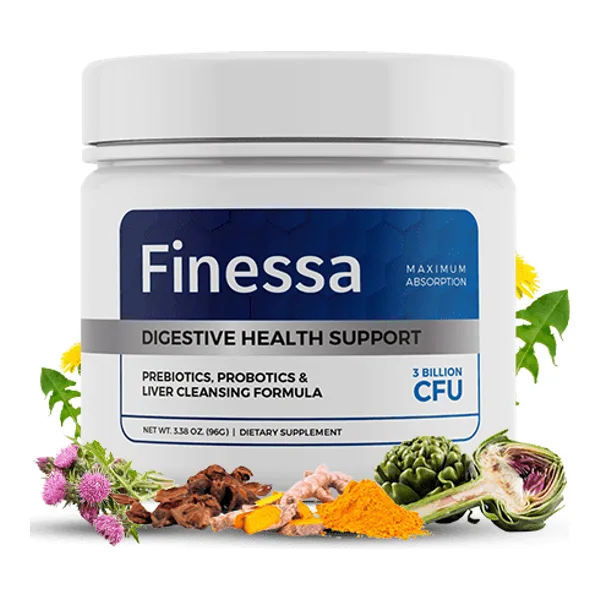
Finessa is a flavored powder marketed for digestion, regularity and a flatter belly. We compared its facts panel with the sales page and looked at human research on its better-known ingredients. The big limitation is that most amounts are bundled together.
Our verdict: 1.8 / 5
| Ingredient evidence | 2.5 | Some human studies on artichoke, probiotics and fibers, with important formula and dose differences |
|---|---|---|
| Dosing vs. research | 1 | Most ingredient amounts are hidden inside blends, so meaningful dose comparisons are not possible |
| Label transparency | 1 | Blend totals are listed, but many named ingredients on the sales page do not appear on the facts panel |
| Value and refund terms | 2.5 | $39 to $59 per container plus shipping on the single-bottle option; 180-day refund promise, with details to confirm before purchase |
Worth considering if you want a scoopable drink mix, have checked the full facts panel yourself, and are comfortable trying a multi-ingredient blend without knowing most individual doses.
Probably skip it if you want clear amounts, evidence matched to the formula, or a bottle that unambiguously provides the number of daily servings advertised. The label and package description do not agree on that point.
For men over 50: persistent changes in bowel habits, blood in stool, unexplained weight loss, or new or worsening abdominal symptoms deserve medical care. Do not use a supplement to put off an evaluation.
Smallest order $59, from $39 per bottle, 180-day refund policy from the seller
See the current Finessa packages, shipping and refund termsOpens the seller's page. It may start with a long video or letter; the packages and refund terms are usually further down. We may earn a commission.
Came here for Finessa? The highest-rated gut and digestion label we checked is Gut Save, 2.4 out of 5.
What Finessa is
Finessa is a powdered dietary supplement sold through the myfinessa.com sales page. The page describes one scoop mixed into a drink each morning and presents the product for both men and women. It emphasizes digestion, occasional irregularity, bloating and a flatter belly, while also making broader weight and energy claims. The seller or manufacturer is not clearly identified in the page material we reviewed.
The facts panel image on the sales page says a serving is one scoop and there are 50 servings per container. The order section describes one bottle as a 30-day supply. Those statements cannot both describe one scoop per day. We could not find an explanation on the page, so ask the seller to clarify how many servings are in the bottle before using the price-per-month claims.
The label also does not match all of the ingredients discussed in the sales copy. Its facts panel names blends containing dandelion, turmeric, milk thistle, artichoke, cinnamon, ginger, cascara, DGL licorice, fructooligosaccharides, several probiotics and polyphenol-rich plant powders. Elsewhere the page discusses camu camu, EGCG, mangosteen, panax, bitter melon, ashwagandha, acerola, eleuthero, alfalfa and inulin. Those names do not appear on the facts panel image we inspected. That difference needs a clear vendor explanation.
The label, next to the research
Finessa uses several proprietary blends. It states the total weight of each blend, but not how much of any individual ingredient is in a scoop. We can describe studies on similar ingredients, but cannot say whether Finessa provides the same plant part, extract, strain or amount.
| Label entry | Amount stated per scoop | Relevant research | What can be compared |
|---|---|---|---|
| Artichoke extract, standardized to 5% cynarin | Inside 450 mg liver blend | 640 mg extract three times daily for 6 weeks in a dyspepsia trial [1] | Individual amount and extract equivalence are unknown |
| Probiotic blend | 52.5 mg total, 5 billion CFU at manufacture | 17 trials in adults with constipation-predominant IBS pooled [4] | Strains and total CFU are not enough to match the trial mixtures or doses |
| Fructooligosaccharides | Inside 755 mg gut blend | Inulin trial used 12 g daily for 4 weeks [5] | FOS is related fermentable fiber, but its amount here is unknown |
| Turmeric powder | Inside 450 mg liver blend | Review covered 21 clinical studies of curcumin or turmeric across digestive conditions [6] | Not a Finessa study; amount and curcuminoid content are not stated |
| Ginger and cascara | Inside 755 mg gut blend | One 4-week trial paired ginger with artichoke extract [3] | Combination and standardized extracts differ from this multi-ingredient powder |
Artichoke: some human evidence, but dose is the missing piece
A six-week randomized, double-blind study assigned 247 people with functional dyspepsia to a commercial artichoke leaf extract or placebo. The extract group had a greater improvement in the overall symptom score and quality-of-life score. The tested amount was 320 mg three times daily, or 960 mg each day [1]. Finessa lists artichoke extract standardized to 5% cynarin within a 450 mg blend that also includes several other ingredients. The artichoke amount could be far lower, and the extract may differ.
A smaller report analyzed 208 adults with dyspepsia and IBS symptoms after two months using artichoke leaf extract. It reported changes in self-reported bowel patterns and symptom scores, but this was a subset analysis from an earlier open study, not a clean placebo-controlled test of Finessa [2]. It is a reason to study the ingredient further, not proof for the powder.
Probiotics: results depend on the exact strains
A systematic review pooled 17 randomized trials with 1,469 adults who had constipation-predominant IBS. Across the included probiotic products, bowel frequency improved by about 1.29 movements per week compared with control, and transit time was shorter by about 12 hours. The authors also said more adequately sized trials were needed to identify the best strains, amounts and duration [4].
Finessa lists a 5-billion-CFU blend at manufacture plus 2 mg of Akkermansia muciniphila powder. But the 5-billion figure does not tell us the count for each strain, whether the same strains were tested in the review, or how many CFU remain by the end of shelf life. The proprietary mixture cannot be judged against that pooled result.
Fiber, turmeric and other plants
In a crossover trial, 44 healthy volunteers with constipation took 12 g a day of chicory inulin or placebo for four weeks. Median stool frequency was four per week on inulin and three on placebo [5]. Finessa lists fructooligosaccharides, a related fermentable fiber, but does not state its amount. The label does not list inulin, despite the sales page discussing it.
A systematic review of curcumin or turmeric in digestive conditions included 21 studies involving 1,478 patients. The studies covered different conditions, formulations and combinations, with mixed results; the authors called for more controlled trials [6]. Finessa lists turmeric powder, not a stated curcumin dose. That review cannot establish what this powder does.
One randomized trial tested ginger and artichoke extracts together for four weeks in 126 people with functional dyspepsia, using two capsules a day. Some symptom measures improved in the supplement group [3]. The study does not tell us whether the smaller, undisclosed quantities in Finessa have a similar effect. We found no clinical trial of Finessa itself.
What the marketing says and what we could verify
The sales page describes a “gut-liver axis” and says the formula optimizes it, while connecting that idea with regularity, bloating, metabolism and weight. Communication between the gut and liver is a real area of physiology. We could not trace a human study showing that Finessa, or this combination of ingredients at these amounts, optimizes that axis. Since the label hides most amounts and differs from the ingredient descriptions on the page, the specific product mechanism remains unverified.
The page also says the drink supports a flatter belly and weight loss. We did not find a PubMed trial of Finessa or evidence that its listed formula produces those outcomes. We do not use its testimonials or before-and-after style stories as evidence. The meaningful claim we can check is narrower: some individual ingredients have been researched for digestive measures, but the amounts and preparations do not line up clearly with Finessa.
Price, packages and refund policy
Prices displayed on the sales page when we checked were:
- 6 containers: $39 each, $234 total, free US shipping, plus three digital bonuses.
- 3 containers: $49 each, $147 total, free US shipping, plus three digital bonuses.
- 1 container: $59, plus $9.95 US shipping.
The page advertises a 180-day satisfaction refund. We did not find enough detail in the material reviewed to confirm return-shipping requirements, whether empty containers qualify, or how to begin a claim. Review the current terms at checkout and keep your order details. The 50 servings on the label also make the stated 30-day supply unclear.
Finessa packages
6 bottles, 180-day supply
$39/bottle
$234 total · Free US shipping
Lowest price per bottle
Three digital bonuses
Check the 6-bottle price3 bottles, 90-day supply
$49/bottle
$147 total · Free US shipping
Three digital bonuses
Check the 3-bottle priceButtons open the seller's Finessa website, where you choose your supply and complete the order. Prices as listed on the seller's site on October 23, 2026; the price shown at checkout is final.Orders are covered by a 180-day refund policy from the seller (see their terms). We may earn a commission.
Safety
Because the facts panel lists multiple botanicals, a stimulant laxative herb and live microorganisms, the hidden individual amounts matter for safety as well as efficacy. The label lists cascara sagrada extract but does not say how much. It also lists turmeric. A PubMed review of curcuminoid interactions describes possible changes in drug exposure, including for cardiovascular medicines and anticoagulants, while noting that human interaction evidence is limited [7]. A separate review highlights how poorly documented interactions and toxicity can be for many herbal products [8].
Talk with your doctor or pharmacist before use if you take prescription medicines, especially blood thinners or heart and blood-pressure medicines, or if you have ongoing digestive symptoms. Since the formula includes probiotics and cascara, ask whether a multi-strain product and laxative ingredient fit your health history. We could not verify a specific interaction profile for this exact blend or its undisclosed doses. Results vary. New or worsening symptoms, blood in stool, severe pain or unexplained weight loss deserve medical care.
What we liked and what gave us pause
Liked
- The label gives total weights for the main blends and a probiotic count at manufacture
- Several ingredient types have human digestive research that can inform future studies
- A 180-day refund promise is advertised
Gave us pause
- Individual amounts are hidden, so study dose comparisons are not possible
- Fifty label servings do not match the advertised 30-day bottle
- Multiple ingredients discussed on the page are absent from the facts panel
- No published clinical trial of the Finessa formula was found
Frequently asked questions
How many servings are in a Finessa container?
The sales page calls a bottle a 30-day supply. The facts panel says one scoop per serving and 50 servings per container. We could not reconcile those statements, so confirm the serving count with the seller.
Does the label show the amount of each ingredient?
No. It gives combined weights for its polyphenol, gut health, liver health and probiotic blends. The only separate probiotic amount shown is 2 mg for Akkermansia muciniphila powder.
Is there research on Finessa itself?
We did not find a published human trial of the complete Finessa formula. The research discussed here concerns individual ingredients or other combinations.
Can I take it with my medication?
Ask your doctor or pharmacist first. The formula contains turmeric and several other botanicals, and interaction data for the complete blend are not available. Do not stop or change a prescription on your own.
Want to review the product page yourself? Use the link below to see the seller’s current ingredient and package information.
View Finessa packagesHow we reviewed Finessa
We checked the sales page, its Supplement Facts image, the listed prices, the refund promise and the affiliate terms. We searched PubMed for human studies and reviews relevant to the listed digestive ingredients, and verified every PMID through PubMed E-utilities esummary. We compared the studies with the ingredients and amounts shown on the label. Most ingredient quantities are not disclosed, so those comparisons have limits. We did not test the product on people, and nobody at Stark Verve is a medical professional. Read our editorial policy to learn how we choose and update reviews. Stark Verve earns a commission if you buy through our links; that never changes what we write about the evidence.
References
- Holtmann G, et al. Efficacy of artichoke leaf extract in the treatment of patients with functional dyspepsia: a six-week placebo-controlled, double-blind, multicentre trial. Aliment Pharmacol Ther. 2003;18(11-12):1099-105. PMID 14653829
- Bundy R, et al. Artichoke leaf extract reduces symptoms of irritable bowel syndrome and improves quality of life in otherwise healthy volunteers suffering from concomitant dyspepsia: a subset analysis. J Altern Complement Med. 2004;10(4):667-9. PMID 15353023
- Giacosa A, et al. The effect of ginger and artichoke extract supplementation on functional dyspepsia: a randomised, double-blind, and placebo-controlled clinical trial. Evid Based Complement Alternat Med. 2015;2015:915087. PMID 25954317
- Wen Y, et al. The efficacy and safety of probiotics for patients with constipation-predominant irritable bowel syndrome: a systematic review and meta-analysis based on seventeen randomized controlled trials. Int J Surg. 2020;79:111-9. PMID 32387213
- Micka A, et al. Effect of consumption of chicory inulin on bowel function in healthy subjects with constipation: a randomized, double-blind, placebo-controlled trial. Int J Food Sci Nutr. 2017;68(1):82-9. PMID 27492975
- Atefi M, et al. A systematic review of the clinical use of curcumin for the management of gastrointestinal diseases. Adv Exp Med Biol. 2021;1291:295-326. PMID 34331698
- Bahramsoltani R, Rahimi R, Farzaei MH. Pharmacokinetic interactions of curcuminoids with conventional drugs: a review. J Ethnopharmacol. 2017;209:1-12. PMID 28734960
- Suroowan S, Mahomoodally MF. Herbal medicine of the 21st century: a focus on the chemistry, pharmacokinetics and toxicity of five widely advocated phytotherapies. Curr Top Med Chem. 2019;19(29):2718-38. PMID 31721714